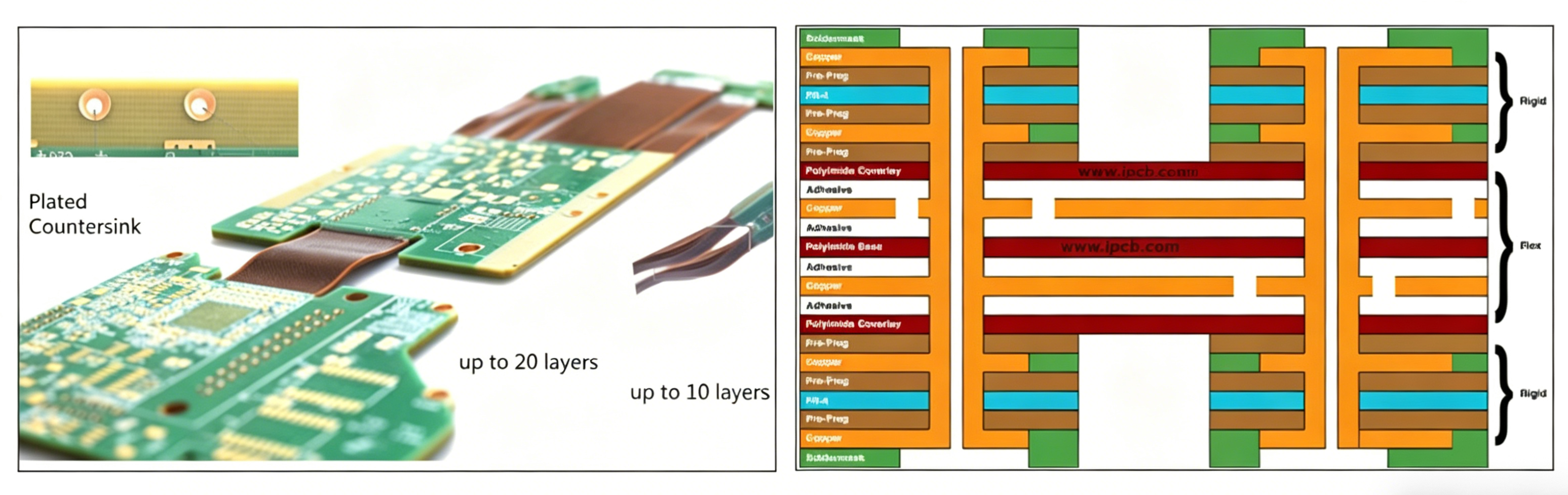
Rigid-Flex Printed Circuit Board (PCB) is an integrated multi-layer interconnect structure fabricated by laminating rigid substrate layers and flexible circuit layers into a single monolithic assembly, designed and manufactured in strict compliance with IPC-2223 (Rigid-Flex PCB Design Standard) and IPC-6013 international performance specifications. Combining the structural support capability of traditional rigid PCBs with the dynamic bendability and 3D routing performance of flexible circuits, Rigid-Flex PCBs have become the core interconnect solution for high-reliability, miniaturized electronic systems. With over 10 years of industry expertise, MaxiPCB houses a dedicated professional R&D and manufacturing team for Rigid-Flex PCBs, providing global customers with end-to-end solutions from design optimization, rapid prototyping to high-volume mass production.
Core Design & Performance Advantages
- Superior Interconnection Reliability: The monolithic integrated structure replaces traditional discrete interconnect solutions combining multiple separate PCBs, connectors, flat flexible cables (FFCs) and jumper wires. It eliminates contact failure risks from discrete connectors and cable fatigue, drastically improving long-term system interconnection stability and environmental resistance.
- Extreme Miniaturization & Space Optimization: Flexible layers enable free 3D routing via bending and folding, breaking the spatial limitations of traditional 2D planar circuit design. This maximizes the utilization of internal space in end equipment, significantly reducing overall system footprint and weight, which is critical for portable and compact electronic devices.
- Full Lifecycle Cost Efficiency: While the upfront manufacturing cost of Rigid-Flex PCBs is higher than standard rigid PCBs, a single Rigid-Flex component replaces multiple discrete interconnect parts, simplifying assembly processes, reducing material management costs, and lowering assembly failure rates. With the continuous maturity of industry processes and supply chain optimization, the overall cost of Rigid-Flex PCBs continues to decline, delivering superior cost-effectiveness throughout the full product lifecycle.
Core Material & Process Control Specifications
The core technical challenge of Rigid-Flex PCB manufacturing lies in heterogeneous material compatibility matching and multi-dimensional stress control, with strict process controls aligned with IPC industry standards:
- Heterogeneous Material Matching System
Rigid layers adopt industry-standard FR-4 epoxy glass cloth substrates, while flexible layers use high-temperature resistant, fatigue-resistant polyimide (PI) substrates — the only industry-recognized material for mass production Rigid-Flex PCBs. To solve industry pain points including coefficient of thermal expansion (CTE) mismatch, lamination shrinkage and interlayer bonding failure between the two heterogeneous materials, we use modified epoxy resin adhesive sheets exclusive to Rigid-Flex PCBs, ensuring long-term interlayer bonding reliability under extreme temperature fluctuations.
- Multi-Dimensional Stress Management
Unlike planar rigid PCBs, Rigid-Flex PCBs require synchronous control of three core dimensions: XY-axis graphic fabrication precision, Z-axis interlaminar stress during lamination, and dynamic bending fatigue resistance of flexible regions. We implement targeted structural optimization for bending areas, with dedicated stack-up design and process controls to ensure the dynamic bending life and long-term service reliability of flexible layers.
- Dedicated Manufacturing Process System
While Rigid-Flex PCBs share basic fabrication principles with standard FR-4 PCBs, their production requires a fully customized process system to adapt to heterogeneous material characteristics. We have established exclusive production lines for Rigid-Flex PCBs, with calibrated lamination, precision drilling and pulse electroplating processes, to ensure the integrity of interlayer interconnection and batch-to-batch consistency. For a standard 4-layer Rigid-Flex PCB, the typical production cycle is 2-3 times that of an equivalent 4-layer FR-4 rigid PCB, with strict controls to shorten lead times while maintaining quality.
Target Application Markets
Rigid-Flex PCBs are widely deployed in industries with non-negotiable requirements for miniaturization, light weight and high reliability:
- Aerospace & Defense: Airborne weapon navigation systems, satellite transceiver equipment, avionics systems, missile guidance platforms
- High-End Medical: Precision diagnostic and treatment equipment, portable medical instruments, implantable medical electronics
- Consumer Electronics: TWS earbuds, action cameras, high-fidelity audio players, smart wearables, portable imaging devices
- Industrial & Automotive: Automotive electronics, ADAS systems, industrial control modules, intelligent equipment, security electronics
MaxiPCB Core Manufacturing Capabilities
| Core Parameter |
Mass Production Capability |
Prototype Capability |
| Layer Count |
2~16 Layers |
Up to 20 Layers |
| Minimum Line Width/Line Spacing |
3/3mil (75/75μm) |
2/2mil (50/50μm) |
| Impedance Control Tolerance |
±5% |
±3% |
| Minimum Laser Microvia Diameter |
75μm |
50μm |
| Dynamic Bending Life |
≥10,000 Cycles (Customizable) |
≥50,000 Cycles (Customizable) |
| Supported Structures |
Symmetric/Asymmetric Stack-up, Blind & Buried Vias, Staggered/Stacked Vias |
Customized 3D Integrated Structures |
| Flexible Layer Materials |
High-Temperature PI, Low-Loss PI, High-Fatigue PI |
Customized Special Flexible Substrates |
Quality Assurance & Compliance
- All Rigid-Flex PCB products are manufactured in strict accordance with IPC-2223 and IPC-6013 Class 2/Class 3 international standards, with a fully closed-loop quality management system covering raw material incoming inspection, in-process SPC statistical process control, and finished product reliability testing
- Professional DFM engineering team provides free pre-production design for manufacturability audits, optimizing stack-up design, bending area structure, impedance matching and material selection to minimize production risks and ensure long-term reliable operation
- All products fully comply with RoHS, REACH and other global environmental regulations, supporting automotive-grade, industrial-grade, aerospace-grade high-reliability application scenarios
- Our products are widely used in communications, power supply, industrial control, automotive electronics, smart equipment and security electronics, with distribution across Europe, the United States and other global markets. We are fully committed to providing our customers with efficient, convenient and professional one-stop PCB services.


