1. What is PCB Assembly (PCBA)?
PCB Assembly, abbreviated as PCBA, refers to the production process where electronic components are assembled onto a printed circuit board (PCB) through SMT (Surface Mount Technology) assembly or DIP (Dual In-line Package) plug-in processes. The finished product after completing these processes is also referred to as PCBA or PCB'A.
2. The Difference Between PCB and PCBA
-
PCB (Printed Circuit Board): A bare circuit board made through electronic printing technology, without any electronic components mounted on it. It is an essential electronic component in the electronics industry and is widely used in the production of various electronic products.
-
PCBA (Printed Circuit Board Assembly): Refers to the processing flow of assembling components onto a PCB, or the finished board after all assembly processes are completed. Simply put, a PCB is just a bare board, while a PCBA is a functional finished board with components mounted and soldered.
3. SMT vs DIP: Two Core Assembly Methods
Both SMT and DIP are methods for integrating components onto a circuit board, with the main difference lying in whether drilling is required and the mounting method:
3.1 SMT (Surface Mount Technology)
SMT mainly uses a placement machine to mount small and micro components onto the circuit board, without the need to drill holes on the PCB. Its production process is as follows:
-
PCB positioning
-
Solder paste printing
-
Component placement by placement machine
-
Reflow soldering (reflow oven)
-
Inspection
3.2 DIP (Dual In-line Package)
DIP, also known as "plug-in", involves inserting component pins into pre-drilled holes on the PCB. It is used for larger components that are not suitable for SMT mounting. Its main production process is as follows:
-
Back gluing (to fix components)
-
Component plug-in
-
Pre-inspection
-
Wave soldering
-
Board cleaning
-
Finished product inspection
Note: A PCB can only be regarded as a single component; it needs to be soldered with components such as ICs, resistors, capacitors, inductors, and connectors to become a functional finished product (PCBA).
4. PCBA and Its Components
Electronic components are the core of a PCBA board. According to their different functions and mounting methods, they can be divided into the following categories:
4.1 Plug-in Components
Components connected by inserting their pins into jacks on the PCB, such as plug-in resistors, capacitors, and inductors. These components are usually larger and suitable for occasions requiring resistance to large currents and voltages.
4.2 Chip Components
Components mounted on the PCB through soldering, such as IC chips in SOT, SOP, and QFP packages, chip resistors, and chip capacitors. These components are small in size and light in weight, making them suitable for high-density, miniaturized electronic products.
4.3 BGA Components
BGA (Ball Grid Array) components are welded to the PCB through spherical pins, usually used in high-end electronic products such as processors and graphics cards. They have a large number of pins and high density, which imposes high requirements on the welding process and equipment. BGA components must be mounted automatically using SMT equipment (including placement machines, soldering machines, and inspection machines) to ensure efficient and accurate mounting and soldering.
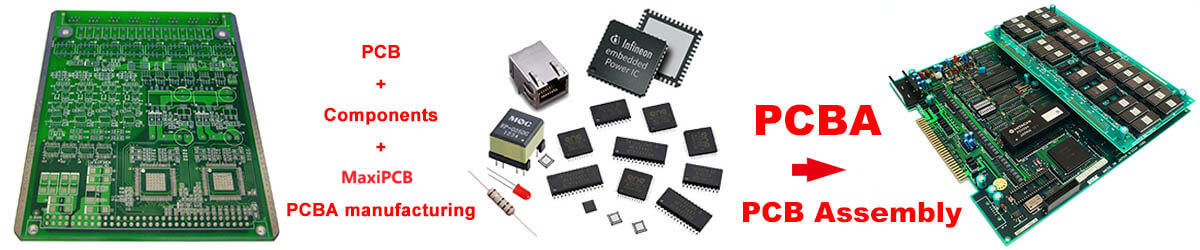
PCB vs PCBA
5. PCBA Manufacturing Process & Required Materials
5.1 Manufacturing Process
-
Electronic Components Procurement
-
PCB Prototype Fabrication
-
SMT Patch Assembly
-
DIP Plug-in Assembly
-
Circuit Assembly Testing
-
Finished Product Assembly
5.2 Required Materials & Equipment
Necessary materials and equipment for PCBA manufacturing include: Printed Circuit Board (PCB), Electronic Components, Solder Wire, Solder Paste, Welding Rod, Solder Preform (depending on welding type), Flux, Welding Platform, Wave Soldering Machine, SMT Equipment, and Testing Equipment.
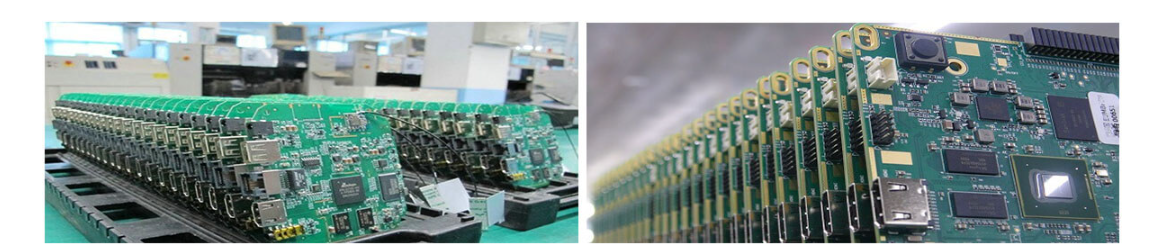
PCBA
6. Maxipcb’s PCB Assembly Services
Maxipcb provides full and partial PCB assembly manufacturing services, tailored to meet different customer needs:
6.1 Full Assembly Manufacturing
We take full responsibility for the entire process, including production, material procurement, online order tracking, incoming material certification/quality inspection, and final assembly. This one-stop service allows customers to focus on their design without worrying about procurement and production details.
6.2 Partial Assembly Manufacturing
Customers can purchase the PCB and some materials themselves, and we will complete the remaining processes (such as mounting, soldering, and testing).
6.3 One-Stop Inquiry Process
To get a quote for PCB assembly, please send your BOM (Bill of Materials) to Maxipcb, along with the required quantity. We will provide a quote within 24 hours. Note: The BOM must include the quantity, part number, manufacturer name, and manufacturer model number of each component.
6.4 Key Advantages of Our Services
-
Material Procurement Support: Our purchasing team optimizes procurement by sourcing more components from the same supplier, adjusting packaging (tape, tube, bulk, etc.) for small-volume BOMs to reduce costs. We can handle hard-to-order and obsolete components, and strictly follow the material models and manufacturers in your BOM (no alternative materials will be used without your approval).
-
Transparent Pricing: The total service price includes welding cost, board cleaning cost, and material procurement cost. Component quotes are sourced from authoritative suppliers such as Digi-Key, Mouser, Avnet, Arrow, Future, Newark, or your designated suppliers. No additional procurement fees are charged.
-
Punctual Delivery: We conduct PCB fabrication and material procurement simultaneously. If there are no hard-to-order components or documentation errors, a full set of PCB assembly usually takes 2 weeks.
-
DFM Support: We review your Gerber files, BOM, assembly files, and circuit diagrams to prevent engineering problems, optimize assembly processes, and reduce costs. We also conduct a comprehensive matching check between your component list and PCB file before procurement to avoid cost waste and delayed delivery.
-
Risk Control: All PCBs undergo electrical testing. For batch orders, we can send sample boards for your pre-test before mass production. X-ray testing is used to detect the welding quality of BGA and leadless components (e.g., QFN, DFN), ensuring all welding issues are resolved before delivery.
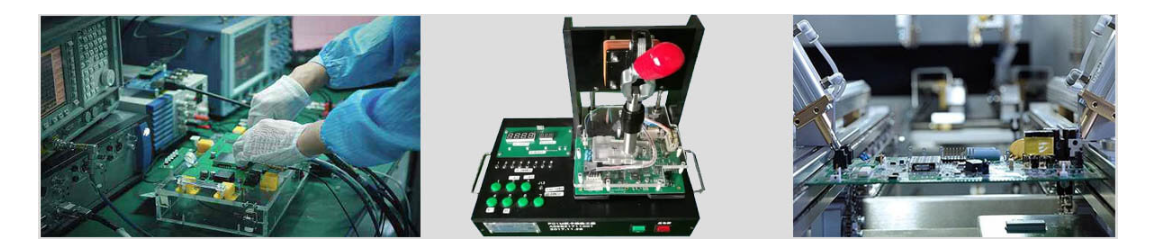
PCBA test
7. PCBA Testing
PCBA testing refers to testing the electrical conductivity and input-output values of a PCB assembly board with mounted electronic components. It is a key step to ensure production and delivery quality.
7.1 Why Testing is Necessary?
PCBA production involves complex processes (PCB manufacturing, component procurement/inspection, SMT assembly, etc.), and problems may occur due to improper equipment or operation. Testing verifies whether the actual performance meets the design requirements (e.g., voltage, current values) and ensures no quality issues in the final product.
7.2 Testing Principle
The FCT (Functional Test) fixture is made according to the test point program and test steps provided by the customer. The PCBA board is placed on the FCT test bench to form a complete circuit path, connected to a computer and recorder. The MCU program is uploaded to capture user input actions (e.g., long-pressing a switch for 3 seconds), control circuit on/off (e.g., LED flashing), or motor rotation. The test is completed by observing the voltage and current values between test points and verifying that input/output actions match the design.
7.3 Common Testing Methods
-
Manual Test: Uses visual inspection to confirm component mounting. Widely used but unsuitable for small, high-volume components; functional defects are hard to detect, and data collection is difficult.
-
Automatic Optical Inspection (AOI): Conducted by a dedicated tester, used before and after reflow soldering. Effective for component polarity inspection but poor at identifying short circuits.
-
Flying Needle Tester: Ideal for prototypes and low-volume production due to high mechanical accuracy, speed, reliability, fast conversion, and fixture-free operation.
-
Function Test: A test method for specific PCBs or units, completed by special equipment. Includes final product testing and hot mock-up.
-
Manufacturing Defect Analyzer (MDA): Advantages include low initial cost, high output, easy diagnosis, and fast, complete short-circuit/open-circuit testing. Disadvantages: No function testing, no test coverage indication, requires fixtures, and high test costs.
8. How Components Are Mounted to Form PCBA
The mainstream assembly method currently is SMT assembly, which follows these steps: print solder paste on the bare PCB → mount electronic components onto the PCB → pass through a reflow oven → solder components to the PCB via the melted solder paste.
For a small number of PCBA requiring DIP, wave soldering technology is adopted. DIP is used for heavy components that need external force for insertion/removal—these components are either not technically feasible as SMD components, have uneconomical SMD prices, or require user insertion/removal. They are designed as through-hole components (DIP) and soldered to the PCB via a wave soldering furnace.
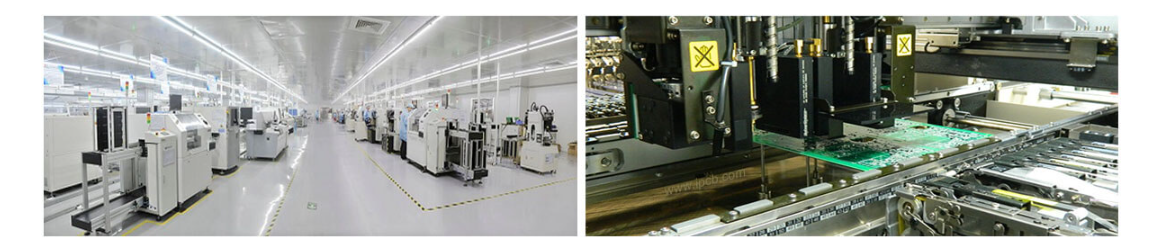
One-Stop PCB Assembly / PCBA manufacturing
9. One-Stop PCB Assembly / PCBA Manufacturing Services
Maxipcb provides one-stop PCBA manufacturing and design services, offering practical technical solutions based on the customer’s design concept, analyzing product market positioning, and providing functional proposals, lists, and reports. This helps customers make products more market-adaptable while meeting functional requirements.
Key services include:
-
Test Program Provision: We design test programs for circuit boards, set test points, conduct general function tests, and use professional test benches to verify board stability, noise, and circuit paths. After sample production, we perform functional and stability tests (waterproof, drop, noise, etc.) before mass production.
-
DFM Report Provision: Our engineers analyze the circuit board structure, provide constructive suggestions to improve manufacturability and product quality, and issue a DFM report according to customer requirements.
-
BOM Optimization: If components in the BOM do not meet process requirements, we propose optimization and alternative material solutions to ensure no impact on PCBA function while maintaining maximum consistency within technical parameters.
SMT Welding Process Advantages
Our SMT welding process is carefully matched to meet your design requirements and limitations. We provide DFT (Design for Testability) suggestions based on your SMT PCB assembly documents (with final decisions left to you). We strictly follow SMT welding requirements for SMD components and implement precise control of reflow soldering. For SMD solder joint quality detection, we use 3D X-ray testing—critical for leadless packages (QFN, DFN, BGA) where visual inspection cannot fully identify welding issues.
10. How to Choose the Best PCB Assembly Manufacturer
To select a high-quality, efficient, and reliable PCB assembly manufacturer, focus on the following 5 aspects:
-
Technical Equipment: Professional and advanced equipment (e.g., high-speed placement machines, multi-temperature zone reflow ovens) reflects the manufacturer’s production capacity.
-
Pricing & Cost-Effectiveness: PCBA manufacturing prices are relatively transparent. Avoid choosing "lowest price" blindly—some manufacturers cut corners to reduce costs, while others use formal channels for original components and strict quality control (resulting in reasonable higher costs). Select a cost-effective manufacturer based on your quality, efficiency, and service needs.
-
Production Site Management: Observe the placement of incoming materials, semi-finished products, pending inspection products, and finished products—they should be reasonable, clear, and up to standard. Protective measures (e.g., turnover vehicles, electrostatic boxes) indicate attention to detail and product safety.
-
Service Attitude: A manufacturer with a good service attitude takes initiative to assume responsibility, responds quickly to customer needs, and solves problems promptly—enhancing trust and facilitating long-term cooperation.
-
Detail-Oriented Operation: Manufacturers that meet the above standards and adhere to the philosophy of "attention to detail, high service, high quality, and high efficiency" have comprehensive strength and are worthy of trust.
11. Conclusion
No matter which stage your design is in, Maxipcb is ready to assist with your project. As a professional prototype PCBA manufacturer, we provide DFM advice early in your design process. As the project progresses, we offer flexible sampling lead times and one-stop assembly arrangements.
Maxipcb is a professional PCB and PCBA manufacturing company, providing end-to-end R&D and production services from PCB design, manufacturing, and assembly to finished products. If you have a project idea, please contact us via email—we will respond promptly.

