• FPC Flexible PCB
  • FPC Flexible PCB
  • FPC Flexible PCB
  • FPC Flexible PCB
  • FPC Flexible PCB
  • FPC Flexible PCB

FPC Flexible PCB

Product Model: Flexible FPC PCB
Material: PI and PET substrate
Layers: 1 to 12 layers available
Finished Thickness: 0.1mm–0.8mm
Copper Weight: 1/3oz ~ 1oz
Solder Mask: Yellow / Green / White
Surface Finish: Immersion Gold / OSP
Min. Trace / Space: 2mil/2mil
Min. Aperture: 0.1mm
Application: All kinds of electronic products

  • FPC Flexible PCB
  • FPC Flexible PCB
  • FPC Flexible PCB
  • Description

  • Data Sheet

1. Definition & Core Characteristics of FPC

FPC (Flexible Printed Circuit), also known as flexible PCB or flexible printed circuit board, is fabricated using flexible substrate materials such as Polyimide (PI) or Polyethylene Terephthalate (PET), which feature excellent foldability and bendability. As a high-performance interconnection solution, FPC boasts high circuit density, lightweight, thin thickness, and superior bending performance, perfectly meeting the miniaturization and mobility requirements of modern electronic products.
FPC can be freely bent, wound, and folded, withstanding millions of dynamic bending cycles without conductor damage. It can be arbitrarily arranged according to spatial layout requirements and move freely in three-dimensional space, realizing the integration of PCB assembly and conductor connection. Additionally, FPC prototypes offer advantages including good heat dissipation, excellent solderability, easy assembly, and low comprehensive cost, making them widely applied in LED strips, aerospace, defense, mobile communication, laptops, computer peripherals, PDAs, digital cameras, and other high-tech fields.

2. Differences Between FPC and Rigid PCB

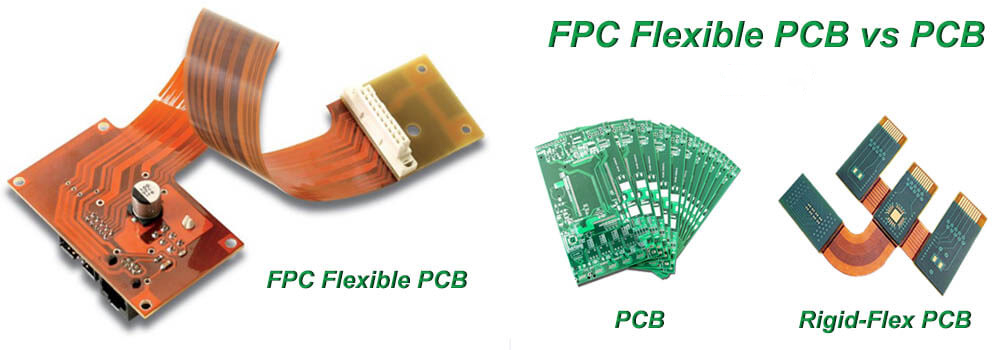
Both FPC and rigid PCB are categorized under printed circuit boards (PCBs), as both are manufactured via printing processes. In industry practice, "PCB" generally refers to rigid printed circuit boards, while "FPC" (or FPCB) specifically denotes flexible printed circuit boards. The core differences between the two lie in structure, characteristics, and application scenarios, as detailed below:
Spatial Utilization: Rigid PCBs are typically flat unless three-dimensional wiring is achieved via film adhesion, limiting spatial flexibility. FPC, by contrast, enables full utilization of three-dimensional space through flexible bending, providing a more optimal solution for compact electronic product designs. Rigid PCBs often rely on slots and interface cards for spatial extension, while FPC can achieve similar structures through transfer design with greater directional flexibility.
Material & Flexibility: FPC adopts flexible substrates such as PI or PET, allowing free bending and flexing. Rigid PCBs are usually made of FR4, ceramics, Teflon, or metal materials, which are non-bendable and rigid.
Application Purposes: FPC is suitable for connections requiring repeated bending and small-sized components. Rigid PCBs are preferred for scenarios where bending is unnecessary and higher hardness is required.


3. Classification of FPC Substrate Types

FPC is classified into seven main types based on structure and application, each with distinct characteristics and use cases:
Single-Sided FPC: Composed of "single-sided circuit + protective film", featuring excellent foldability and cost-effectiveness, suitable for simple circuit designs with low electrical performance requirements.
Double-Sided FPC: Composed of "protective film + double-sided circuit + protective film", with copper foil on both sides of the substrate and inter-layer connection via PTH holes. Its flexibility is slightly lower than that of single-sided FPC but offers enhanced circuit carrying capacity.
Single+Single Composite FPC: Formed by bonding two single-sided copper foils with pure glue, with inter-layer conduction via PTH holes. Pure glue in the bending area is removed to ensure flexibility, balancing circuit density and bendability.
Embossed FPC: Composed of "pure copper foil + upper/lower protective films", with thicker pure copper foil pressed onto PI substrate and suspended finger structures in specific areas. Mostly used for TFT liquid crystal display crimping, providing dense welding plug-in functionality.
Multilayer Flexible PCB: Fabricated from "multiple single-sided/double-sided CCLs + pure glue + protective film (CVL)", with inter-layer conduction via PTH holes. Due to the multi-layer structure, its overall flexibility is reduced, but flexibility can be optimized by opening pure glue in key bending areas.
Rigid-Flex PCB: Formed by welding or laminating "single-sided/double-sided FPC substrate + multi-layer rigid PCB substrate", with inter-layer conduction via PTH holes. It enables three-dimensional assembly, features light weight, thin thickness, and short length, reducing electronic product assembly size, weight, and wiring errors.
Flexible PCB Antenna: Integrates antenna lines on FPC and uses external metal as the antenna, suitable for mid-to-low-end mobile phones and intelligent hardware with complex frequency bands. It supports over 10 frequency bands (e.g., 4G) with good performance and low cost, applicable to most small electronic products.

4. FPC Manufacturing Process

4.1 2-Layer FPC Manufacturing Process

Cutting → Drilling → PTH → Electroplating → Pretreatment → Dry Film Lamination → Alignment → Exposure → Development → Pattern Electroplating → Film Stripping → Pretreatment → Dry Film Lamination → Alignment & Exposure → Development → Etching → Film Stripping → Surface Treatment → Cover Film Lamination → Pressing → Curing → Nickel Deposition → Legend Printing → Cutting → Electrical Testing → Punching → Final Inspection → Packaging → Shipment

4.2 1-Layer FPC Manufacturing Process

Cutting → Drilling → Dry Film Lamination → Alignment → Exposure → Development → Etching → Film Stripping → Surface Treatment → Cover Film Lamination → Pressing → Curing → Surface Treatment → Nickel-Gold Deposition → Legend Printing → Shearing → Electrical Testing → Punching → Final Inspection → Packaging → Shipment

5. FPC Soldering, Cleaning & Reinforcement

5.1 FPC Soldering to PCB

FPC is typically connected to rigid PCB via FPC connectors. Rigid-Flex PCB emerged as an optimized solution, eliminating the need for FPC connectors and reducing associated costs. It offers better spatial utilization and more stable performance, though its manufacturing cost is significantly higher than that of standalone FPC.

5.2 FPC Cleaning

Plasma cleaning machines effectively solve FPC hydrophilicity and copper plating adhesion issues. The poor hydrophilicity of PI substrate (a common FPC material) is a key factor affecting copper plating reliability. Plasma surface treatment of PI substrate can significantly improve its hydrophilicity—water contact angle can be reduced from over 45° to less than 5°, ensuring the bonding force of copper film meets design requirements when combined with magnetron sputtering coating.

5.3 FPC Reinforcement

Due to FPC's softness, reinforcement design is often required for soldering components. FPC reinforcement is typically implemented via Altium design, using flexible aluminum PCB to connect FPC to rigid PCB, enhancing the hardness of FPC production ports and facilitating assembly.

6. Detailed Features of FPC Types

FPCs are characterized by flexibility and reliability, with four main categories (single-sided, double-sided, multilayer, and Rigid-Flex) each tailored to specific application needs:
Single-Sided FPC: Lowest cost for applications with low electrical performance requirements. It features chemically etched conductive patterns on flexible insulating substrates (PI, PET, acrylamide fiber ester, PVC) using calendered copper foil as the conductive layer.
Double-Sided FPC: Etched conductive patterns on both sides of the insulating base film, with inter-layer conduction via metalized holes to meet flexible design and functional requirements. Cover films protect the wires and indicate component placement positions.
Multilayer FPC: Consists of three or more layers of single-sided/double-sided flexible circuits, with inter-layer conduction via drilled and electroplated metalized holes, eliminating complex welding processes. It offers higher reliability, better thermal conductivity, and more convenient assembly, requiring consideration of the interaction between assembly size, layer count, and flexibility during layout design.
Rigid-Flex PCB: Composed of selectively laminated rigid and flexible substrates, with compact structure and inter-layer conduction via metalized holes. It is ideal for printed circuit boards with components on both sides; for single-side component layouts, a double-sided FPC with FR4 reinforcement on the back is a more cost-effective alternative.
Hybrid-Structure FPC: A multilayer PCB with conductive layers made of different metals (e.g., Langtang alloy, copper, gold as separate leads). Typically, an 8-layer board uses FR4 as the inner medium and PI as the outer medium, suitable for low-temperature environments with strict requirements on electrical signal conversion, heat conversion, and electrical performance.

7. Economy of FPC

The economy of FPC depends on circuit design complexity, size, and application requirements: traditional internal connections are more cost-effective for simple, small-sized FPC designs. FPC becomes a superior choice for complex circuits, high-signal-volume applications, or those requiring special electrical/mechanical properties, especially when application size and performance exceed the capabilities of rigid circuits.
FPC can achieve 12mil pads, 5mil holes, and 3mil line/space on a single film, enabling direct chip mounting with higher reliability (free of flame retardants that may cause ionic drilling contamination). These films can be cured at high temperatures to achieve higher glass transition temperatures, reducing costs by eliminating plug-ins.
High raw material costs are the main driver of FPC's high price: polyester-based FPC raw materials cost 1.5 times that of rigid PCB, while high-performance PI-based FPC raw materials cost up to 4 times or more. Additionally, material flexibility increases automated processing difficulty, reducing production output. Design mismatches can lead to assembly defects (e.g., flexible attachment stripping, line breakage), often requiring reinforcement materials under high bending stress.
The polymer thick film (PTF) process offers an efficient, low-cost alternative: conductive polymer ink is selectively printed on inexpensive flexible substrates (e.g., PET), with silk-printed metal or carbon powder fillers. This clean, etching-free process uses lead-free SMT adhesives, with PTF circuits costing 1/10 of copper-PI thin-film circuits and 1/2-1/3 of rigid PCBs. It is ideal for device control panels, mobile phone components, switches, and lighting devices, saving costs and energy.

8. FPC Application Fields

FPC is widely used across multiple industries, leveraging its excellent flexibility, thinness, and light weight to meet diverse application needs:
Consumer Electronics: Applied in mobile phones, tablets, smart wearables, digital cameras (DSC), and video recorders (DV). It enables high integration, supports miniaturized and high-density circuit connections, and optimizes spatial utilization, enhancing product performance and portability.
Automotive Electronics: Used in in-car navigation, entertainment systems, communication devices, steering wheel key connections, door audio/function controls, reversing radar imaging systems, vehicle sensors, satellite navigation, and front-rear seat controller connections. It provides flexible connectivity in limited spaces, ensuring stable performance of automotive electronic systems.
Medical Equipment: Increasingly adopted in signal monitoring equipment, therapeutic instruments, and medical imaging devices. It maintains reliability in high-temperature, high-humidity environments and complies with strict medical safety standards.
Industrial Control: Applied in automation equipment, robots, and other industrial systems, providing high-density wiring and reliable connections to meet the high-performance and stability requirements of modern industrial equipment.
Aerospace: Used in critical aerospace equipment, leveraging its thinness and high vibration resistance to reduce overall weight and improve aircraft performance.

9. FPC Cost Trends

FPC assembly prices are gradually decreasing, approaching those of traditional rigid circuits, driven by updated materials, improved production processes, and optimized structures. New materials enhance thermal stability and reduce material mismatches; thinner copper layers enable more sophisticated lines, making components lighter and suitable for small spaces. Advanced manufacturing techniques (e.g., adhesive-free copper foil direct deposition on substrates) produce ultra-thin copper layers (several microns) and fine lines (3mil or narrower). Adhesive-free FPCs offer flame retardant properties, accelerating UL certification and further reducing costs. FPC solder masks and other surface coatings also contribute to cost reduction in flexible assembly.

10. Future Development Trends of FPC

Thickness: FPC is becoming increasingly flexible and thinner, adapting to more compact electronic product designs.
Bending Resistance: As an inherent advantage, FPC's bending resistance continues to improve, exceeding millions of bending cycles.
Price: Currently higher than rigid PCB, FPC prices are expected to decrease further with technological advancements.
Process Precision: With continuous process upgrades, minimum aperture and line width/line spacing are meeting increasingly stringent requirements.
Future FPC development will focus on smaller, more complex designs, requiring innovative assembly methods and hybrid flexible circuits. The industry faces the challenge of leveraging technological advantages to keep pace with consumer demand, computer, and remote communication development. Additionally, FPC will play a key role in lead-free manufacturing.

11. Maxipcb FPC Service Advantages

As a professional FPC manufacturer, Maxipcb provides cost-effective FPC solutions, including FPC prototypes and customized FPC services, with competitive pricing. Our comprehensive capabilities cover:
Surface Finishing: OSP, ENIG, Lead-Free HASL, Plated Gold, Flash Gold, Immersion Tin, Immersion Silver, Electrolytic Gold (meeting welding, conductivity, and environmental reliability requirements).
Manufacturing Capabilities: Golden Finger Beveling, Heavy Copper Fabrication, Blind & Buried Via Processing, Precision Impedance Control, Resin-Filled Vias, Carbon Ink Printing, Backdrilling, Countersink Machining, Depth-Controlled Drilling, Half-Plated Holes, Press-Fit Holes, Peelable Blue Mask, Peelable Solder Stop, Thick Copper Circuitry, Oversized Board Customization.
One-Stop Services: Design optimization, technical consultation, rapid prototyping, mass production, and after-sales support. Maxipcb strives to be a trusted partner for global high-end FPC and Rigid-Flex PCB needs, committed to delivering high-quality, cost-effective solutions.

Model: FPC Flexible PCB

Material: PI, PET

Layers: 1 layer - 12 layers

Finished Thickness: 0.1mm+0.8mm

Copper Thickness: 1/3OZ - 1OZ

Color: Yellow / Green / White

Surface Treatment: Immersion Gold / OSP

Min Trace / Space: 2mil/2mil

Min Hole: 0.1mm

Application: Various electronic products