I. Substrate Characteristics Involved in Lead-Free Assembly
RoHS restricted substances: Lead (Pb), Cadmium (Cd), Mercury (Hg), Polybrominated Biphenyls (PBB), Polybrominated Diphenyl Ethers (PBDE), etc.
Lead-free assembly involves the following substrate characteristics:
- Thermal decomposition temperature (Td)
- Coefficient of Thermal Expansion (CTE)
- Water absorption rate
- Delamination time
II. Additives
Additives include curing agents and flame retardants.
1. Curing Agents
Curing agents are required for the chemical reactions of organic components in resins to produce polymerization and cross-linking reactions.
- Dicyandiamide: Strong water absorption, which easily leads to delamination
- Non-dicyandiamide: More suitable for lead-free soldering
2. Flame Retardants
RoHS not only restricts the use of lead but also imposes restrictions on flame retardants in resin formulations.
- Solid-phase inhibition method: Isolates the heat source by changing the state of the surface material
- Gas-phase inhibition method: Inhibits chemical reactions by modifying the polymer during combustion
Most materials undergo both solid-phase and gas-phase inhibition simultaneously. The type of resin and curing agent affects the basic flammability of the material, determining the required amount of flame retardant and thus the combustion grade of the material. Organic phosphorus-based flame retardants have become one of the most common types for PCB substrates. The selection of flame retardants needs to consider their impact on the resin system and substrate product performance.
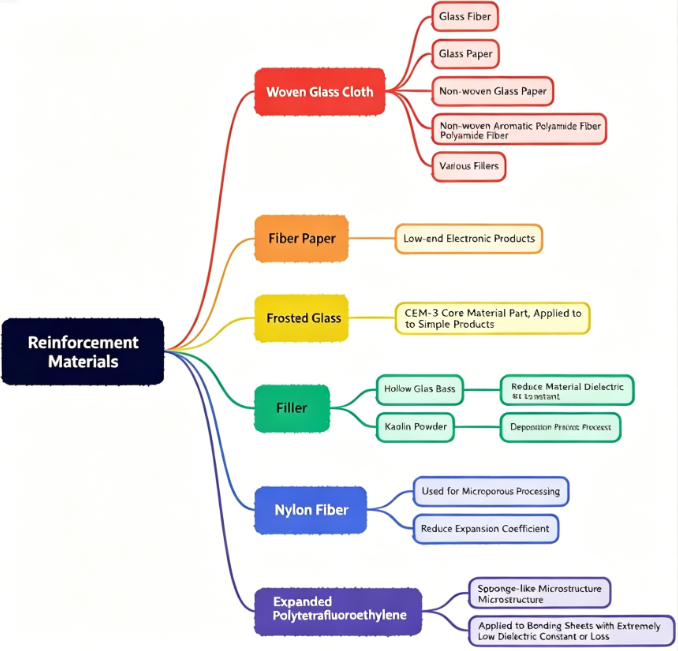
III. Reinforcing Materials
Various reinforcing materials are added according to different product requirements to ensure product performance:
Comparison of E-glass and NE-glass
E-glass and NE-glass combine excellent electrical, mechanical and chemical properties, making them the most commonly used glass fibers for PCBs.
| Property |
E-glass |
NE-glass |
| Coefficient of Thermal Expansion (ppm/°C) |
5.5 |
3.4 |
| Dielectric Constant (1MHz) |
6.6 |
4.4 |
| Dielectric Loss (1MHz) |
0.0012 |
0.0006 |
A coupling agent (silane coupling agent) is coated on the glass cloth to enhance the adhesion between glass fibers and resins, and also plays an important role in inhibiting the growth of Conductive Anodic Filament (CAF).
IV. Resin Systems
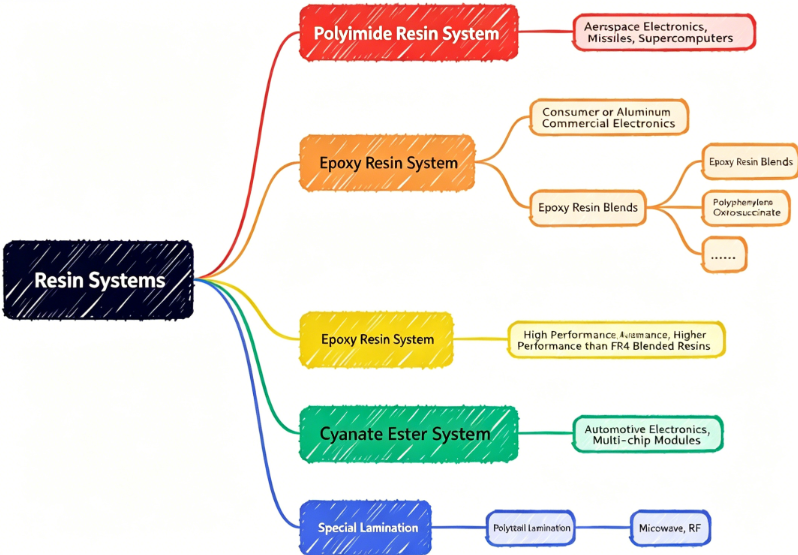
FR-4 belongs to the epoxy resin system. FR stands for flame retardant, and 4 represents the number of epoxy groups.
Epoxy resin mixtures include epoxy-polyphenylene oxide (PPO), epoxy-cyanate ester, etc., which improve the electrical properties of epoxy resins and are generally used in low-grade materials with electrical performance requirements. Ceramic-PTFE (Teflon) blends are also used.
Classification and Applications of Resin Systems
The classification of resin systems may vary in different materials. The selection of various resin systems is aimed at meeting the requirements of specific products or pursuing certain performances. Mixing different resin systems is also the most economical solution to achieve the required performance.
About Maxipcb
Maxipcb empowers innovators to turn cutting-edge technologies into reality.
We offer one-stop solutions for design, simulation, testing, PCB manufacturing, component procurement and SMT assembly, enabling efficient development, rapid deployment and risk control across the full product lifecycle.Serving the world in communications, industrial automation, aerospace, automotive, semiconductor and beyond, we build a safer, more connected future together.