Preparing PCB board for screen printingAfter the blueprint is completed, the next step is to convert it into hardware. To ensure high quality results, please follow the following steps:
First, select the appropriate board type. MorePCB provides comprehensive services and top products. Share the documents you need to get a quick quote. Why delay?
After selection, the selected materials will go through a cleaning process, and then the circuit board will be carefully handled with adhesive tape. This prepares for the printing stage of PCB. At this time, PCB layout should be printed in black on transparent paper. After drying, put the design on the screen printing board. Align the silk cloth with the marks on the screen printed PCB design.
To prevent any movement, please use scotch tape to fix the design. Keep its position and flip the whole setup (design and screen printing) down. Cover the top with dark cardboard.
Irradiating ultraviolet rays for about 15 minutes to complete the production of PCB screen printing.
Using pressurized water to remove the part of the emulsion that was not exposed to ultraviolet rays, exposing the developed screen printing template.
Screen printing on PCBThis stage involves screen printing on PCB. When the board is fixed on the printing machine, the screen can move in many directions to realize accurate printing. The PCB has been etched according to the pattern created in the software.
Before transferring screen printing to printed circuit board, the printed circuit board must be etched. Now, you screen print the fabric on the PCB, making sure it covers the whole surface. Fabric should be properly aligned with PCB to ensure accurate transfer.
Apply light pressure to fix the fabric, ensuring that it remains flat and tight. After the transfer is completed, remove the silk-printed fabric from the PCB. Check to ensure that the top screen-printed artwork is accurately aligned.
Use a scraper to apply white curable UV ink to the screen printing design. Screen printing ink must be cured after being coated on PCB substrate to ensure sufficient adhesion. In most cases, this is achieved by exposing the PCB to high temperature or ultraviolet radiation in an oven for 10 minutes. In this way, the PCB surface will be permanently marked.
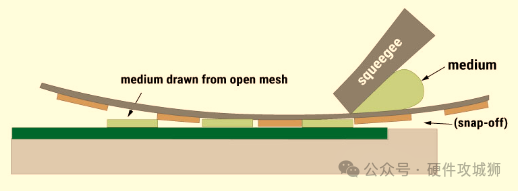 PCB screen printing process
Ensure proper handling.
Even after printing is completed, correct handling is still very important to maintain the quality of PCB. Therefore, several steps need to be followed.
Thorough inspection of PCB screen printingInspection shall be carried out during handling and processing steps. This ensures that the quality of PCB panel can pass visual evaluation. This step verifies whether the human eye can correctly read the information on the board. It is essential to ensure that there are no typographical errors or omissions.
PCB screen printing processingIn the final stage, screen printing is processed and checked to ensure the product is ready. After quality assurance, your printed PCB is ready. Errors in the silk screen printing layer may lead to assembly and functional problems, so this is a key stage of production.
PCB screen printing methodWhen using screen printing, many factors need to be considered, such as the time and effort required to make screen printing, as well as the cost, accuracy and materials of printing screen printing plates. Therefore, it is your responsibility to view all this information. There is no need to study the details further now. Let's focus on the most common screen printing methods for the time being:
Liquid photo imagingEpoxy lamination of PCB is a prerequisite for LPI. Because epoxy resin has a photo-imaging function, screen printing can be transferred to the board by exposing it to ultraviolet light.
If you use LPI screen printing technology, you will get excellent accuracy. Compared with screen printing technology, this technology does not need a large working area. The only disadvantage of this method is that it requires more time and ink to set up compared with the competitive method.
LPI technology allows you to reduce the PCB size while still obtaining high-quality screen printing.
Direct legend screen printingDLP is the last option for screen printing in this list. You will adopt the same basic idea behind the page printer. Using a page printer is similar to printing on paper and the steps are the same. The ink of the high-pressure inkjet printer can be directly transferred to the board without further steps.
Due to the accuracy of this modern screen printing technology, a lot of time and energy can be saved. If you choose screen printing technology, you will save time and money. The only limitation is that silver-based PCB cannot be used in this technology.
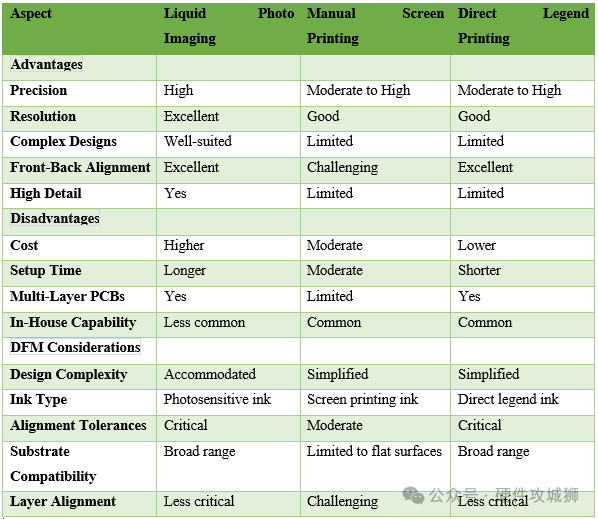
Comparison of different printing methods
How to determine the cost of PCB screen printing?Do you know that screen printing of PCB accounts for 12-15% of the total cost of PCB? Character sizes such as width, thickness, height, position and spacing are all part of text layout, which will increase the cost of screen printing.
The ink cost of screen printing in PCB projects depends on the printing technology you use. Manual screen printing uses epoxy ink, while digital light processing (DLP) uses acrylic ink. The color and chemical composition of ink have great influence on the final tone.
The price of ink depends on its characteristics, such as compatibility with substrate, adhesion, curing process and acid and alkali resistance.
When estimating the cost of screen printing, we must also consider whether to print works of art on both sides-the prices of both sides will rise.
DIY screen printing on PCBIt is more intuitive to set up manual procedures for PCB screen printing at home or in the office. This operation is an integral part of the MorePCB. You can rely on our comprehensive support and quality goods. You can get an instant quotation by sending us the necessary documents. So, why are we stagnant?
To use PCB screen printing at home, you need something. To create a PCB, you must know how to use design software, choose colors and fonts, and arrange text. This is an essential step in screen printing art. PCB can be more attractive through creative methods, but it must still be readable.
Secondly, the most important part in the printing process is to transfer the ink to the laminate. This is a subtle operation that will have serious consequences for the final product. Every step of the manual screen printing process must be carefully paid attention to in order to obtain high-quality final results.
First, an aluminum frame is used to stretch the polyester screen. In the second stage, the screen is coated. Incorrect placement of the screen and panel may result in the whole circuit board being useless.
The coating must be thoroughly dried before use. When designing your own PCB screen printing, please make sure to follow all these procedures. But you still have reasons to choose to cooperate with a specific manufacturer. Read on for advice on how to choose a manufacturer instead of doing it yourself.
About Maxipcb
Maxipcb empowers innovators to turn cutting-edge technologies into reality.
We offer one-stop solutions for design, simulation, testing, PCB manufacturing, component procurement and SMT assembly, enabling efficient development, rapid deployment and risk control across the full product lifecycle.Serving the world in communications, industrial automation, aerospace, automotive, semiconductor and beyond, we build a safer, more connected future together.conclusion
Screen printing on PCB is a fine process, which can affect the overall quality of PCB and provide value through fine design. It improves the assembly process by providing basic information about orientation, component placement and orientation. Screen printing meets the requirements of function and quality assurance, and its marks can withstand the extreme temperatures and chemicals needed in PCB production. When finalizing the design, you must consider the cost-benefit analysis.

