The Institute for Interconnecting and Packaging Electronic Circuits (formerly known as the Institute of Printed Circuits, IPC) aims to enhance the competitive advantages and commercial success of more than 3,700 member companies.
The Institute for Interconnecting and Packaging Electronic Circuits (formerly known as the Institute of Printed Circuits, IPC) aims to enhance the competitive advantages and commercial success of more than 3,700 member companies. IPC members cover all links in the electronics industry and its industrial chain, including electronic design, PCB manufacturing, electronic assembly, and testing. IPC provides services such as industry standards, training and certification, market research, and environmental protection, and launches various programs to meet the demands of the global electronics industry with a market value of 2 trillion US dollars.
IPC offers a business cooperation network and information exchange platform for the global electronics industry covering technology, management, marketing, and other fields. Founded by 6 PCB companies in 1957, IPC now has more than 3,700 member companies worldwide. Since establishing its first office in China in 2002, IPC has provided localized services to Chinese electronics enterprises, and the number of Chinese member companies has reached more than 500 to date. IPC Greater China is headquartered in Qingdao, with offices in Shanghai, Shenzhen, Beijing, Suzhou, Chengdu, Taipei and other regions.
IPC guides and supervises the association through volunteer organizations including the Board of Directors, PCB Management Council, EMS Management Council, PCB Supplier Management Council, SMEMA Council, Solder Evaluation Council, OEM Critical Components Council, Printed Electronics Council, Designer Council, Market and Technology Executive Committee, and Technical Activities Executive Committee. These bodies help the association perceive industry demands, collect industry suggestions, and improve service quality.
The development status of various businesses carried out by IPC is as follows:
- Standard Development: IPC has organized more than 10,000 global industry experts to successfully develop over 220 standards. Among them, the IPC-A-610 standard is one of the most widely used standards worldwide and is recommended by the International Electrotechnical Commission (IEC) as the global preferred acceptance standard for electronic assemblies. IPC China’s 41 technical groups have completed the development of 31 standards.
- Training and Certification: IPC has provided IPC standard training for employees of thousands of electronics enterprises, and more than 250,000 people have obtained IPC standard certification certificates.
- QML and QPL: IPC has launched two new services for electronics manufacturing enterprises – Qualified Manufacturing List (QML) and Qualified Product List (QPL). QML certification is a targeted and highly operable systematic certification for the processes of electronic manufacturing service enterprises in accordance with IPC J-STD-001/IPC-A-610 standards. QPL certification is a product quality conformity certification for supplier products in accordance with IPC J-STD-004/005/006 and other standards.
- Market Research: IPC conducts market research including global quarterly statistics on base materials, solder products, process consumables, assembly equipment, and electronic manufacturing services, as well as annual research on the EMS industry and monthly statistics on the PCB industry.
- Public Policy Advocacy: Covering environment, health and safety, international trade, intellectual property protection, and corporate social responsibility.
- Government Relations: IPC represents the electronics industry to provide suggestions, project cooperation, and policy promotion to governments during the public policy formulation process.
- Industrial Programs: Such as technical and management conferences, seminars, lectures, manual soldering competitions, and PCB design competitions.
- Exhibitions: Such as IPC APEX EXPO in Las Vegas, USA, IPC ESTC in Las Vegas, USA, and IPC APEX SOUTH CHINA FAIR (Shenzhen).
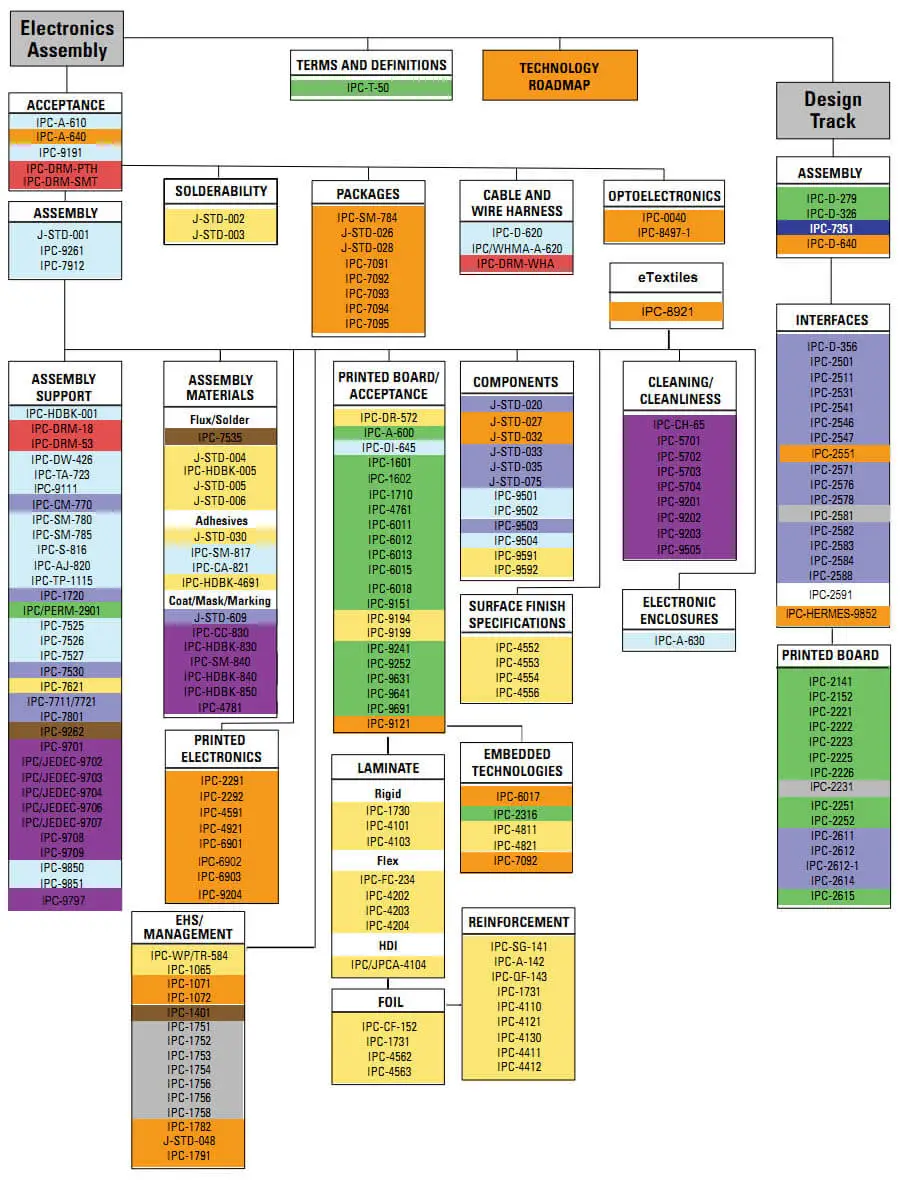
Tree Diagram of IPC Standard System
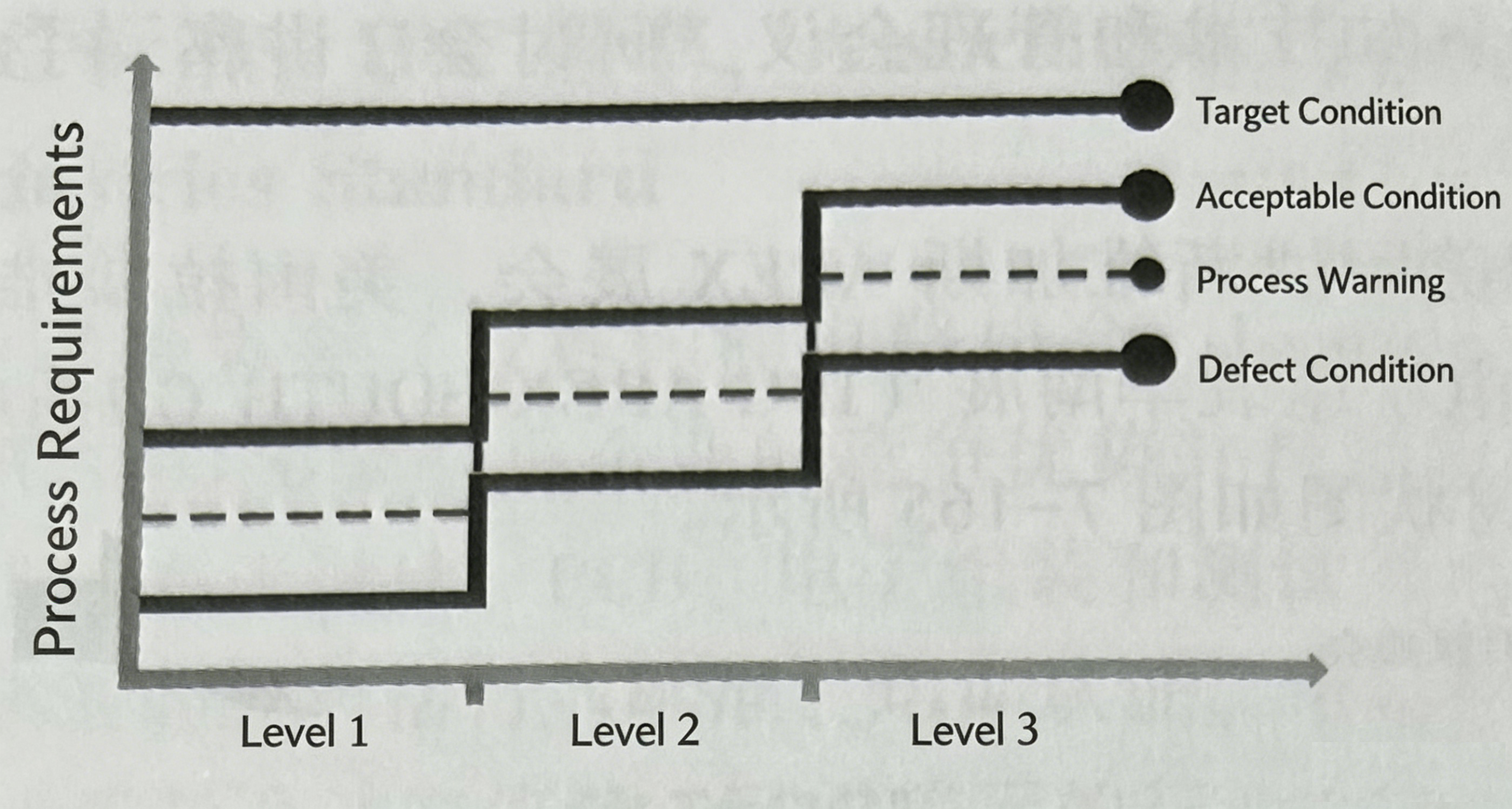
IPC Standardized Quality Management Diagram
IPC defines the grades for general electronic products as follows:
- Class 1 (General Electronic Products): These products are mainly function-oriented, such as radios, televisions, telephones in consumer electronics, and some computer peripherals.
- Class 2 (Dedicated Service Electronic Products): These products require continuous operation and a long service life, preferably uninterrupted operation (non-strict requirement). Under normal circumstances, failures will not occur due to changes in the operating environment. They mainly include communication equipment, measuring instruments, etc.
- Class 3 (High-Performance Electronic Products): These are critical products that require continuous operation or strict operation in accordance with instructions. Service interruption during use is unacceptable, and they operate in extremely harsh environments, such as aerospace equipment, military equipment, life-saving equipment, etc.
IPC provides training and certification programs including: Printed Circuit Board Production Requirements (IPC-A-600H), Electronic Assembly Production Requirements (IPC-A-610F), Assembly Process Requirements (IPC-J-STD-001F), Rework and Repair Operations and Requirements (IPC-7711/21B), Cable and Wire Harness Assembly Operations Requirements (IPC-A-620B), Designer Certification Courses (IPC-CID, CID+), PCB Qualification and Performance Specifications (IPC-6012C), etc.
About Maxipcb
Maxipcb empowers innovators to turn cutting-edge technologies into reality.
We offer one-stop solutions for design, simulation, testing, PCB manufacturing, component procurement and SMT assembly, enabling efficient development, rapid deployment and risk control across the full product lifecycle.Serving the world in communications, industrial automation, aerospace, automotive, semiconductor and beyond, we build a safer, more connected future together.
