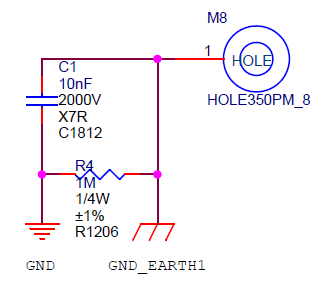
I often see friends asking in the group: How to connect the ground of a PCB board to the metal enclosure of a product?
Today I will share an online article. Please note the following treatments:
- The metal enclosure is connected to the earth (GND_EARTH), and the gap maintained with the system GND is at least 2mm;
- Regarding the treatment of the metal ground, it is as follows: A 1M resistor is connected in series between the enclosure ground and the signal ground, and a 0.01uf capacitor is also connected to the signal ground.
I. The Role of the Capacitor
From the perspective of EMS (Electromagnetic Susceptibility), this capacitor is used to reduce the impact of possible high-frequency interference signals referenced to the earth level on the circuit under the premise that PE is well connected to the earth, and to suppress the transient common-mode voltage difference between the circuit and the interference source. In fact, directly connecting GND to PE is the best option, but direct connection may be unfeasible or unsafe. For example, the GND generated after 220V AC passes through the rectifier bridge cannot be connected to PE, so a path that blocks low frequencies and passes high frequencies is created. From the perspective of EMI (Electromagnetic Interference), if there is a metal enclosure connected to PE, this high-frequency path can also prevent high-frequency signals from radiating out.
Capacitors pass AC and block DC. Assuming the enclosure is well connected to the earth, from the electromagnetic susceptibility perspective, this capacitor can suppress the dynamic common-mode voltage between the high-frequency interference source and the circuit; from the EMI perspective, the capacitor forms a high-frequency path, and the high-frequency interference generated inside the circuit board will flow into the enclosure and then to the earth through the capacitor, avoiding antenna radiation formed by high-frequency interference. In another case, if the enclosure is not reliably grounded (e.g., no ground wire, dry environment for the ground rod), the enclosure potential may be unstable or have static electricity. If the circuit board is directly connected to the enclosure, the circuit board chips will be damaged. Adding a capacitor can isolate low-frequency high voltage, static electricity, etc., and protect the circuit board. This parallel capacitor should be a Y capacitor or a high-voltage film capacitor, with a capacitance value between 1nF and 100nF.
Summary:
- From the EMS perspective, suppress the transient common-mode voltage difference between the circuit and the interference source;
- From the EMI perspective, the capacitor forms a high-frequency path, and the high-frequency interference generated inside the circuit board will flow into the enclosure and then to the earth through the capacitor.
II. The Role of the Resistor
This resistor can prevent damage to the circuit board caused by ESD (Electrostatic Discharge). If only a capacitor is used to connect the circuit board ground and the enclosure ground, the circuit board is a floating ground system. During ESD testing or when used in a complex electric field environment, the charges entering the circuit board have nowhere to release and will gradually accumulate; when accumulated to a certain extent, exceeding the voltage that the weakest insulation point between the circuit board and the enclosure can withstand, discharge will occur - in a few nanoseconds, tens to hundreds of amperes of current will be generated on the PCB, which will cause the circuit to crash due to electromagnetic pulses or damage the components connected near the discharge point. Parallel connection of this resistor can slowly release these charges and eliminate high voltage. According to the IEC61000 ESD test standard of 10s/time (releasing 2kV high-voltage charges in 10s), a resistor of 1M to 2M is generally selected. If the enclosure has high-voltage static electricity, this large resistor can also effectively reduce the current and will not damage the circuit board chips.
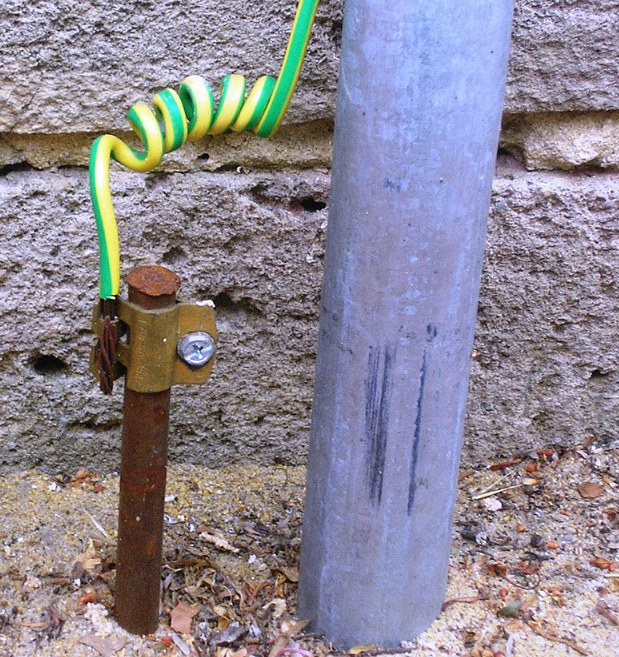
The leakage current of Class II products specified by safety standards is 0.25mA. The human body will feel trembling when the leakage current exceeds 0.5mA; 220V/0.25mA=880k, so we often take the value of 1M.
Summary: Slowly release the accumulated charges on the circuit board and eliminate electrostatic high voltage.
Finally, a question is left: Enclosures are divided into metal and non-metal. So when the enclosure is non-metal, how is the ground of the whole machine handled?
About Maxipcb
Maxipcb empowers innovators to turn cutting-edge technologies into reality.
We offer one-stop solutions for design, simulation, testing, PCB manufacturing, component procurement and SMT assembly, enabling efficient development, rapid deployment and risk control across the full product lifecycle.Serving the world in communications, industrial automation, aerospace, automotive, semiconductor and beyond, we build a safer, more connected future together.