In addition to the conventional round holes, there are some special hole designs for PCB to meet different functions or requirements.
In addition to the conventional round holes, there are some special hole designs for PCB to meet different functions or requirements.
I. Mechanical slotsSlot hole: generally refers to irregular drilling holes, and conventional drilling holes are round holes.
Slots are oval slots, square slots, L-shaped slots and other shapes.
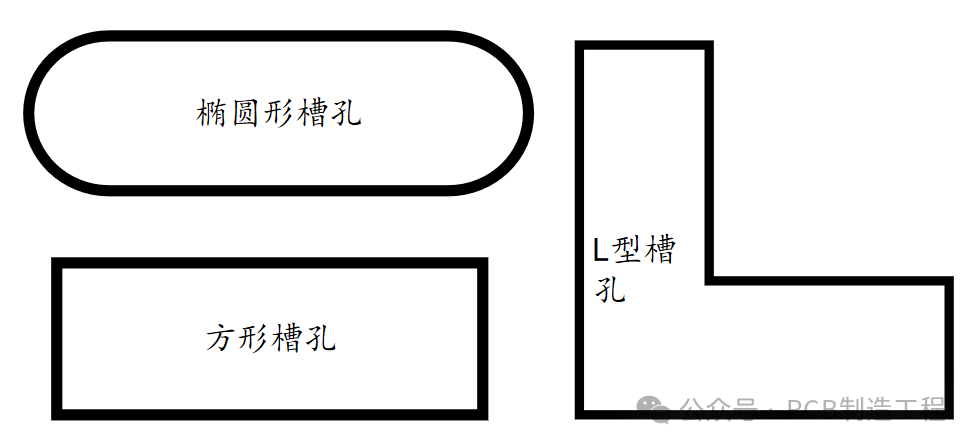 1. oval Slot
Slot tolerance:
General tolerance of PTH Slot for electroplating: width tolerance +/-0.075mm, length tolerance+/-0.1 mm.
Strict tolerance of PTH Slot of electroplating type: width tolerance +/-0.05mm and length tolerance+/-0.075 mm.
The general tolerance of NPTH Slot of non-electroplating type: width tolerance +/-0.05mm, length tolerance+/-0.075mm..
Strict tolerance of NPTH Slot of electroless plating type: width tolerance +/-0.025mm, length tolerance+/-0.05mm..
Generally speaking, it is relatively difficult to control the precision of short Slot.
Definition of short oval slot: slot length < =2 times slot width.
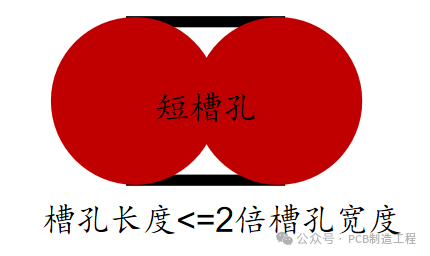
Slotted holes are actually realized by drilling multiple round holes.
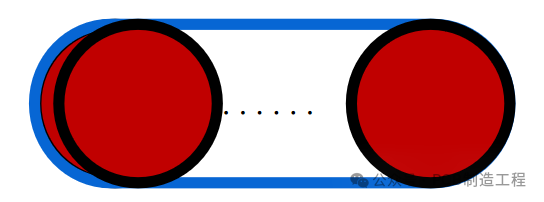
If the tolerance of NPTH oval slot is +/-0.1mm or more, it can be made by forming fishing type.
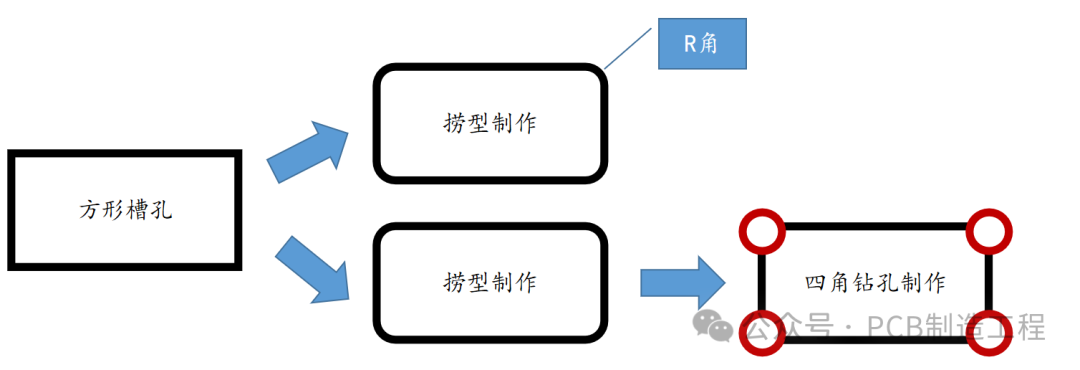
2. Square slotThe manufacturing method is closely related to the tolerance.
Tolerance: +/-0.075mm, then Slot drilling is required.
There are two methods, which needs to be confirmed with the customer.
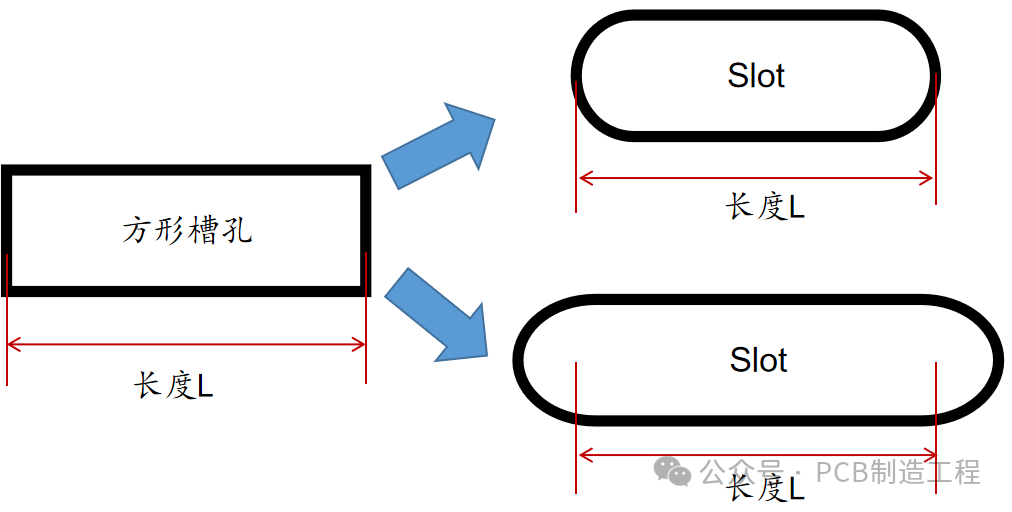
Tolerance: +/-0.1mm or above, customers are usually advised to make fishing type, and R angle is allowed. If the customer does not allow the R angle, it is necessary to suggest to the customer DFM/EQ that fishing+drilling should be adopted. In case of special requirements of customers, it is recommended to confirm with customers, so as to avoid violating customer requirements.
 3. L-shaped and other shaped slots
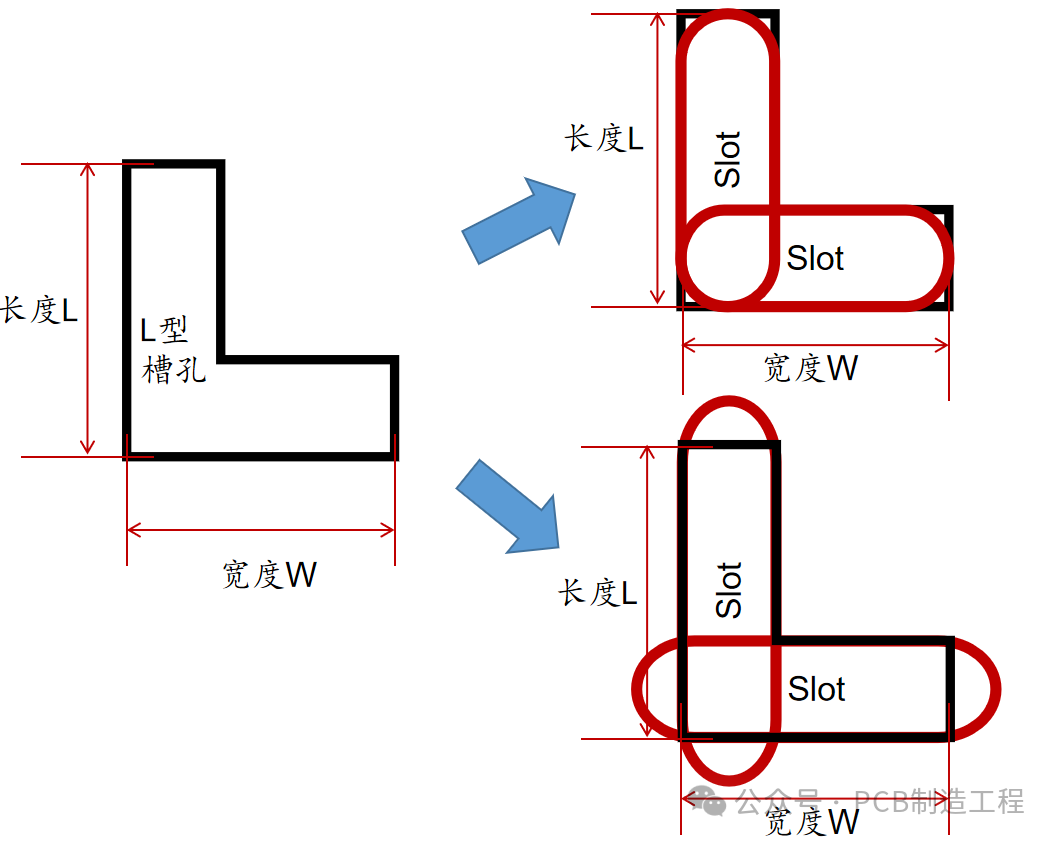
The manufacturing method is closely related to the tolerance.
Tolerance: +/-0.075mm, then Slot drilling is required. There are two methods, which needs to be confirmed with the customer.
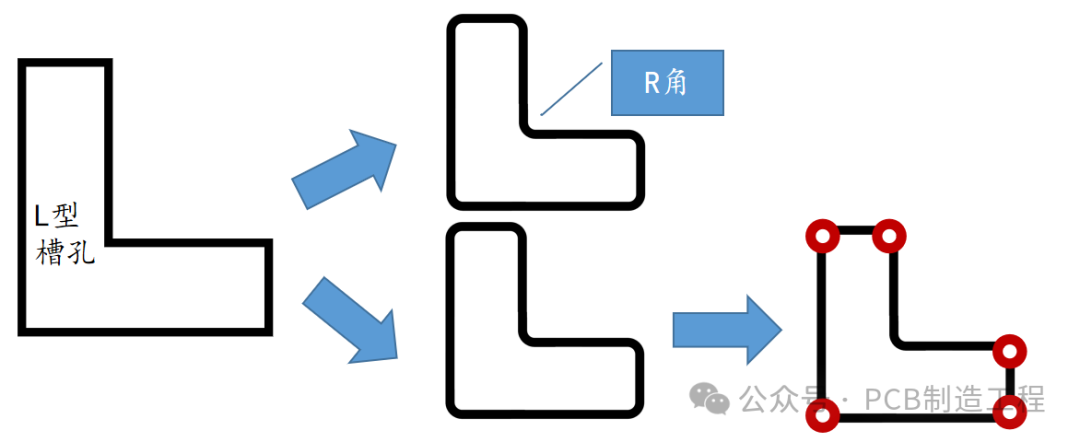
Tolerance: +/-0.1mm or above, customers are usually advised to make fishing type, and R angle is allowed.
If the customer does not allow the R angle, it is necessary to suggest to the customer DFM/EQ that fishing+drilling should be adopted.
If you encounter slots with other shapes, analyze the specific situation and confirm with customers.
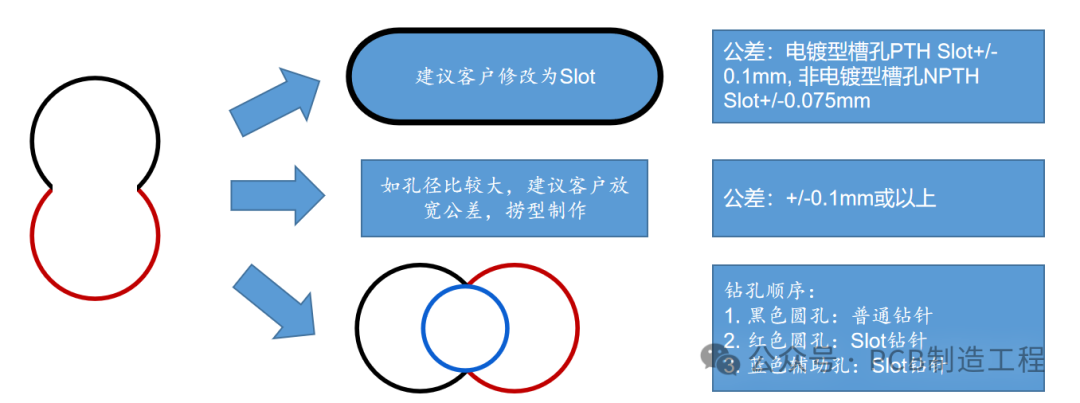
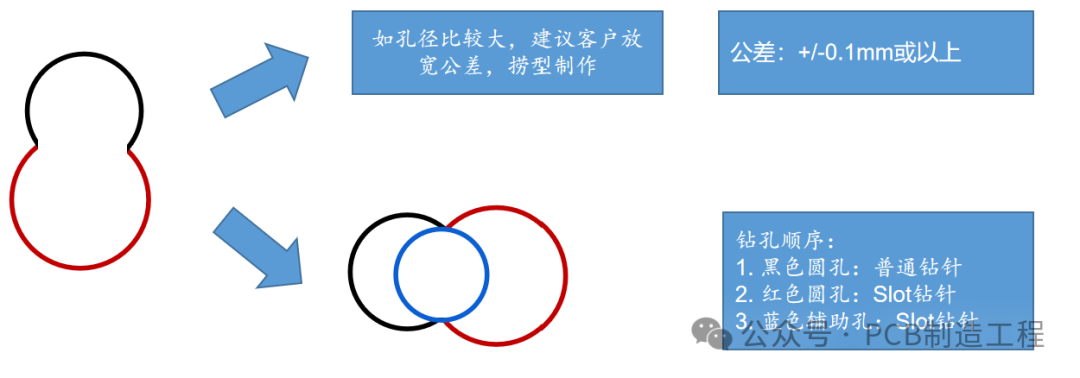
II. 8-shaped hole1. Equal-size 8-shaped holesThe diameters of the two circular holes that make up the 8-shaped hole are the same.
The manufacturing method can be selected according to the specific aperture tolerance and quality requirements of customers or confirmed with customers.
If the parameters and precision of the drilling needle are not well controlled, some defects may remain at the joint of the 8-shaped hole, and customers may be advised to allow burrs or uneven electroplating.
 2. Unequal 8-shaped holes
The diameters of the two circular holes that make up the 8-shaped hole are different.
The manufacturing method can be selected according to the specific aperture tolerance and quality requirements of customers or confirmed with customers.
If the parameters and precision of the drilling needle are not well controlled, some defects may remain at the joint of the 8-shaped hole, and customers may be advised to allow burrs or uneven electroplating.
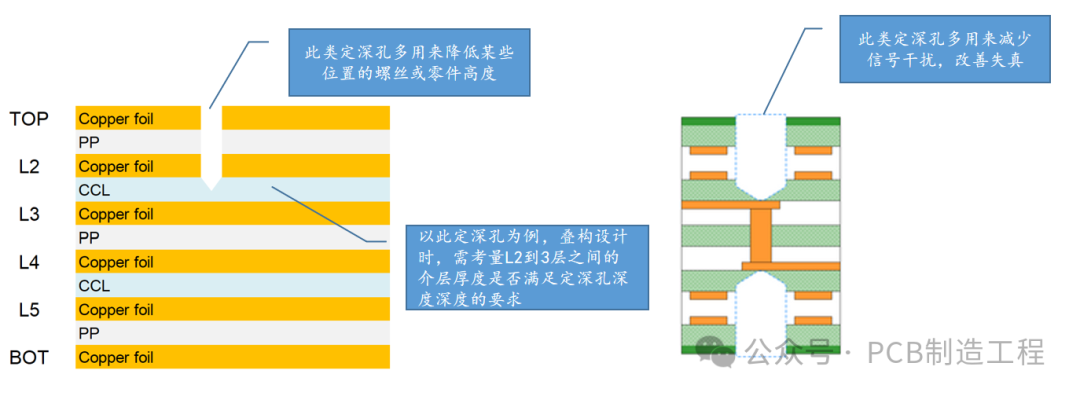
 III. Control Depth Hole of Fixed Depth Hole
Fixed depth holes are mechanical drilling holes, which are basically non-electroplated holes and have no conduction function.
Fixed-depth holes are common in the back plate, and most of them are drilled from the Bottom surface of the back, which is also called backdrilling.
Customers will carry out different designs according to different purposes of the fixed depth hole, and the common functions include heat dissipation and interference reduction.
Considering the inertia of the drilling needle in the drilling process, it is generally required that the thickness of the dielectric layer between the terminal layer and the next layer of the fixed depth hole should meet the requirements of the depth tolerance of the fixed depth hole.
 IV. Plug-in hole Press Fit Hole
Press Fit Hole of plug-in: most of them are PTH holes, and the aperture tolerance is strict, generally+/-0.05 mm.
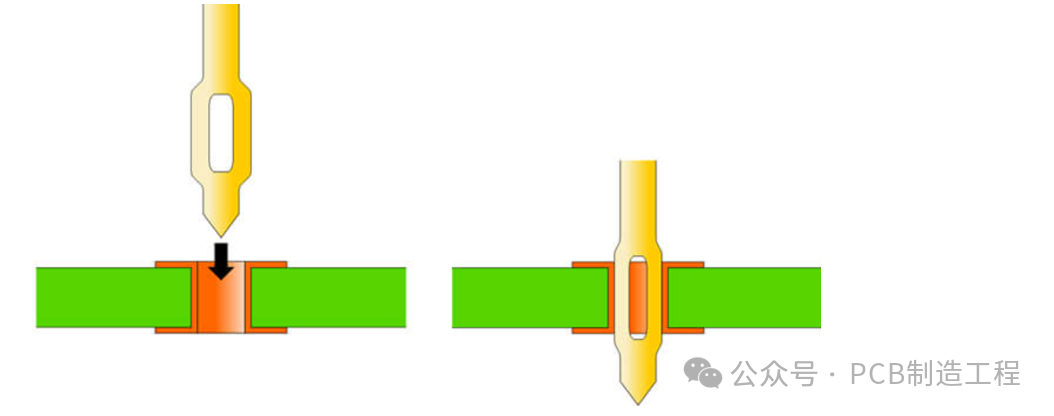
Press-fit crimping technology: also known as "fisheye terminal", this technology is an alternative solution for welding installation. A connection formed by elastic deformable pins or rigid pins matching with PCB metallization holes.
Press-fit mainly realizes the reliable connection of electrical contacts through the welding-free way of cold connection. In the process of pressing the pin into the plug-in hole, the fisheye end is elastically deformed and provides a tight connection with low contact impedance and high reliability.
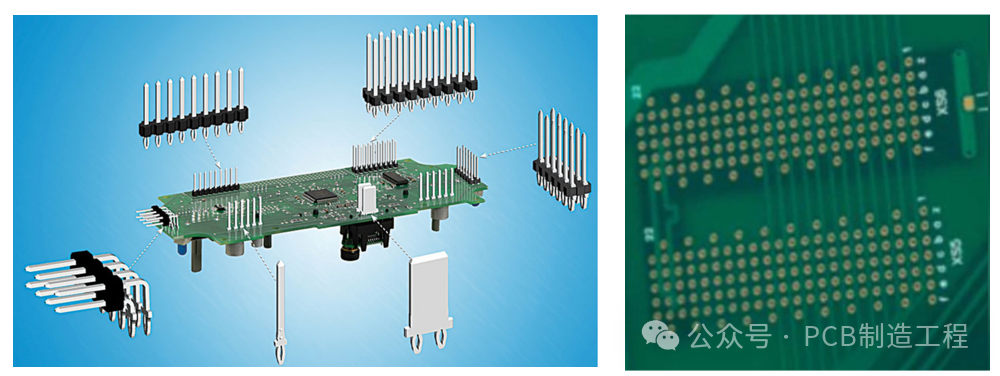
Common requirements for PCB board designed by Press Fit Hole with plug-in holes:
Plug-in holes are arranged in rows or matrices, and drawing drawings are usually marked specially.
Hole copper thickness > =20um.
Tolerance of aperture size: +/-0.05mm, common plug-in aperture sizes: 0.60mm(24mil), 0.70mm(28mil), 0.80mm(32mil), 0.90mm(36mil) and 1.0mm.
Under normal circumstances, the board size is relatively large and the thickness is relatively thick, which is more common in the thickness of 1.0mm or more.
 V. Countersink/Counterbore Hole
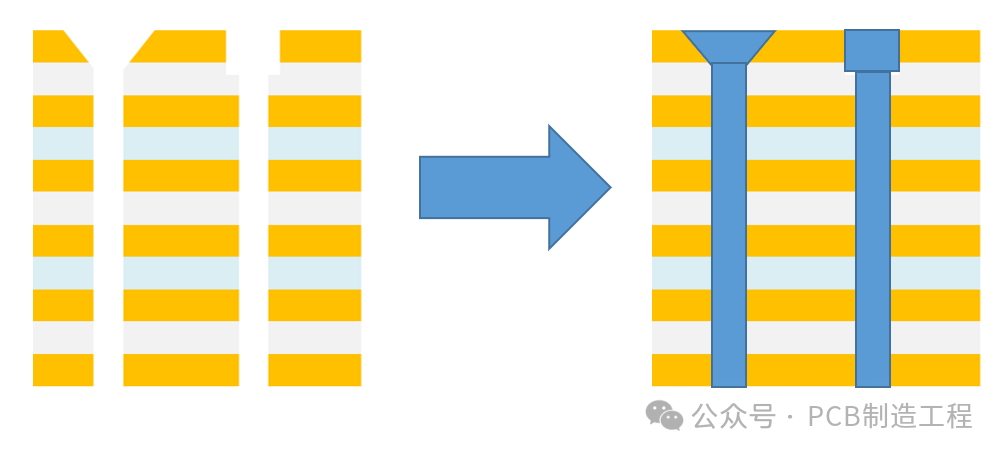
Countersink/Counterbore Hole: Also known as countersunk hole, stepped hole, funnel hole or horn hole. Usually used when the head of flat head screw is required to be below the surface of the part.
Function: Countersunk hole is mainly used to make the head of the screw lower than the surface of PCB, so as to avoid the protrusion of the screw head from affecting the overall thickness.
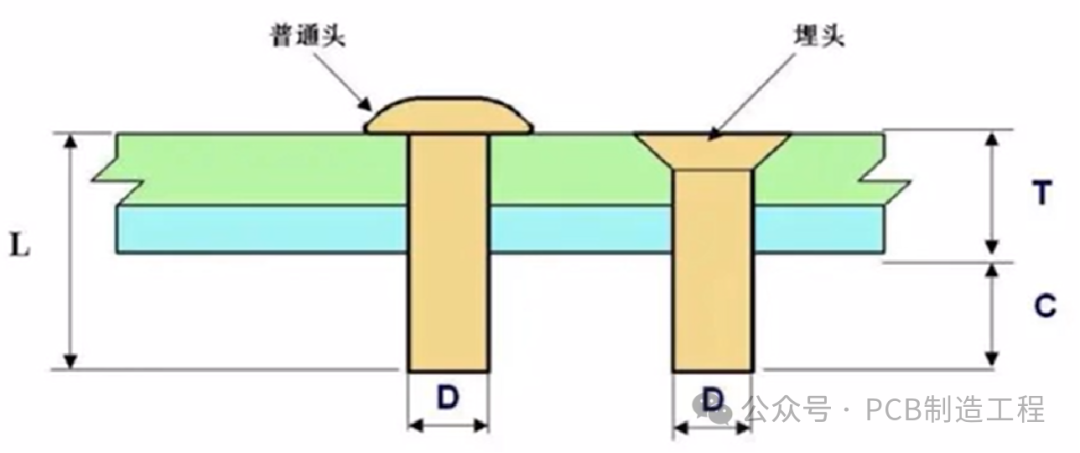
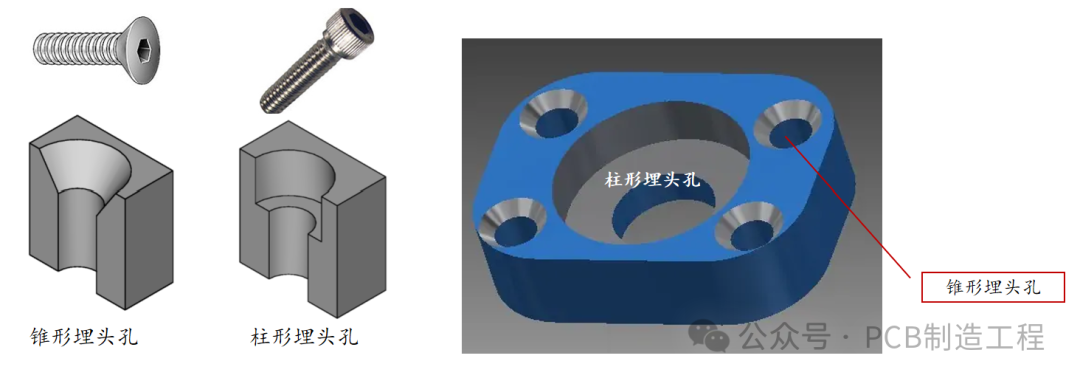
Countersunk holes are mostly non-electroplated holes, which are divided into two categories:
Countersink Hole: It is usually made to make the head of countersunk rivet, screw or bolt flush with or lower than the surface of the surrounding material.
Counterbore Hole: a cylindrical and flat bottom hole.
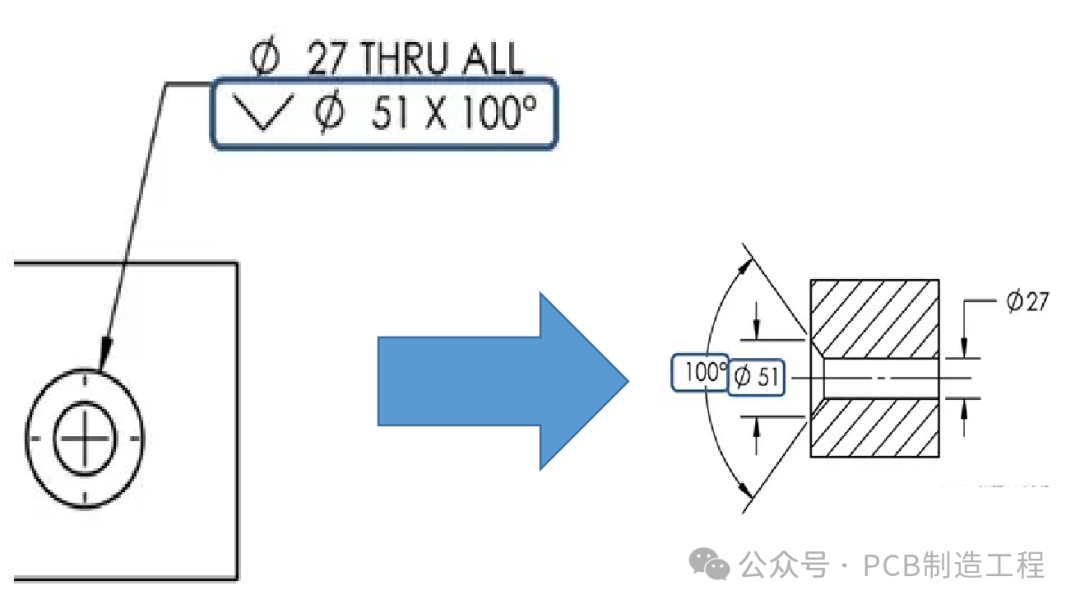
Countersunk hole identification symbol: the V symbol is placed before the diameter dimension without spaces, and it is a cylindrical element. The angle of countersink is the angle of the cone, so it should be followed by the diameter symbol.
Countersunk hole and PCB board
The countersink of PCB is used to reduce the overall thickness of the whole PCB after assembly.
Usage: generally used for fixing professional parts and reducing the overall thickness of PCB after assembly.
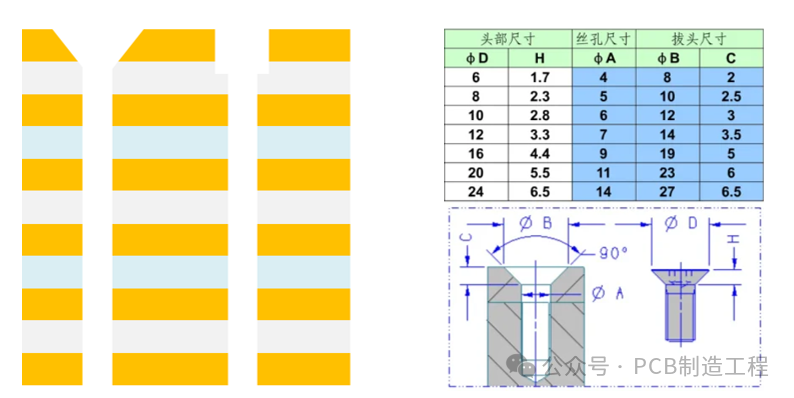
The common specification definition of countersink includes aperture d, angle b (common angle 160 to 180 degrees) and height h, as shown in the figure below.
Countersunk holes need special drill needles, and the specifications of the drill needles are determined according to the size requirements.
If you are not familiar with countersink making, you can contact the drilling machine supplier/drilling needle supplier for assistance.
 VI. Via In Pad in the middle plate
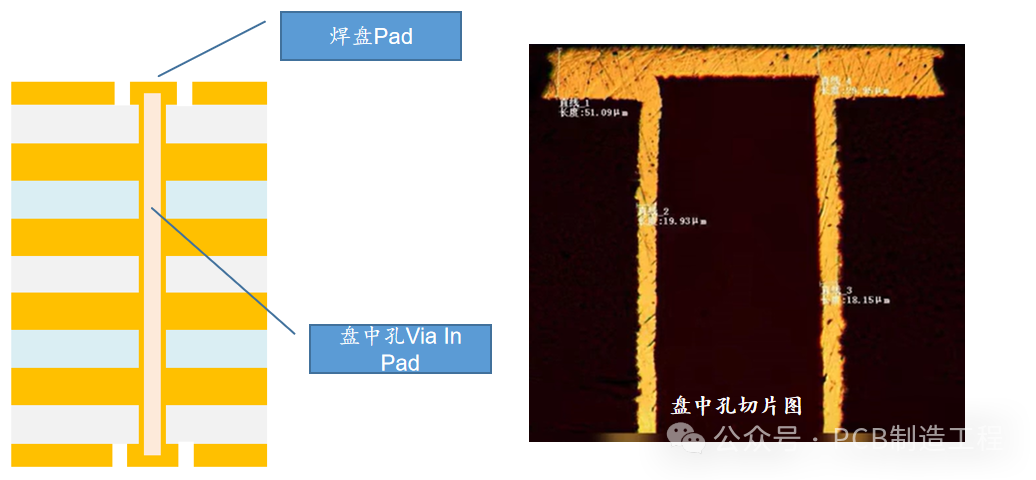
Via In Pad: VIP or VOP for short, which is located under the Pad.
The hole in the disc is Via hole, and the aperture is generally below 0.5 mm.
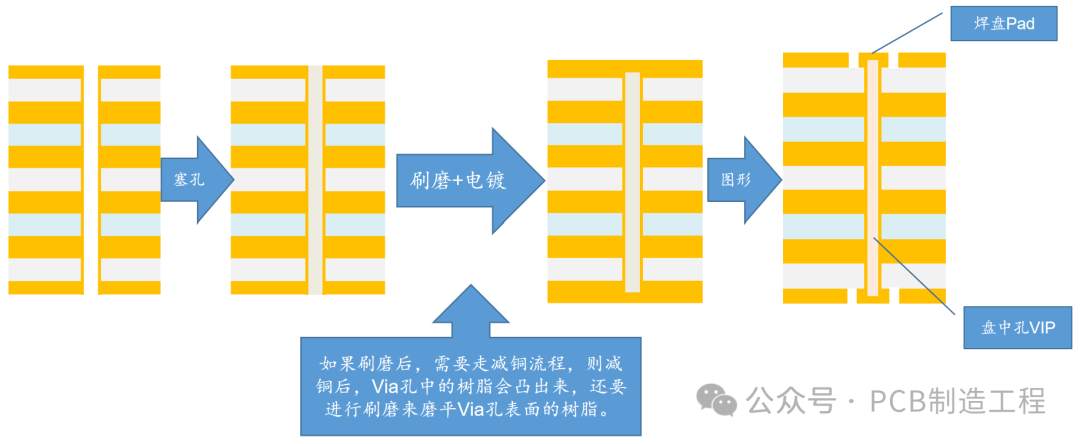
After electroplating, resin plug holes will be used to plug the holes, and then a layer of copper will be electroplated to cover the Via holes.
The hole in the disk is hidden under the pad and is mainly used for conduction.
The PCB board with VIP design has relatively complicated through holes: the industry often says "brush reduction", that is, after the VIP hole is plugged with resin, it is necessary to brush and grind the resin on the surface of Via hole, and then carry out the copper reduction process of surface copper; After copper reduction, the resin in Via hole will protrude, so brush grinding is needed to smooth the resin on the surface of Via hole.
VII. Laser Slot Hole
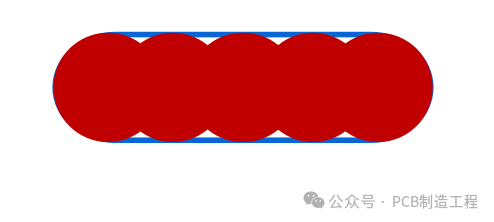
At present, some information about laser Slot holes can be searched on the internet, and it is speculated that it should be in the development stage.
Laser Slot hole function: reduce the resistance of some areas or increase heat dissipation.
 About Maxipcb
Maxipcb empowers innovators to turn cutting-edge technologies into reality.
We offer one-stop solutions for design, simulation, testing, PCB manufacturing, component procurement and SMT assembly, enabling efficient development, rapid deployment and risk control across the full product lifecycle.
Serving the world in communications, industrial automation, aerospace, automotive, semiconductor and beyond, we build a safer, more connected future together.

