The design of PCB power supply is a complicated process, and many factors need to be considered.
The design of PCB power supply is a complicated process, and many factors need to be considered.
1. When choosing the power supply topology, it is necessary to comprehensively consider the input voltage range, output voltage, power level, efficiency requirements, ripple index, cost budget and other factors.Take Buck circuit as an example, it is suitable for applications with high input voltage and low output voltage, and can realize high-efficiency Buck conversion. However, when the output voltage is lower than about 35% of the input voltage, serious conduction loss will occur, so Buck structure is not recommended at this time.
Another common Boost circuit is suitable for boost application on the low voltage side, which can achieve high boost ratio and efficiency, but there are some working limitations such as low input voltage and imbalance.
2. When selecting the key devices, the power switch tube is one of the core devices.For MOSFET, it is necessary to comprehensively consider its withstand voltage level, rated current, on-resistance Rdson, reverse recovery characteristics, drivability, switching speed and power loss during operation.
For IGBT, it is more suitable for high voltage and high power occasions. In addition, the design of transformer/inductor is also very important, which needs to be designed reasonably according to the parameters such as core size, material, winding length, turns ratio, coupling coefficient and scattering inductance to ensure good energy transfer efficiency and working stability.
3. when designing output and input filter capacitors, electrolytic capacitors are usually needed to suppress low-frequency ripple.For the output filter capacitor, it is necessary to select the appropriate capacitor value and electrolyte model and specification in combination with the expected service life, working temperature, ripple current and other conditions.
At the same time, parallel ceramic capacitors can well suppress AC ripple and overshoot peak. For the input filter capacitor, electrolytic capacitor is also needed to filter out low-frequency ripple, and safety resistors are connected in series at its two ends, while ceramic capacitor is used to suppress high-frequency ripple.
4. Good thermal design is very important for the reliable operation of power products.In PCB layout, it is necessary to keep the power devices with high heat generation away from the temperature-sensitive components, and at the same time, keep good heat dissipation channels around the heat source components.
For low power circuits, the natural convection heat dissipation ability can be improved by increasing the area of external heat sink and increasing the area of copper foil layer inside PCB.
For high-power circuits, it is necessary to use fans to force air convection to dissipate heat, and combine with appropriate radiators for heat dissipation design.
5. in order to meet the EMI/EMC regulations and standards, it is necessary to take corresponding protective measures in the power supply design.At the AC input end, it is necessary to design a Pi or T filter network to filter the EMI; at the AC input end. At the DC output end, it is necessary to design an LC filter circuit or add an independent EMI filter to suppress EMI radiated to the load end.
On the PCB layout level, the high-voltage high-frequency switching circuit should be reasonably isolated from the low-voltage analog circuit, and an appropriate shielding cover or isolation layer should be adopted. At the same time, it is necessary to ensure good grounding in all areas, and use copper foil wiring as thick as possible at the high-frequency loop to reduce the high-frequency grounding impedance.
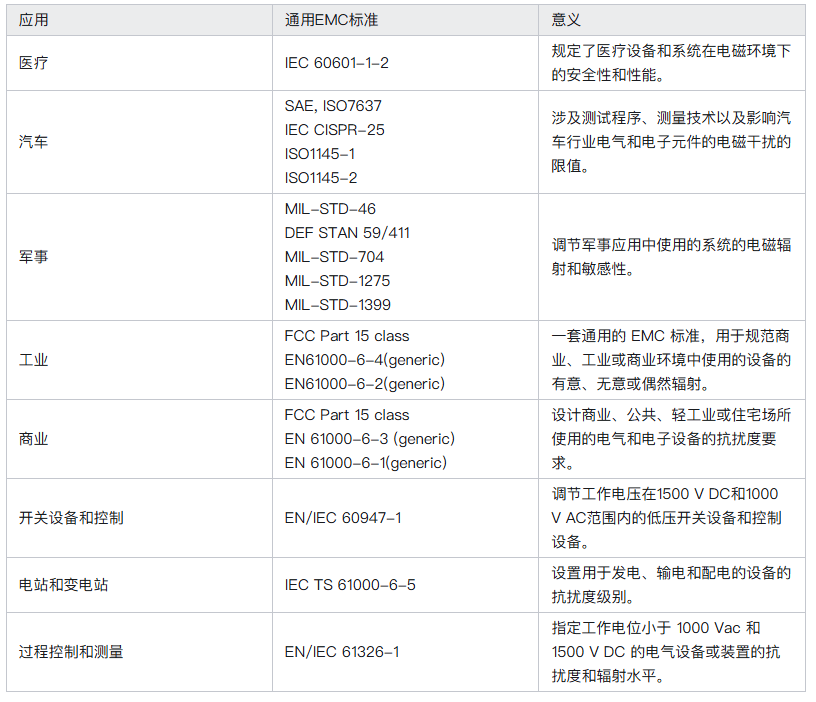
EMC standard
6. the design of commercial, public, light industry or residential use of electrical and electronic equipment immunity requirements.Switchgear and control EN/IEC 60947-1 Low-voltage switchgear and control equipment with regulated working voltage in the range of 1500 V DC and 1000 V AC. The power station and substation IEC TS 61000-6-5 set the immunity level of the equipment used for power generation, transmission and distribution. Process control and measurement of immunity and radiation level of electrical equipment or devices with working potentials less than 1000 Vac and 1500 V DC specified in EN/IEC 61326-1.
7. in the design of feedback control, the classic control methods are peak current mode control and average current mode control.The former has a simple structure, which can effectively prevent the current from flying away, but there is a coupling resistance effect and the feedback response is relatively slow. The average current mode is more suitable for high current load applications, with short reaction time, low ripple and harmonic content, but relatively high cost.
In recent years, the rise of digital control chip has brought new possibilities for power control algorithm, which can realize all kinds of flexible and intelligent control algorithms, but the time delay of its A/D sampling and digital processing also needs to be considered.
No matter which control mode is adopted, the parameter design of its feedback compensation network is the key, which directly determines the dynamic response performance of the power supply.
8. in terms of protection circuit design, it is necessary to cover the normal working range of the whole power supply.Including input undervoltage latch protection, overvoltage/undervoltage protection for detecting output voltage, overcurrent/short circuit protection based on resistance sampling or peak current mode, soft start circuit to avoid the impact of surge current on components during starting process, and temperature detection protection circuit to prevent power overheating, etc.
These protective measures need to be reasonably designed to ensure that circuit damage can be reliably prevented under abnormal conditions.
9. Reasonable PCB layout is also very important for realizing high-performance power supply design.When wiring, it is necessary to control the loop area of high-frequency and high-energy current path to the minimum to reduce high-frequency electromagnetic radiation.
At the same time, magnetic components, power switches and other devices should be kept away from analog control circuits to avoid interference from magnetic fields and electric fields.
For high-frequency switch nodes, solder mask holes or slot wiring can be used to reduce cross coupling. For magnetic devices such as coupling inductors, magnetic field shields or isolation layers can be provided.
The whole power supply circuit should adopt a separate ground plane to reduce the ground impedance.
Finally, the important role of modeling and simulation in modern power supply design can not be ignored.It is usually necessary to carry out idealized power stage circuit simulation first to predict key performance indicators such as efficiency, ripple and steady-state characteristics. Then the parasitic parameters are added to simulate the whole circuit, and the transient response and EMI noise are analyzed. Finally, thermal model and EMI simulation model are added to comprehensively analyze thermal effect and EMI performance.
Simulation can not only help to find and solve design problems in advance, but also optimize key parameters and shorten the verification period of actual design.
The design of PCB power supply is a complex project. It needs to comprehensively control many key links such as circuit topology, device selection, thermal design, EMI control, control algorithm, protection circuit, PCB wiring and simulation verification, and accumulate experience in practice, so as to finally design a high-performance and highly reliable power supply product.
About Maxipcb
Maxipcb empowers innovators to turn cutting-edge technologies into reality.
We offer one-stop solutions for design, simulation, testing, PCB manufacturing, component procurement and SMT assembly, enabling efficient development, rapid deployment and risk control across the full product lifecycle.
Serving the world in communications, industrial automation, aerospace, automotive, semiconductor and beyond, we build a safer, more connected future together.
