An electronic engineer who has never burned a board is not an excellent engineer.
An electronic engineer who has never burned a board is not an excellent engineer.
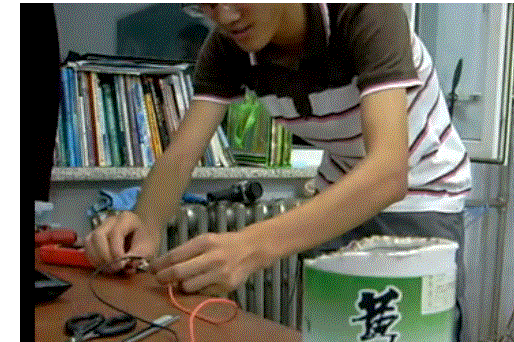
Note: Dangerous action, please do not imitate!
Circuit boards catch fire, components smoke, and even explode, which is the daily life of many electronic engineers, especially the power board that needs excessive current, which is very easy to catch fire with high voltage and high current-so how to avoid the pit? In view of this situation, of course, we choose to design it as
a thick copper board~ ~
What is
the thick copper Board?
Thick copper Board, as the name implies, is a PCB board with a thick circuit layer. Some factories will distinguish PCB boards with a circuit layer copper thickness of ≥2oz from ordinary boards, which is called thick copper board. (At present, there is no unified standard in the industry, but in the fourth edition of Terms and Definitions of Electronic Circuits published by CPCA in 2021, the definition of thick copper plate is: printed boards with conductor copper thickness greater than 105μm(3oz), including single board, double board and multilayer board).
Why do you need thick copper plates for high current?
First of all, thick copper plate has strong current carrying capacity.According to the formula:
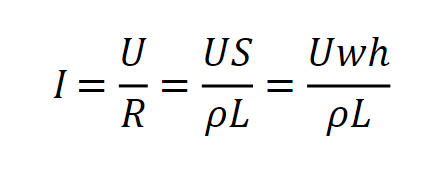
(where I represents loadable current, U represents voltage, R represents resistance, S represents line cross-sectional area, ρ represents resistivity, L represents line length, W represents line width, and H represents line thickness).
It can be seen that the loadable current I of the line is proportional to the thickness h of the line when other conditions are unchanged (especially the line width), and the thicker the line, the greater the loadable current.
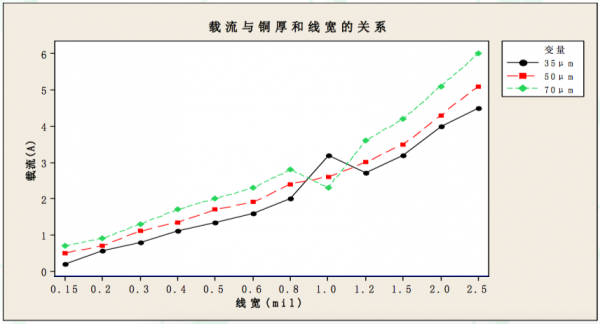
Correlation between current carrying and copper thickness and line width
Secondly, the thick copper plate has good heat dissipation.Everyone knows about metal substrates, and the typical representatives are aluminum substrates and copper substrates, which have excellent heat dissipation performance. The thick copper plate, because of its relatively thick copper thickness, can also have certain heat dissipation performance.
The following is a set of related experiments about the influence of copper foil thickness on heat dissipation:
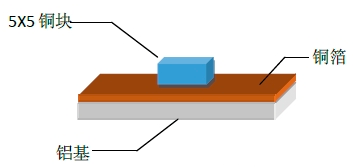
The thickness of copper foil was gradually increased by single variable method, and the temperature difference between the two ends of copper foil was measured.
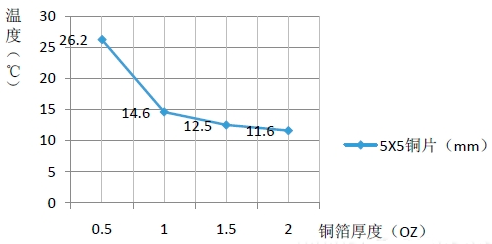
According to the change curve, with the gradual increase of copper foil thickness, the temperature difference between the two ends of the sample gradually decreases.
Therefore, designing the board into thick copper plate can improve the heat dissipation performance of the board.
Finally, thick copper boad can reduce thermal strain.According to the formula:
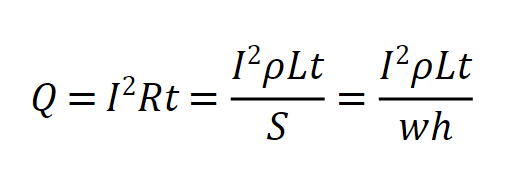
(where q represents calorific value, I represents current passing through, R represents resistance, T represents electrifying time, ρ represents resistivity, L represents line length, S represents line cross-sectional area, W represents line width and H represents line thickness).
It can be seen that the calorific value of the line is inversely proportional to the thickness of the line when other conditions remain unchanged.
Therefore, designing the board as a thick copper plate can reduce the calorific value and further reduce the thermal strain caused by heating.
To sum up, different from ordinary PCB, thick copper plate has the obvious advantages of carrying large current, good heat dissipation and reducing thermal strain, which greatly reduces the risk of burning the board and is an excellent option for PCB design with large current. In addition, the design of thick copper plate can also increase the mechanical strength of the circuit board and reduce the volume of the end product.
About MaxipcbMaxipcb inspires and empowers innovators and helps them bring world-changing technologies to life. We provide advanced design, simulation and testing solutions to help engineers complete development and deployment faster in the whole product life cycle, while controlling risks. Our customers are all over the world, such as communication, industrial automation, aerospace and national defense, automobile, semiconductor and general electronics. We join hands with customers to accelerate innovation and create a safe and interconnected world. 
