Under the trend towards brushless upgrades in power tools, the level of integration, circuit complexity, and PCB footprint of the drive solution directly determine the product development cycle, production cost, and structural compatibility.
Under the trend towards brushless upgrades in power tools, the level of integration, circuit complexity, and PCB footprint of the drive solution directly determine the product development cycle, production cost, and structural compatibility. Traditional discrete‑component brushless drive solutions require a large number of external op‑amps, comparators, sampling circuits, and driver modules. This not only makes circuit design cumbersome and PCB layout overly large, but also suffers from incompatibility between different voltage platforms, high R&D and debugging costs, and insufficient mass‑production stability – all of which have become core obstacles for manufacturers upgrading their products.
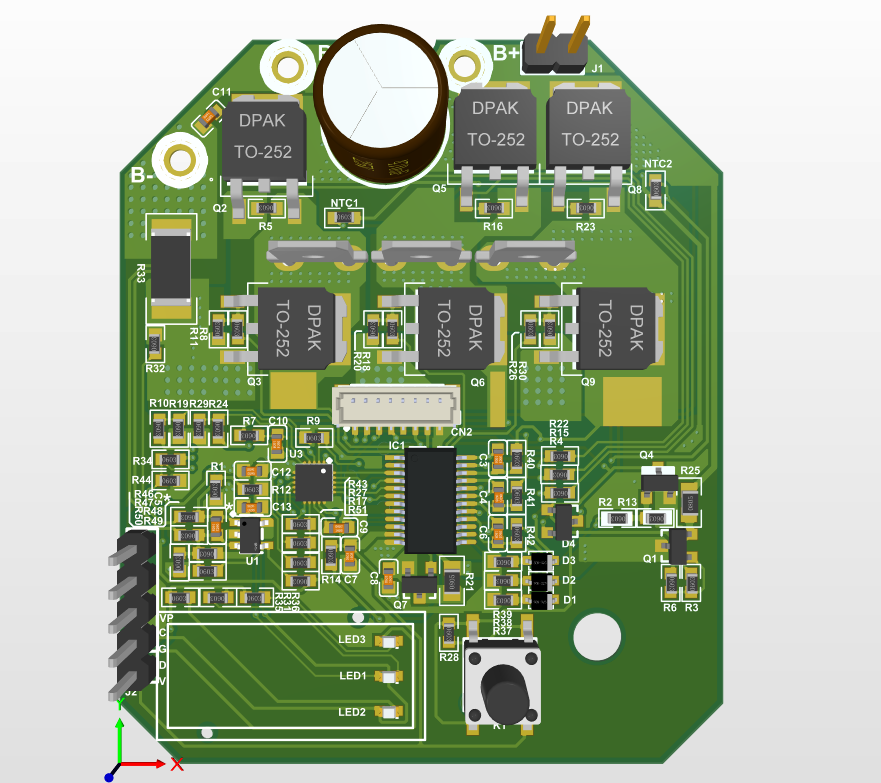
Qili Tianxia has developed a highly integrated brushless drive solution for power tools that addresses these industry pain points. With the KY32DS024 high‑performance 32‑bit MCU as the control core, it integrates the MCU and gate driver into a single chip, greatly simplifying the hardware circuit and effectively reducing PCB footprint, while also supporting multiple voltage platforms. It is widely applicable to electric drills, impact wrenches, angle grinders, garden tools, as well as high‑speed motor applications such as vacuum cleaners and ceiling fans, providing manufacturers with a lightweight, easy‑to‑develop, and easy‑to‑mass‑produce one‑stop drive solution.
I. Industry Pain Points: Traditional Discrete Solutions Have Complex Circuits, Large PCB Footprints, and High R&D Costs
Most general‑purpose brushless drive solutions on the market adopt a combination architecture of MCU + discrete driver + discrete analogue components. In actual development, these solutions suffer from three major drawbacks:
-
High component count: They require additional op‑amps, voltage comparators, sampling modules, gate‑driver chips, and many other components, leading to numerous circuit nodes and higher failure risks.
-
Cumbersome PCB layout: The routing of power loops and signal loops is complex, occupying a large amount of board space, making it difficult to meet the compact structural requirements of handheld power tools.
-
Poor platform compatibility: A single solution supports only a fixed voltage level; switching between low‑voltage lithium‑ion tools and high‑voltage industrial equipment requires a complete redesign, resulting in long development cycles and high costs.
To solve these challenges, the key is to adopt a highly integrated, all‑in‑one drive solution that reduces peripheral components at the chip level, simplifying the circuit and optimising PCB area.
II. Core Breakthrough: MCU + Gate Driver Integration Simplifies the Circuit at the Root
The core competitiveness of Qili Tianxia's brushless drive solution lies in its highly integrated single‑chip platform design. Using the KY32DS024 as the control hub, it integrates motor control and drive functions to a high degree, completely overturning traditional discrete architectures:
-
Integrated control and drive: The 32‑bit high‑performance MCU and gate driver are integrated into a single device, eliminating the need for separate driver chips and interface circuits. The hardware architecture is more streamlined, signal transmission delay is reduced, and system stability is significantly improved.
-
Built‑in full‑featured analogue peripherals: The KY32DS024 integrates a 12‑bit 1‑Msps high‑speed ADC, two programmable gain amplifiers (PGAs), and two analogue comparators. It supports single‑resistor or dual‑resistor high‑precision current sensing, eliminating the need for external analogue conditioning circuits and enabling direct, accurate acquisition and processing of motor current and voltage signals.
-
Native motor‑dedicated drive interfaces: The chip features a 16‑bit enhanced PWM (EPWM) module with three‑channel, six‑way complementary outputs, built‑in dead‑time control, hardware emergency stop, and synchronous triggering. It can directly drive three‑phase brushless motors without additional PWM shaping or protection circuits.
Through single‑chip high‑integration, the total number of peripheral components is reduced by over 60 %, circuit design complexity is greatly decreased, and the R&D and debugging cycle is significantly shortened.
III. Area Optimisation: High Integration Enables PCB Miniaturisation, Saving Space and Improving Structural Adaptability
The most tangible benefit of high‑integration design is the substantial reduction in PCB footprint, perfectly matching the compact structural requirements of power tools:
-
Simpler routing: Power loops and signal loops are shorter, with lower EMI, eliminating the need for complex shielding and isolation designs.
-
Smaller board area: Compared with traditional discrete solutions, PCB area can be reduced by 30‑50 %, easily fitting into compact housings of handheld drills, lithium‑ion impact wrenches, angle grinders, and the like.
-
Simpler manufacturing: Fewer component placements improve SMT efficiency and lower defect rates, further enhancing mass‑production capability.
At the same time, the solution supports multiple gate‑drive voltage levels – 45 V, 250 V, and 600 V – covering both low‑voltage lithium‑ion power tools and high‑voltage industrial equipment. A single hardware platform can adapt to all voltage levels without the need for repeated development, further reducing R&D and material costs for manufacturers.
IV. Integration Without Compromise: High Performance and High Reliability Are Guaranteed
Qili Tianxia's highly integrated drive solution, while simplifying the circuit and reducing PCB area, fully retains the high performance and high reliability required by power tools:
-
Strong computing power: The KY32DS024 is built on an ARM Cortex‑M0 core with a maximum frequency of 48 MHz, equipped with a single‑cycle hardware multiplier. It can stably run a deeply optimised sensorless FOC vector control algorithm, achieving power conversion efficiency of up to 92 %, meeting the heavy‑load, high‑torque output requirements of power tools.
-
Industrial‑grade stable operation: The chip supports a wide voltage range of 2.5‑5.5 V and an operating temperature range of ‑40 °C to +105 °C, with stop‑mode power consumption as low as 1 μA, making it suitable for various harsh working conditions. The solution features six layers of protection – overcurrent, overvoltage, undervoltage, overtemperature, stall, and hardware emergency stop – with millisecond‑level response, ensuring reliable long‑term operation without frequency drop or system crashes.
-
Mass‑production ready: The solution supports batch automated parameter calibration, with each production line unit requiring only 30 seconds for tuning. The hardware design includes sufficient power margin to accommodate component batch variations, and the mass‑production yield consistently reaches 99.5 %. Prototype development can be completed in just 7 days, enabling rapid product roll‑out across multiple models.
V. Full‑Scenario Coverage: One Solution Covers Power Tools and Consumer Motor Categories
Leveraging its advantages of high integration, miniaturisation, and wide compatibility, Qili Tianxia's brushless drive solution breaks through single‑category limitations to achieve full‑scenario high‑speed motor drive coverage:
-
Power tools: Electric drills, lithium‑ion impact wrenches, angle grinders, garden tools, and other heavy‑duty, high‑frequency equipment.
-
Cleaning appliances: 130,000‑rpm brushless vacuum cleaners, floor washers, car vacuum cleaners, and other high‑speed devices.
-
Home appliances: Quiet, high‑efficiency single‑motor applications such as ceiling fans.
The same highly integrated solution can be adapted to different products with only minor parameter adjustments, truly enabling one‑time development and reuse across multiple categories.
Conclusion: High Integration = Simplified Circuits + PCB Space Savings + Cost Reduction + Faster Mass Production
For power tool manufacturers, high integration is already an inevitable trend in brushless drive solutions. Qili Tianxia's brushless drive solution, with the KY32DS024 high‑performance MCU at its core, achieves substantial circuit simplification and significant PCB area reduction through integrated design, while also supporting multiple voltage platforms, full‑scenario adaptability, and mass‑production stability. Choosing this highly integrated drive solution not only reduces R&D difficulty and saves structural space but also controls BOM costs and improves production efficiency – helping manufacturers quickly develop lightweight, high‑performance, cost‑effective brushless power tool products and seize a competitive edge in the market.
About Maxipcb
Maxipcb empowers innovators to turn cutting-edge technologies into reality.We offer one-stop solutions for design, simulation, testing, PCB manufacturing, component procurement and SMT assembly, enabling efficient development, rapid deployment and risk control across the full product lifecycle.
Serving the world in communications, industrial automation, aerospace, automotive, semiconductor and beyond, we build a safer, more connected future together.
