You may have noticed that there are some differences between our power supply boards and ordinary PCBs. For example, on switching power supply boards, there are slots in some areas of the board. What is the function of these slots?
You may have noticed that there are some differences between our power supply boards and ordinary PCBs. For example, on switching power supply boards, there are slots in some areas of the board. What is the function of these slots?
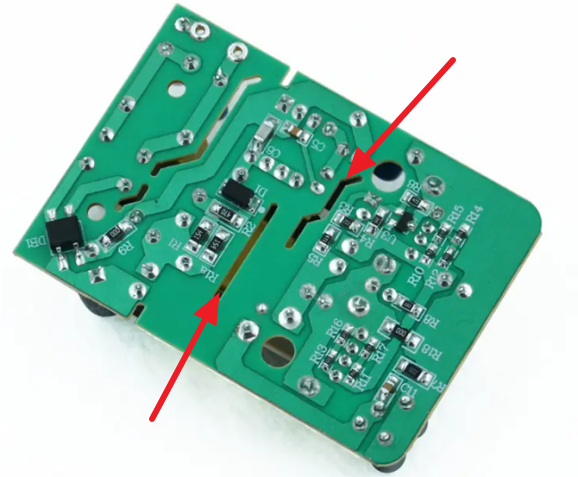
To understand the reason, we first need to learn a key concept: creepage distance. It refers to the shortest distance measured along the surface of the insulation between two conductive parts, or between a conductive part and the protective interface of the equipment. Under different application conditions, the insulating material around the conductor is polarized, causing the insulating material to present a charged phenomenon, and the radius of this charged area is the creepage distance. In other words, it is the shortest spatial distance measured along the surface of the insulating material between two conductive parts, or between a conductive part and the accessible surface of the equipment. The distance of discharge along the insulation surface, i.e., the leakage distance, is also called the creepage distance, or creepage for short.
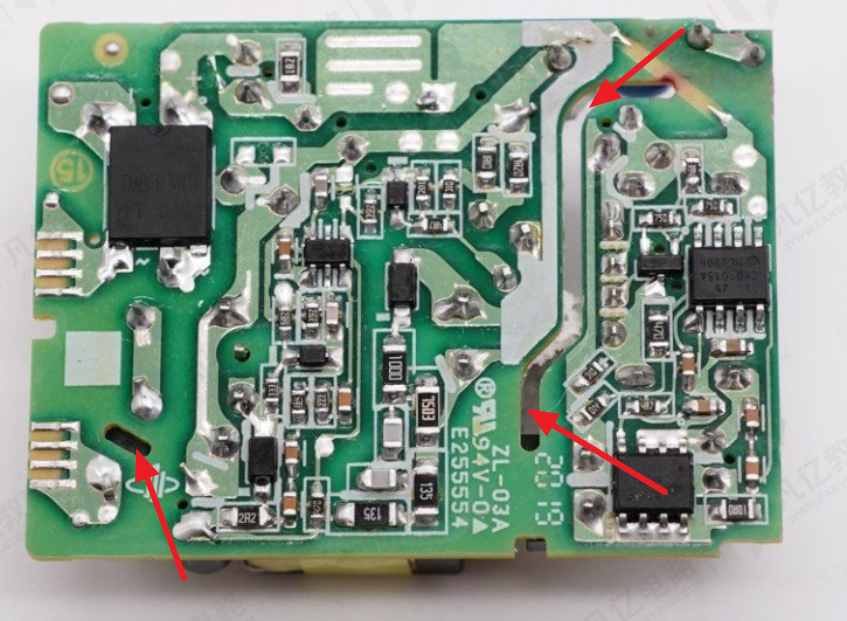
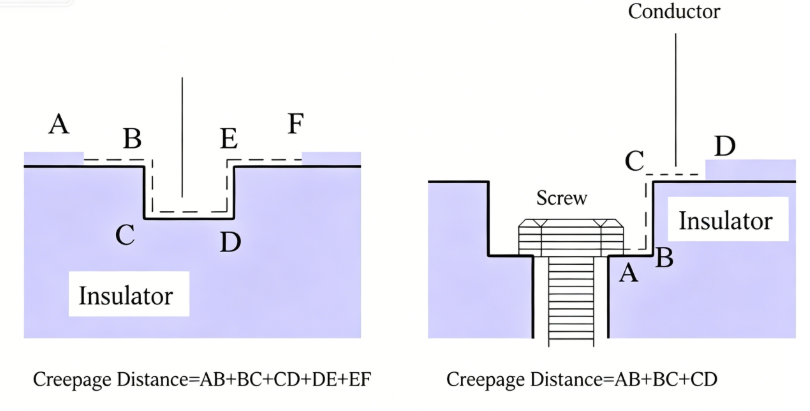
Creepage distance = surface distance / system maximum voltage, which varies according to the pollution degree. To put it simply, the creepage distance can be regarded as the shortest path that an ant must travel from one charged body to another. In contrast, the electrical clearance is the shortest distance that a winged ant can fly through the air.
When there are high-voltage components and low-voltage components on our PCB, we must isolate these two parts. First of all, copper pouring is prohibited on all layers in the high-voltage area. There must be a clear dividing line between the high-voltage and low-voltage parts, and the minimum creepage distance must be maintained between the high-voltage and low-voltage sides. In our design, there are some areas where this creepage distance cannot be met, so we need to find other solutions. Slot cutting is the most commonly used and practical method. We cut off the PCB material in this area where the distance is too small to achieve the isolation effect. This is the reason why there are slots on many power supply boards.
As we have learned earlier, the creepage distance is related to the voltage: the higher the voltage, the larger the required creepage distance. It is also related to the operating voltage, pollution degree, insulation class, and materials.
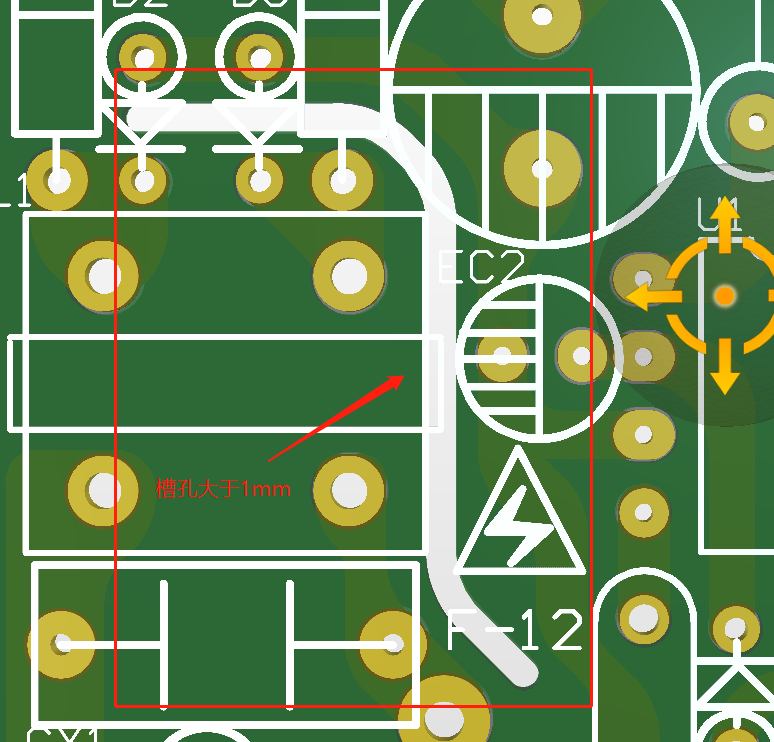
If space permits, we should make this distance larger to reduce the risk. It should also be noted that the width of the slot generally needs to be greater than 1mm.
 About Maxipcb
Maxipcb empowers innovators to turn cutting-edge technologies into reality.
We offer one-stop solutions for design, simulation, testing, PCB manufacturing, component procurement and SMT assembly, enabling efficient development, rapid deployment and risk control across the full product lifecycle.Serving the world in communications, industrial automation, aerospace, automotive, semiconductor and beyond, we build a safer, more connected future together.

