Differential Signal is a very common transmission method at present, which is widely seen on PCB boards.
Concept of Differential Signals
Differential Signal is a very common transmission method at present, which is widely seen on PCB boards.
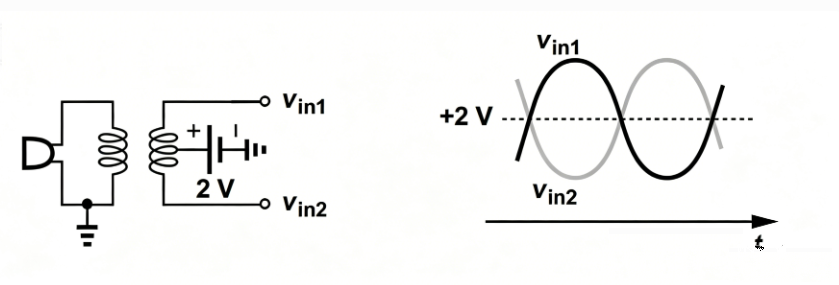
It uses two transmission lines to transmit two signals with equal amplitude variation and opposite phase, and the two signals usually also have an equal DC level.
Compared with single-ended signals, differential signals can greatly improve the anti-interference capability during signal transmission. This is because environmental noise or interference signals will affect both differential signals at the same time, and the receiving end responds to the difference between the two signals, which has a suppression effect on common-mode noise, so these noises or interferences will be cancelled out at the receiving end, as shown in the figure below.
Advantages and Disadvantages of Differential Signals
Advantages of Differential Signals
(1)
Strong anti-interference capability
As mentioned above, common-mode noise or interference signals are applied to both signal lines simultaneously, resulting in a difference value of zero. The receiving end of the differential system only responds to the difference between the two signals, so the noise will not affect the differential signals.
(2)
Reduced interference to the outside world
Because the two differential lines are very close to each other, with equal signal amplitude and opposite phase, the electromagnetic fields generated by them will partially cancel each other out, reducing the interference to the external environment.
(3)
Accurate timing positioning
Differential signals use the point where the difference between the amplitudes of the two signals undergoes positive and negative jumps as the judgment basis, while single-ended signals use the threshold voltage as the judgment basis. Therefore, differential signals are suitable for low-amplitude transmission.
For example, the commonly used differential interface signal LVDS (Low-Voltage Differential Signaling) has a signal amplitude range of 250mV~400mV, while the commonly used LVCMOS (Low-Voltage Complementary Metal-Oxide-Semiconductor) interface signal generally has an amplitude of 1.8V or 3.3V.
Disadvantages of Differential Signals
(1) Compared with single-ended signals, differential signals require an additional trace, which increases the PCB area.
(2) During routing, there are high requirements for the symmetry of the two lines; otherwise, the noise suppression effect will be reduced.
(3) Testing is more complicated than that of single-ended signals.
Implementation of Differential Signals
So how to convert a single-ended signal into a differential signal? The simplest method is to use a transformer, as shown in the figure below. This is also a circuit topology often used in the front end of ADCs (Analog-to-Digital Converters).
About Maxipcb
Maxipcb empowers innovators to turn cutting-edge technologies into reality.
We offer one-stop solutions for design, simulation, testing, PCB manufacturing, component procurement and SMT assembly, enabling efficient development, rapid deployment and risk control across the full product lifecycle.Serving the world in communications, industrial automation, aerospace, automotive, semiconductor and beyond, we build a safer, more connected future together.


