ZuoSi Automotive Research disassembled a cockpit domain controller based on the 8295 chip for an electric sedan launched in December 2023, and released a report titled Analysis and Disassembly of SA8295P Series Cockpit Domain Controllers. The official name of this cockpit domain controller is "Digital Cockpit Head Unit (DHU)". It comes in two versions, high and low, both adopting the Qualcomm SA8295P chip and supplied by Aptiv.
Description
ZuoSi Automotive Research disassembled a cockpit domain controller based on the 8295 chip for an electric sedan launched in December 2023, and released a report titled Analysis and Disassembly of SA8295P Series Cockpit Domain Controllers. The official name of this cockpit domain controller is "Digital Cockpit Head Unit (DHU)". It comes in two versions, high and low, both adopting the Qualcomm SA8295P chip and supplied by Aptiv. From the perspective of cost disassembly, the total cost of the two versions differs by dozens of US dollars.
ZuoSi Automotive Research disassembled the low-end version for this study. This article will conduct a general disassembly and analysis of the basic overview, main control chip, storage, MCU and radio section of this DHU.
Basic Overview
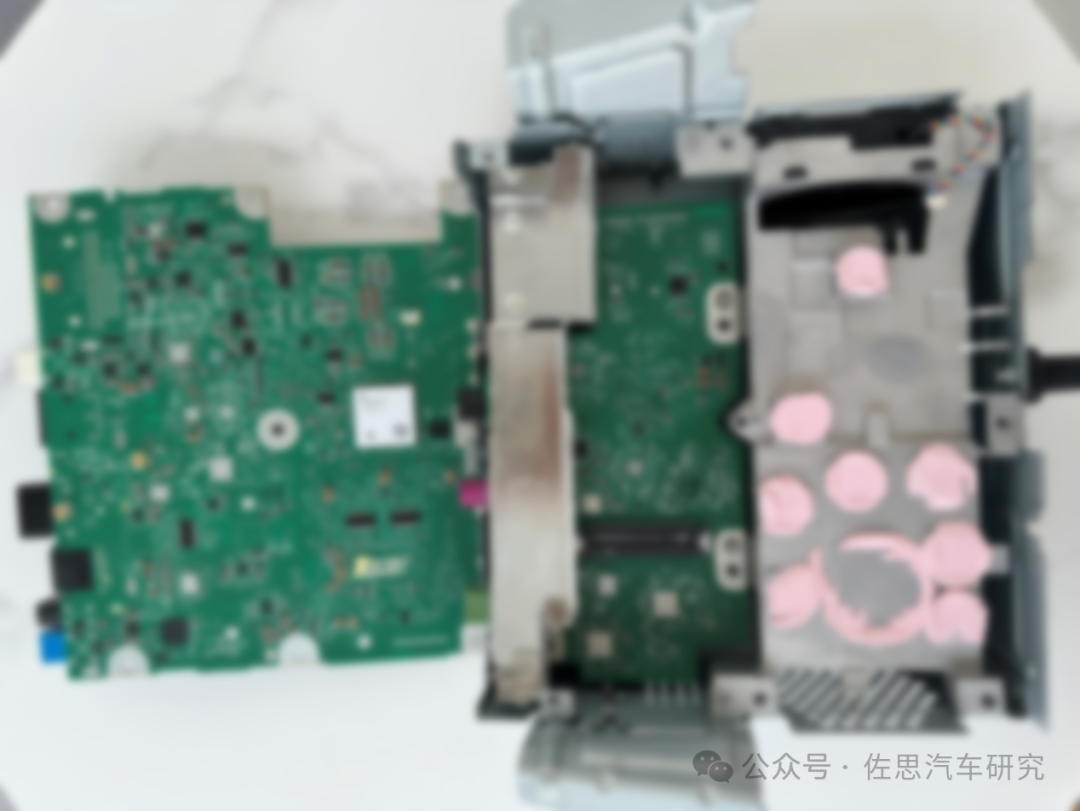
In terms of appearance, the DHU is relatively thick, and three black rectangular blocks can be seen, corresponding to a Bluetooth and WiFi system, a pure Bluetooth system and a radio system respectively.
The reason for its thick form factor is that the DHU adopts a two-layer PCB board design connected by B2B connectors. The upper board is responsible for functions related to cockpit entertainment and instrument panels, while the lower board is responsible for providing camera input, display output, microphone audio reception and other functions.
Source: ZuoSi Automotive Research
Official Account: ZuoSi Automotive Research
Main Control Chip and Storage
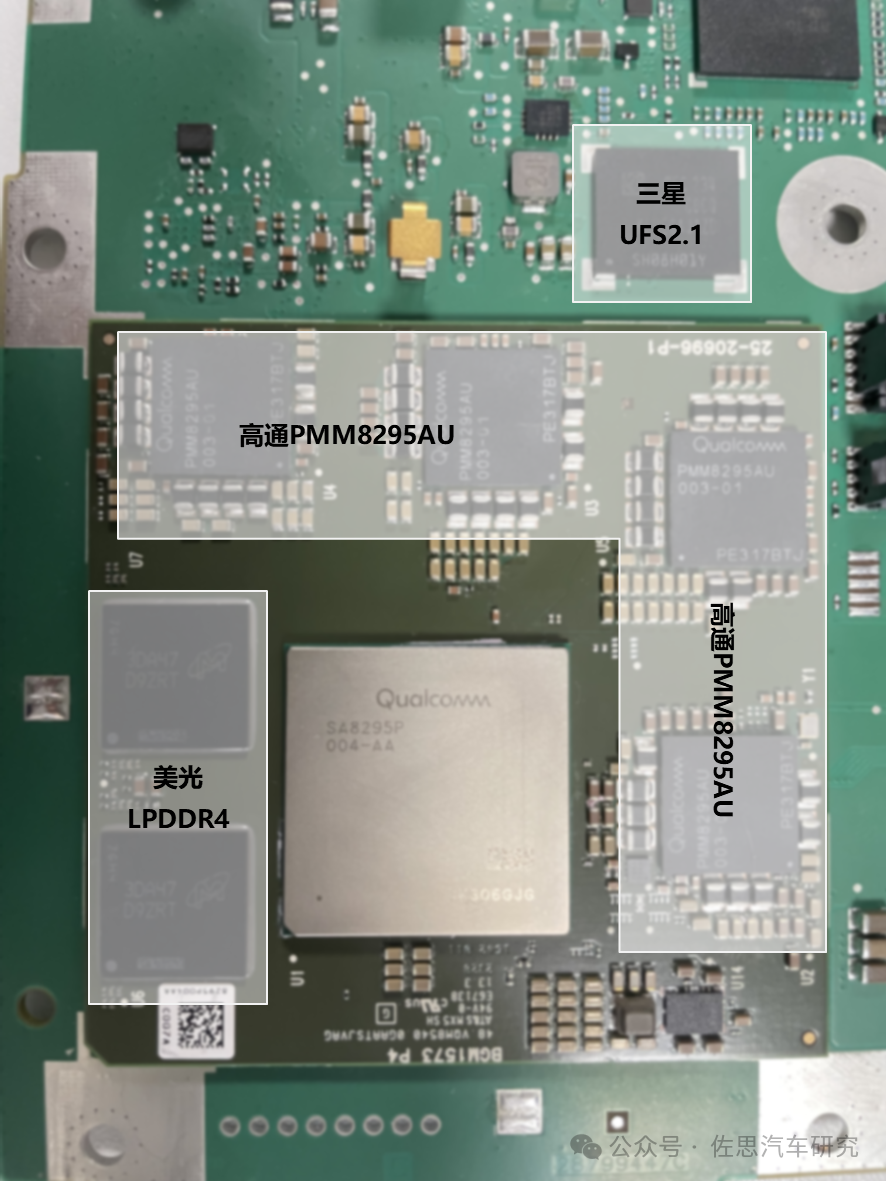
The core onboard board is mounted on the upper board, equipped with the QAM8295P and 6 main chips, including 4 Qualcomm PMM8295AU power management chips and 2 DRAM chips.
Source: ZuoSi Automotive Research
Official Account: ZuoSi Automotive Research
In terms of storage, the DHU is equipped with DRAM chips and NAND chips.
The DRAM chips are Micron LPDDR4 with an FBGA Code of D9ZRT and a clock frequency of 2133MHz, which is the lowest specification and also the most cost-effective automotive-grade LPDDR4. The high-end version, on the other hand, is configured with 32GB of memory on the core board, which may be LPDDR4X.
The NAND storage adopts Samsung's UFS2.1 solution with the model KLUEGAJ1ZD-B0CP, a product common to mobile phones and automobiles. It has a voltage of 1.8/3.3V, a temperature resistance range of -40℃~85℃ and a capacity of 256GB. This chip is arranged outside the core board.
MCU
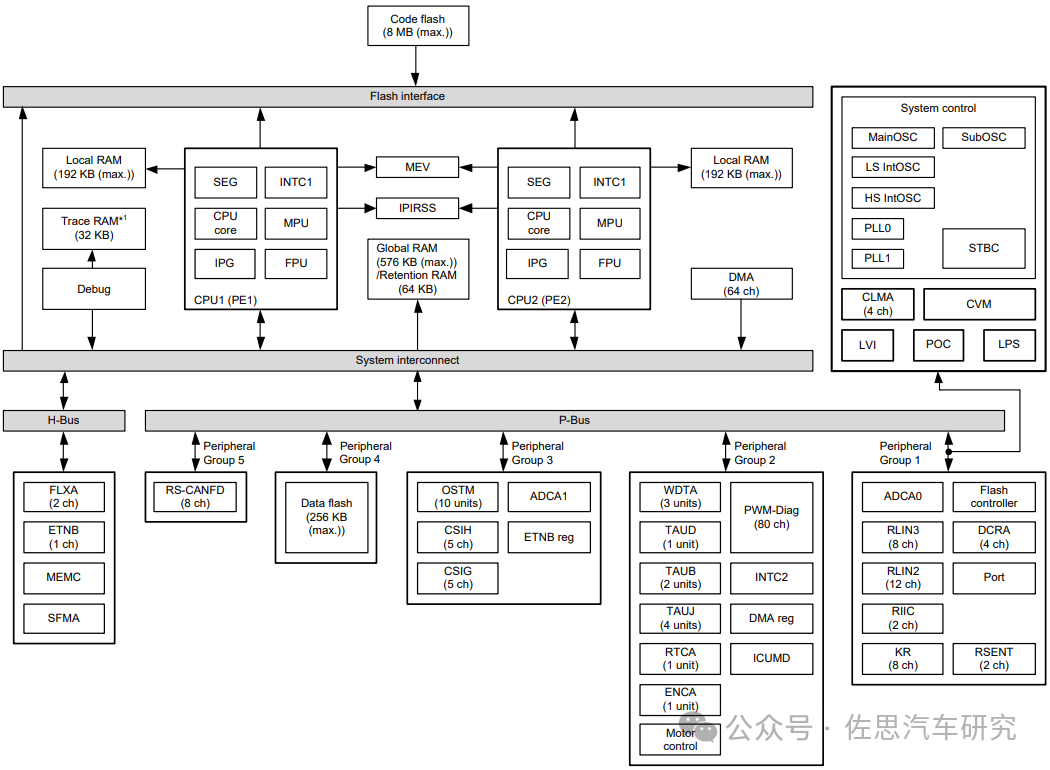
The MCU of the disassembled DHU version is Renesas R7F7017113, belonging to the Renesas RH850/F1KH series, with 233 pins and a temperature resistance range of -40℃~105℃. The high-end DHU version uses Infineon's TC387 as its MCU.
Source: Renesas
Official Account: ZuoSi Automotive Research
Ethernet
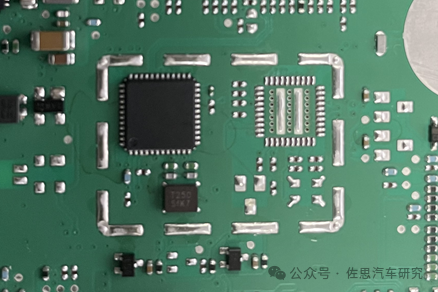
There are configuration differences between the high-end and low-end versions in terms of Ethernet. Specifically, the high-end version is equipped with an Ethernet switch, while the low-end version only has one Ethernet physical layer chip. The PCB boards of the two versions are identical, except that the low-end version has empty positions left on the surface of the Ethernet area without chip mounting.
Source: ZuoSi Automotive Research
Official Account: ZuoSi Automotive Research
Disassembly shows that the Ethernet physical layer chip is Marvell 88Q2122, a 100/1000BASE-T1 Ethernet physical layer transceiver (PHY) defined based on IEEE 802.3bw and IEEE 802.3bp, realizing signal transmission over a single pair of twisted pairs. Adopting a standard digital CMOS process and integrating all required active circuits inside, it achieves simultaneous data reception and transmission over a single pair of twisted pairs, which is well suited for a variety of in-vehicle applications. The 88Q2122 integrates the termination matching resistors required for the Media Dependent Interface (MDI) inside, thus simplifying the motherboard layout and reducing the motherboard cost by reducing the number of external components. Its internally integrated linear regulator can generate all required voltages, and only a single 3.3V power supply is needed externally for operation. Both solutions support 1.8V, 2.5V and 3.3V LVCMOS I/O standards.
Radio
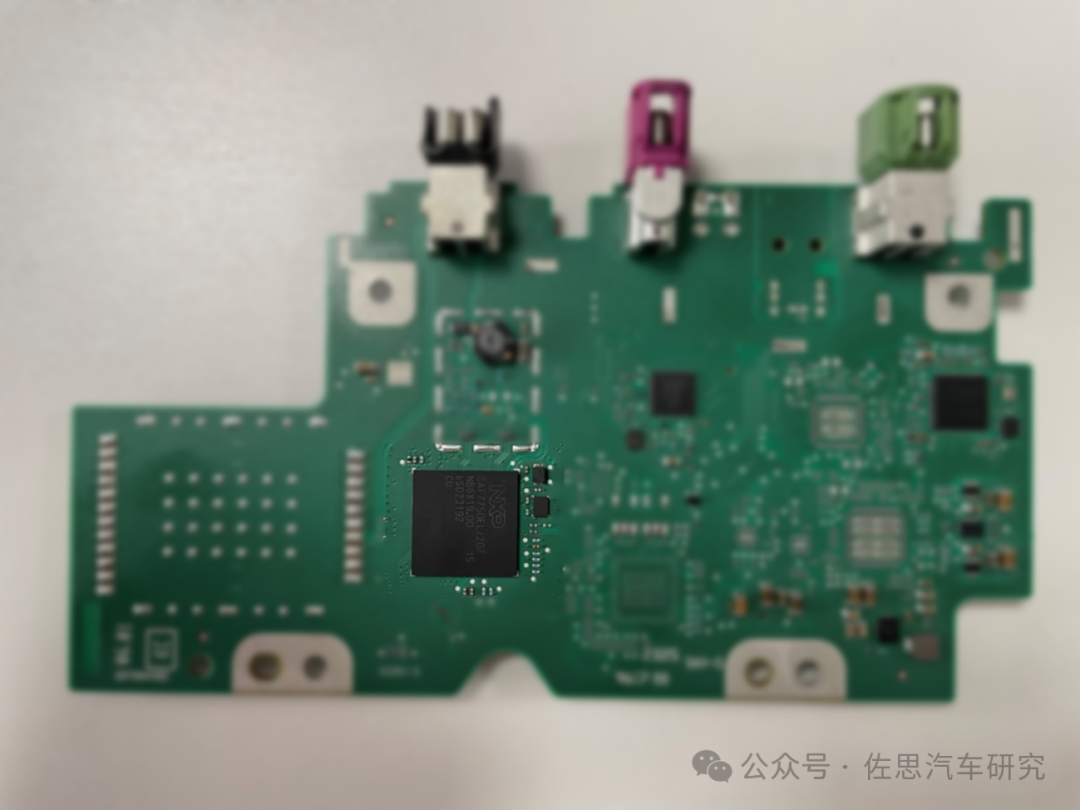
Radio chips are mainly arranged on the lower PCB board, and many reserved chip positions can be seen, mainly for export purposes.
The radio chip of this domain controller adopts NXP SAF7750EL, which is compatible with AM/FM in most countries around the world. However, if DAB radio is required, TEF3100 or TEF3200 needs to be added. The main radio chip for the overseas version is generally SAF4000. Launched by NXP in 2017, SAF4000 is a fully integrated software-defined radio solution that is compatible with all global broadcast audio standards including AM/FM, DAB+, DRM(+) and HD.
 About Maxipcb
Maxipcb empowers innovators to turn cutting-edge technologies into reality.
We offer one-stop solutions for design, simulation, testing, PCB manufacturing, component procurement and SMT assembly, enabling efficient development, rapid deployment and risk control across the full product lifecycle.Serving the world in communications, industrial automation, aerospace, automotive, semiconductor and beyond, we build a safer, more connected future together.

 Source: ZuoSi Automotive Research
Official Account: ZuoSi Automotive Research
Source: ZuoSi Automotive Research
Official Account: ZuoSi Automotive Research Source: ZuoSi Automotive Research
Official Account: ZuoSi Automotive Research
Source: ZuoSi Automotive Research
Official Account: ZuoSi Automotive Research Source: Renesas
Official Account: ZuoSi Automotive Research
Source: Renesas
Official Account: ZuoSi Automotive Research Source: ZuoSi Automotive Research
Official Account: ZuoSi Automotive Research
Source: ZuoSi Automotive Research
Official Account: ZuoSi Automotive Research