In PCB design, there are many aspects that need to consider safety clearance, which can be roughly divided into two categories: electrical safety clearance and non-electrical safety clearance.
In PCB design, there are many aspects that need to consider safety clearance, which can be roughly divided into two categories: electrical safety clearance and non-electrical safety clearance.
1. Electrical Safety Clearance
1.1 Spacing Between Conductors
Based on the processing capacity of mainstream PCB manufacturers, the spacing between conductors (conductor-to-conductor, conductor-to-pad) shall not be less than
4mil.
From a production perspective, the larger the spacing, the better under feasible conditions; the commonly used value is
10mil.
1.2 Pad Aperture and Pad Width
- Mechanical drilling: pad aperture shall not be less than 0.2mm
- Laser drilling: pad aperture shall not be less than 4mil
Aperture tolerance varies slightly with different board materials, generally controlled within 0.05mm.
Pad width shall not be less than 0.2mm.
1.3 Spacing Between Pads
Based on the processing capacity of mainstream PCB manufacturers, the spacing between pads shall not be less than 0.2mm.
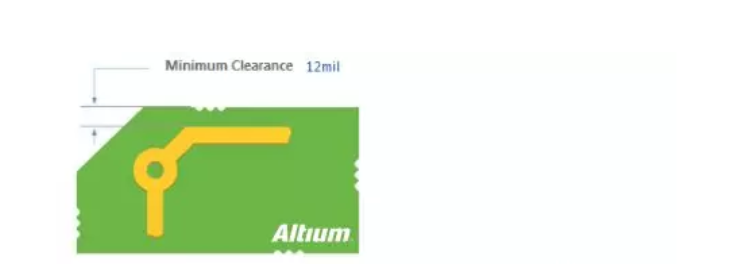
1.4 Spacing Between Copper and Board Edge
The spacing between live copper and the PCB board edge shall be no less than
0.3mm.
[Illustration position: Diagram of copper-to-board-edge clearance setting]
This rule can be set in the
Design-Rules-Board outline page.
For large-area copper pouring, it is usually necessary to set an inward offset from the board edge, generally set to
20mil.
In PCB design and manufacturing, to avoid edge curling, electrical short circuits or for mechanical integrity of the finished board, engineers often recess large copper pours by
20mil from the board edge instead of extending copper to the edge.
Common methods include drawing a keep-out layer at the board edge and setting the clearance between copper pour and keep-out; a simple way is to set a separate safety clearance for copper pour (e.g., 20mil for copper pour while the whole-board clearance is 10mil), which achieves the 20mil recess and removes dead copper inside components.
2. Non-Electrical Safety Clearance
2.1 Character Width, Height and Spacing
No modifications are allowed during text film processing; all character line widths smaller than 0.22mm (8.66mil) will be thickened to 0.22mm.
- Character line width L = 0.22mm (8.66mil)
- Total character width W = 1.0mm
- Total character height H = 1.2mm
- Spacing between characters D = 0.2mm
Text smaller than these standards will appear blurred after processing and printing.
2.2 Spacing Between Vias (Edge-to-Edge)
Via-to-via spacing (edge-to-edge) shall be greater than 8mil.
2.3 Spacing Between Silkscreen and Pads
Silkscreen is
not allowed to cover pads.
Covered pads will fail to solder properly during assembly.
Board factories generally require a reserved spacing of
8mil;
4mil is barely acceptable for space-constrained boards.
If silkscreen accidentally covers pads during design, the factory will automatically erase the overlapping part to ensure solderability.
Special case: silkscreen can be intentionally placed close to pads when pads are very dense, to prevent solder bridging during soldering.
2.4 3D Height and Horizontal Clearance for Mechanical Structures
|
Arc Track |
SMD Pad |
TH Pad |
Via |
Fill |
Poly |
| Outline Edge |
12 |
12 |
12 |
12 |
12 |
12 |
| Cavity Edge |
12 |
12 |
12 |
12 |
12 |
12 |
| Cutout Edge |
12 |
12 |
12 |
12 |
12 |
12 |
| Split Barrier |
12 |
12 |
12 |
12 |
12 |
12 |
| Split Continuation |
12 |
12 |
12 |
12 |
12 |
12 |
During component mounting, conflicts in horizontal direction and 3D height with other mechanical structures must be avoided.
Adequate safety clearance shall be reserved between components, between PCB and product enclosure, and in spatial structure to ensure no interference.
About Maxipcb
Maxipcb empowers innovators to turn cutting-edge technologies into reality.
We offer one-stop solutions for design, simulation, testing, PCB manufacturing, component procurement and SMT assembly, enabling efficient development, rapid deployment and risk control across the full product lifecycle.Serving the world in communications, industrial automation, aerospace, automotive, semiconductor and beyond, we build a safer, more connected future together.

