In SMT, red glue process and solder paste process are two commonly used welding methods. Although their purpose is to fix electronic components on PCB, there are obvious differences between the two processes in materials, equipment, operation flow and product application. Today, let's introduce in detail the "red glue" process that we often hear but are not commonly used.
"In SMT, red glue process and solder paste process are two commonly used welding methods. Although their purpose is to fix electronic components on PCB, there are obvious differences between the two processes in materials, equipment, operation flow and product application. Today, let's introduce in detail the "red glue" process that we often hear but are not commonly used. "
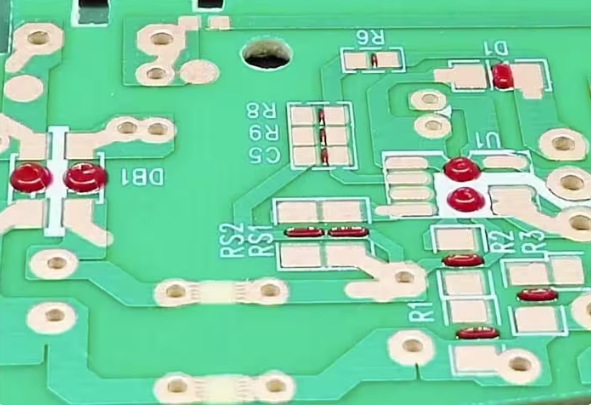 Adhesive layer in KiCad
There are two layers in KiCad PCB that are not common in other EDA tools: F.Adhesive and B.Adhesive:
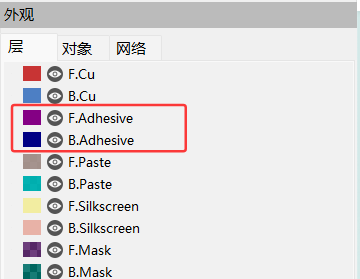
Small partners often ask what are the functions of these two layers? It seems that it is rarely used in PCB and package design.
We can call these two layers glue layer or dispensing layer. Their function is a bit similar to that of Paste flux layer: the flux layer has nothing to do with the entity of PCB, and is used to make steel mesh, so the pads of SMD devices will all appear on the flux layer, and these positions will be painted with solder paste.
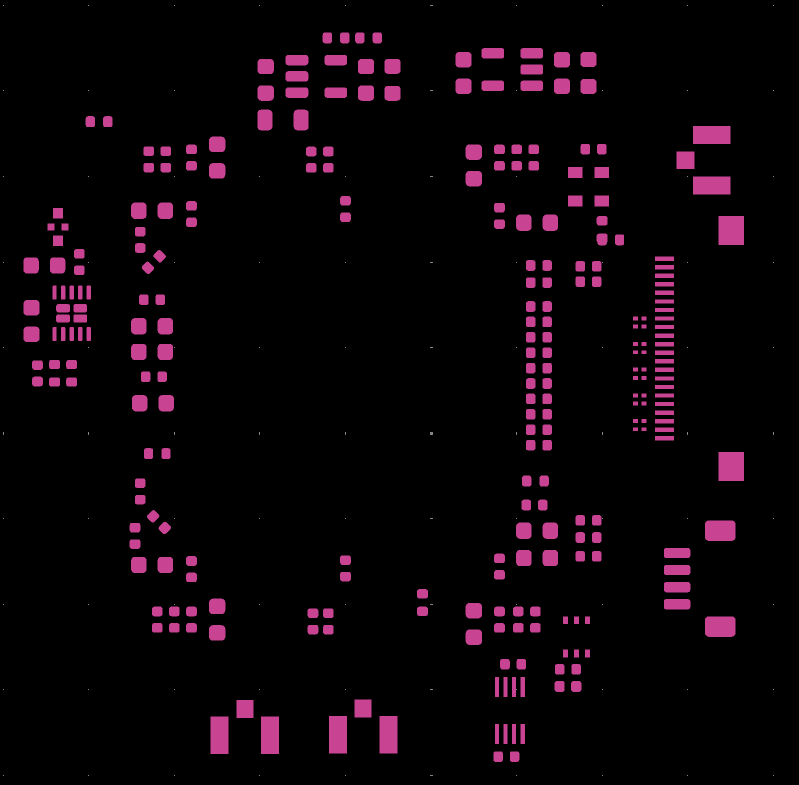
The glue-dispensing layer has a similar function, but it is used to indicate the position where red glue is needed. Compared with solder paste technology, dispensing technology is not commonly used and only related to SMT manufacturing, so many electronic engineers are not clear about the details of dispensing technology.
Definition of red glue processRed glue process refers to applying red glue (usually epoxy glue) to the designated position on PCB designed for SMD mounting in SMT production. Used to temporarily fix surface mount components (SMD) to prevent them from falling off or shifting in the subsequent welding process.
SMT red glue technology uses the thermal curing characteristics of red glue, fills red glue between two pads through a printing machine or a glue dispenser, and then completes curing welding through pasting and reflow soldering. Finally, through wave soldering, the soldering process can be completed only by passing the surface mounting surface over the wave crest without using a fixture.
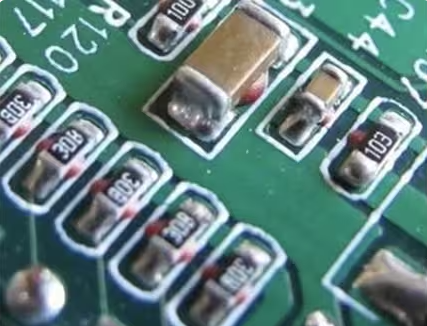
Different from the solder paste that connects components and PCB pads by melting and solidification, the core mission of red glue is to "fix" and ensure that components can still stay in their preset positions when undergoing "tests" such as high temperature and vibration.
Common application scenarios1) Both sides of PCBA have large-size or heavy SMD components.This is the most common situation in actual production. This kind of circuit board needs to be reflowed twice (once for the top surface and once for the bottom surface). During the second reflow soldering, the solder paste on the first soldered side will melt again. Because this side is downward, larger or heavier components may fall off, float or shift from the pad due to their own weight, resulting in welding defects.
Solution: Apply red glue to the sides of these components, as shown in the figure below. With the red glue, during the second reflow soldering, the components are fixed in advance and will not fall off or shift because of the remelting of the solder paste.
Common component types: large-size SMD capacitor/inductor/crystal oscillator/transformer /SMD socket, and other heavy SMD components.
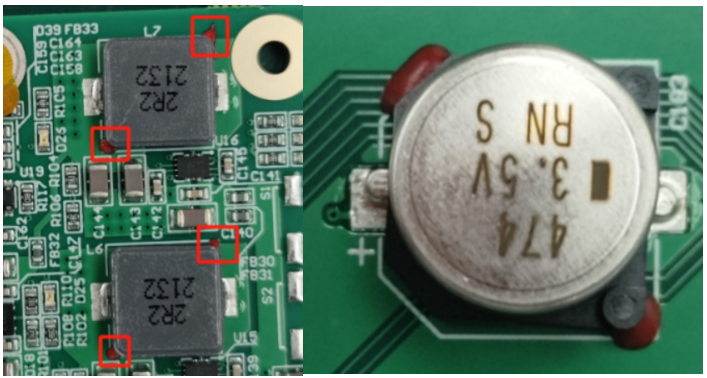 2) Products with high requirements for vibration or impact resistance.
If PCBA is subjected to severe vibration or impact during assembly or use, it may be required to use red glue for some components to enhance mechanical fixation and prevent loosening during use.
For example, in our previous PCBA project, the customer used ultrasonic welding to assemble the shell, which would produce certain vibration and impact. As a result, a fuse on PCBA became loose, so the customer asked to use red glue for the fuse in the production process to increase its fixation firmness.
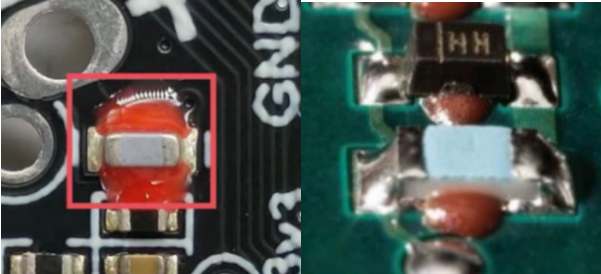 3) Products with poor flatness of 3)PCB or components.
If the bottom of PCB or component is uneven, the component may shift or float during reflow soldering. Pre-fixing components with red glue is helpful to improve welding yield.
For example, we once had a product in which the flatness of one inductor was not very good. In the process of reflow soldering, solder paste would flow under the component, and when the solder solidified, the component would be jacked up, resulting in the defect of floating high and virtual soldering. Applying red glue on both sides of the component can fix it in advance, thus improving the yield.
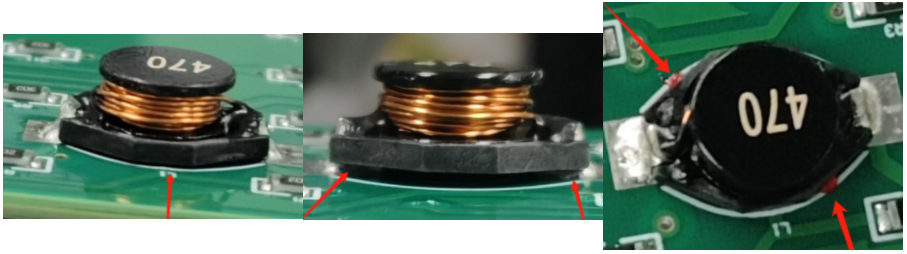
The above are several common scenes of using red glue in actual production. Of course, there are other situations that may also use the red glue process, so I won't list them here.
Application method of red glue processFor small batch orders, manual dispensing is usually selected.
For large orders, the glue scraping process or automatic dispensing machine is used, which helps to control the consistency of glue.
There are two main processes to apply red glue to PCB accurately:
- Scraping (printing) process: similar to printing solder paste, a special steel mesh is used with holes in the corresponding position. Press the red glue through the steel mesh with a scraper, so that it can be printed on the designated position of PCB accurately. This method is fast and efficient, and is suitable for mass production.
- Glue dispensing process: automatic dispensing machine is used to "dot" the red glue from the tiny needle mouth to the PCB through air pressure control. The shape, size and quantity of dispensing can be flexibly controlled by programs, which is very suitable for circuit boards with various or irregular components.
After the coating is completed, the components are attached by the mounter, and the viscosity of the red glue will initially fix the components. Subsequently, the PCB board enters a curing furnace (usually a reflow furnace). At a high temperature of about 150℃, the red glue will undergo an irreversible chemical reaction, changing from paste to solid, thus achieving permanent and firm bonding.
Red glue process VS solder paste processThe division of labor between red glue and solder paste is different. The following is a simple comparison:
| Characteristic |
Red Glue |
Solder Paste |
| Main ingredients |
epoxy resin, curing agent, filler, etc |
Tin alloy powder, flux, etc |
| Core function |
Physical fixation to prevent components from falling off. |
Electrical connection and mechanical fixation |
| Electrical conductivity |
Non-conductive (insulated) |
conduct electricity |
| conduct electricity |
High temperature irreversible curing |
Melting at high temperature and solidification after cooling (reversible) |
When the dispensing process is adopted, red glue will easily become the bottleneck of the whole SMT chip processing production line when there are many points.
Which is more economical, red glue process or manufacturing fixture?Since the main purpose of red glue process is to fix devices, can it be replaced by "fixture"? The fixture can hold or hold down those components that may fall by physical means, which can have a similar effect. First of all, it is clear that both the use of red glue technology and the production of fixtures will increase costs. This is a very practical engineering problem, and the answer is not absolute, but depends on a core factor: production batch.
Simply put:
- Small batch, proofing stage: red glue process is more economical.
- Large-scale and long-term production: it is more economical to make fixtures.
The main cost of making fixture is NRE. When the product has been finalized, it is more appropriate to enter the stage of medium to large-scale production. On the other hand, if it is still in the early proofing or trial production stage, it is not cost-effective to use fixture because it may change frequently.
Concluding remarksIn the highly automated and refined PCBA world, although the red glue technology is only one of many process links, it has solved many problems in the double-sided mounting and mixing process with its unique "fixing" ability, and built a solid "red defense line" for the stability and reliability of electronic products.
Finally, two common SMT red glues are summarized:Q: When do you need to use red glue in SMT assembly?Answer: When there are heavy components on the double panel, and these components are prone to displacement during reflow soldering, red glue must be used.
Q: How does red glue increase the cost of SMT production?A: It will increase the cost of materials, the labor cost required for dispensing/curing, and extend the delivery cycle.
About Maxipcb
Maxipcb empowers innovators to turn cutting-edge technologies into reality.
We offer one-stop solutions for design, simulation, testing, PCB manufacturing, component procurement and SMT assembly, enabling efficient development, rapid deployment and risk control across the full product lifecycle.
Serving the world in communications, industrial automation, aerospace, automotive, semiconductor and beyond, we build a safer, more connected future together.

