Power PCB design is the key link to ensure the efficient and stable operation of electronic equipment.
Power PCB design is the key link to ensure the efficient and stable operation of electronic equipment. The following is a detailed arrangement of the design points of power PCB:
1. Thermal designPower devices will generate a lot of heat when working, so thermal management is the primary task of power PCB design.
Heat dissipation design: design appropriate heat dissipation structures, such as heat sinks and heat pipes, to improve the heat conduction efficiency.
Copper foil layout: increase the copper foil area of PCB to improve the thermal conductivity and reduce the resistance of copper foil.
Thermal isolation: A thermal isolation belt is set between the high-heat device and the sensitive element to reduce the thermal influence.
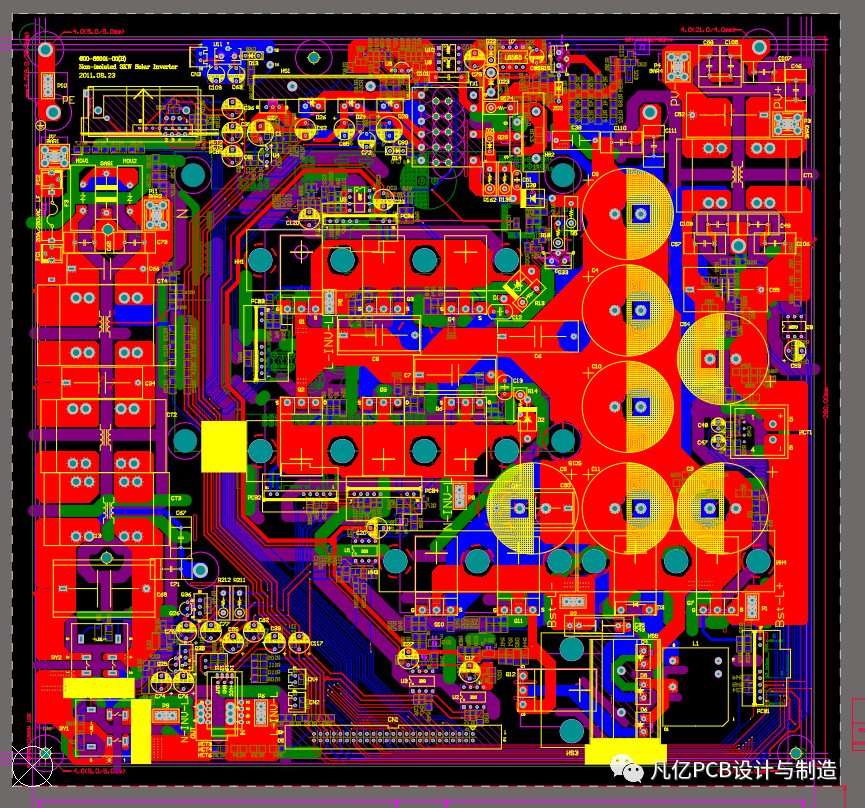 2. Power management
Power path: Optimize the power path and reduce the resistance and inductance on the power line to reduce the voltage drop and ripple.
Decoupling capacitor: Place an appropriate decoupling capacitor on the power line to filter out high-frequency noise.
Multi-power layer: In the design of multi-layer board, special power layer and stratum are used to improve the stability of power supply.
3. Ground wire designSingle-point grounding: Single-point grounding method is adopted to reduce the area of ground loop and the impedance of ground loop.
Ground plane: The ground plane is used in multilayer boards to provide a low impedance ground loop.
Zoning ground: For high-frequency or high-speed signals, zoning ground design is adopted to avoid mutual interference of signals in different functional areas.
4. Route designWiring width: according to the current and the characteristics of the plate, calculate the appropriate wiring width to avoid overheating and voltage drop.
Trace length: Try to shorten the trace length and reduce resistance and inductance.
Differential wiring: For differential signals, keep the length, width and spacing of differential wiring consistent to reduce differential imbalance.
5. Component layoutPower components: Power components should be close to the corresponding power supply and ground connection points to reduce the resistance on the path.
Sensitive components: Keep sensitive components away from high heat and high noise areas.
Symmetrical layout: For symmetrical circuits, keep the symmetrical layout of components to reduce electromagnetic interference.
6. Electromagnetic compatibility (EMC)Shielding design: Shielding high radiation sources to reduce electromagnetic interference.
Filter: Use filters on power lines and signal lines to filter out noise.
Wiring skills: Avoid right-angle wiring and adopt 45-degree angle or arc transition to reduce electromagnetic radiation.
7. Vias and viasLayout of vias: rationally arrange vias to improve the connection stability between power supply and ground.
Use of through holes: Use through holes where the current carrying capacity needs to be improved.
8. Protective measuresOver-current protection: design over-current protection circuits, such as using fuses and current detection circuits.
Overvoltage protection: Use varistor or transient voltage suppressor (TVS) for overvoltage protection.
Short circuit protection: design short circuit protection circuit to prevent device damage.
9. Signal integrity (SI) and power integrity (PI)Impedance matching: ensure that the characteristic impedance of the transmission line matches the source end and the load end.
Crosstalk reduction: reduce crosstalk by increasing trace spacing and using ground plane isolation.
Reflection control: reduce signal reflection through terminal matching.
10. Laminated structureSelection of layers: Select the appropriate PCB layers according to the design requirements.
Stacking optimization: optimize the stacking structure to improve electromagnetic compatibility and thermal performance.
11. Material selectionThermal conductivity: choose materials with high thermal conductivity to improve heat dissipation efficiency.
Electrical characteristics: Choose materials with good electrical characteristics, such as low dielectric constant and low loss tangent.
12. Testing and verificationSimulation analysis: thermal simulation, electromagnetic compatibility simulation and signal integrity simulation are carried out in the design stage.
Prototype test: make a prototype and carry out actual test to verify whether the design meets the requirements.
13. ReliabilityMechanical stress: consider the mechanical stress that PCB may bear during assembly and use.
Environmental factors: Consider the influence of environmental factors such as temperature, humidity and vibration on PCB performance.
14. Assembly and maintenanceAssemblability: the assembly process is considered in the design to ensure that the components are easy to place and weld.
Maintainability: design a circuit that is easy to maintain, which is convenient for later troubleshooting and component replacement.
15. Cost controlPlate selection: on the premise of meeting the performance requirements, select the plate with high cost efficiency.
Design optimization: reduce the use of materials through design optimization, such as reducing the number of layers and optimizing wiring.
16. Documentation and labelingDesign document: record the design process and decision in detail, which is convenient for team communication and subsequent maintenance.
Clear labeling: Provide clear labeling in PCB layout, including component value, reference number and direction indication.
17. continuous learningTechnical update: pay attention to the latest technical trends in the field of PCB design and manufacturing.
Knowledge sharing: encourage team members to share knowledge and experience and jointly improve the design level.
18. Design reviewInternal review: after the design is completed, conduct internal review to check possible errors and omissions.
Third-party audit: Consider using third-party professional services for design audit to ensure the reliability of the design.
19. Environmental complianceRestriction of hazardous substances: comply with laws and regulations on restricting the use of hazardous substances, such as RoHS directive.
Recycling and Reuse: Consider the recyclability and reusability of PCB in the design.
20. User feedbackCollect feedback: collect user feedback after the product is released to understand the performance of the product in actual use.
Continuous improvement: continuously improve PCB design according to user feedback and market changes.
Power supply PCB design is a complex process, which requires designers to have profound professional knowledge and rich practical experience. By following the above points, a reliable power PCB with excellent performance can be designed, which provides a solid foundation for the stable operation of electronic equipment.
About Maxipcb
Maxipcb empowers innovators to turn cutting-edge technologies into reality.
We offer one-stop solutions for design, simulation, testing, PCB manufacturing, component procurement and SMT assembly, enabling efficient development, rapid deployment and risk control across the full product lifecycle.Serving the world in communications, industrial automation, aerospace, automotive, semiconductor and beyond, we build a safer, more connected future together. 
