The success of the prototype does not mean that the design is ready for production. Engineers must fully consider various potential problems in the manufacturing process at the design stage.
"The success of the prototype does not mean that the design is ready for production. Engineers must fully consider various potential problems in the manufacturing process at the design stage. "
Errors in PCB design may cause serious problems in the production stage, leading to design rejection, production delay and cost increase. The success of prototype does not mean that mass production can also be successful, so the importance of production feasibility should be considered in the early stage of design. This paper summarizes the common design defects related to production and provides solutions.
Lack of key signal test pointsQuestion: This is one of the most common mistakes. Without test points, the board factory cannot verify the function of the circuit board, resulting in:
Unable to measure power rails, check communication lines or confirm firmware loading.
Defects cannot be found early, and the cost of later repair is higher.
The manufacturer may deliver the goods without testing, or charge an extra fee to make custom test fixtures.
Solution:Add test points for all important signals (power supply, ground, reset, communication bus, key GPIO).
Avoid adding test points to radio frequency or high frequency signals, because parasitic capacitance will cause problems.
Put all test points on the same side of the circuit board (usually the bottom layer or the side opposite to the component).
Add a grounding pad near the test point and clearly mark it.
Avoid placing test points on both sides of the circuit board, which requires more complicated and expensive double-sided "needle bed" test fixture.
Missing PCB part number and revisionProblem: seemingly insignificant, but it will cause great confusion in production:
Factories may confuse different versions of the design, resulting in the production of the wrong version.
It is difficult to determine the version of the circuit board being viewed when debugging the problem.
Solution:Always include the part number/project name and revision on the screen printing layer of PCB, for example, "Part Number 1203, Revision B". "
Keep labels small, out of the way but clearly visible.
Ensure that the information on PCB is consistent with the information in BOM, Gerber file and patch file.
Missing datum point for patch alignment.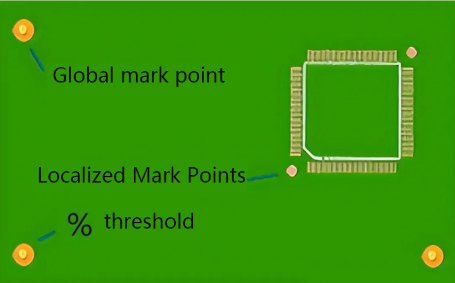
Problem: In complex board or mass production, this will seriously affect manufacturability:
The mounter can't align the circuit board accurately, which leads to the wrong placement of components.
Factories need to manually align (slow and error-prone) or modify files to add datum points.
Solution:Add at least two global reference points on the circuit board, preferably at opposite corners, to provide more reliable alignment.
For high-density packages such as QFN, BGA or fine-pitch connectors, consider adding local reference points near these components to improve placement accuracy.
Make sure that there is at least 1 mm gap around the reference point and do not cover it with solder mask.
There is no splicing or splitting strategy.Problem: mass production, especially small circuit boards, requires splicing:
If it is not planned in advance, the board factory may assemble the board by itself, which may interfere with the layout.
Improper board design may lead to circuit board rupture, connector damage or solder joint fracture.
Solution:Consider splicing from the beginning of design, especially when the circuit board size is small.
Add stamp holes or v-cuts, and ensure that important components are away from the edges.
Communicate with manufacturers about their preferences, learn about tool holes, panel size and spacing, and ask for panel templates.
Use parts that are difficult to purchase or have been discontinued.Problem: This is a big problem when the supply chain is unstable:
Shortage of parts will lead to suspension of production and delay of delivery.
The manufacturer may replace parts without telling you, which increases the product risk.
Solution:Before locking the BOM, use websites such as Octopart or Find Chips to check the availability of parts.
Ensure that each part can be obtained from multiple suppliers and is not close to EOL.
Choose parts that are easy to find and supported.
The distance between components is too tight, and there is no room for repair.Problem: In the prototype stage, components are tightly stacked to save space, but it will cause problems in production:
Difficult to repair, such as probing, re-welding or replacing components.
Too close distance between high and low components may produce shadows during inspection, and even affect reflow soldering.
Solution:Do not place components too tightly unless absolutely necessary.
Leave extra space around connectors, tall components and any components that may need debugging or repair.
Leave room for repair tools (hands, tweezers, soldering iron).
Summary and suggestionPreventive design: it is the key to avoid expensive rework and delay to consider the feasibility of production as soon as possible.
Manufacturer communication: actively communicate with contract manufacturers to understand their requirements and preferences.
Utilize tools: Use design checklists and online resources to identify and avoid common mistakes. The resources of "Design Error List Package" are provided in the video, and it is recommended to use these tools.
By following these best practices, designers can significantly improve the manufacturability of PCB and ensure the smooth transition from prototype stage to mass production.
About MaxipcbMaxipcb inspires and empowers innovators and helps them bring world-changing technologies to life. We provide advanced design, simulation and testing solutions to help engineers complete development and deployment faster in the whole product life cycle, while controlling risks. Our customers are all over the world, such as communication, industrial automation, aerospace and national defense, automobile, semiconductor and general electronics. We join hands with customers to accelerate innovation and create a safe and interconnected world. 
