The cavity problem in the process of solder paste printing and reflow is usually related to the bad phenomenon in the welding process. So what are the differences between solder paste printing and reflow soldering? This article is simply analyzed by Shenzhen Jiajinyuan solder paste manufacturer:
The cavity problem in the process of solder paste printing and reflow is usually related to the bad phenomenon in the welding process. So what are the differences between solder paste printing and reflow soldering? This article is simply analyzed by Shenzhen Jiajinyuan solder paste manufacturer:
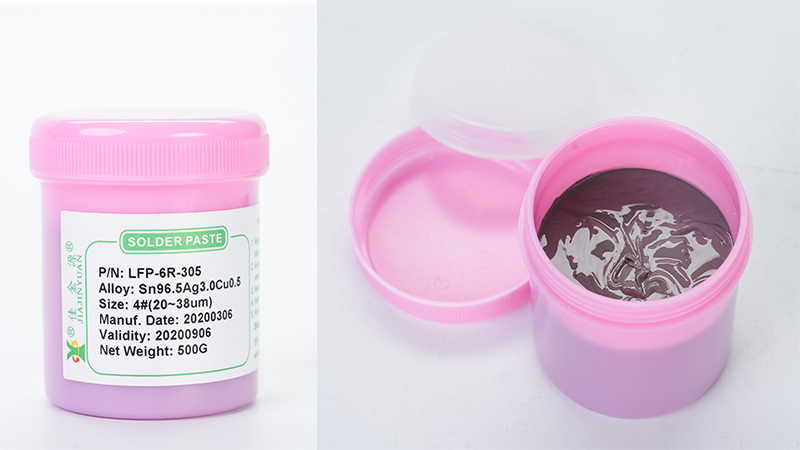 Solder paste printing stage:
1. In the process of solder paste printing, if the printing parameters are set improperly, such as scraper pressure, printing speed, scraping times of scraper, etc., it may lead to uneven distribution of solder paste on PCB pads, resulting in cavities.
2. Adhesion of solder paste is also an important factor. If the viscosity of solder paste is not appropriate, or other characteristics do not match the PCB surface, it may also lead to the uneven adhesion of solder paste and the formation of cavities.
Reflux stage:1. In the reflow stage, volatile components (usually rheological agents) in solder paste will be heated and evaporated to form bubbles. If bubbles can't escape effectively, it may also lead to void problem at solder joints.
2. Inappropriate reflow temperature may cause the residual gas on the bonding pad to be unable to be completely removed, thus forming a cavity.
Material quality:1. Low-quality solder paste may contain bad ingredients, or improper manufacturing process may lead to cavities during reflow soldering.
2. The surface coating and hygroscopicity of PCB and components may also affect the welding quality, including the formation of cavities.
About Maxipcb
Maxipcb empowers innovators to turn cutting-edge technologies into reality.
We offer one-stop solutions for design, simulation, testing, PCB manufacturing, component procurement and SMT assembly, enabling efficient development, rapid deployment and risk control across the full product lifecycle.
Serving the world in communications, industrial automation, aerospace, automotive, semiconductor and beyond, we build a safer, more connected future together.

