The quality of PCB layout directly affects product performance and stability. This article shares several practical tips for mixed PCB layout design.
The quality of PCB layout directly affects product performance and stability. This article shares several practical tips for mixed PCB layout design.
1. Component Placement
Component placement should follow the signal path in the schematic and leave sufficient space for routing. In addition, the following rules must be observed:
- Power supply components should be placed compactly with proper decoupling to ensure power integrity.
- Decoupling capacitors should be placed as close as possible to each device.
- Connectors should be positioned at the board edges.
- Follow the schematic flow for high-frequency components.
- Large storage devices and processors (e.g., clock generators and controllers) should be placed at the center of the circuit board.
2. Isolation of Analog and Digital Modules
To minimize the common return path of analog and digital signals, analog and digital modules must be separated to prevent signal mixing.
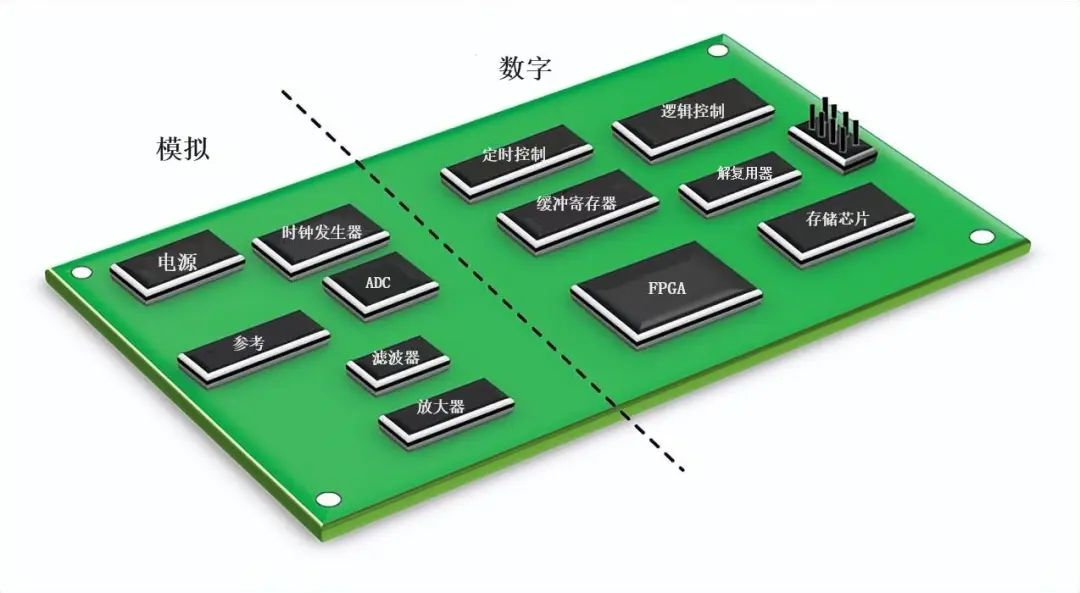 Digital: Logic Control, Timing Control, Demultiplexer, Clock Generator, Buffer Register, Memory Chip
Analog: Power Supply, ADC, FPGA, Reference, Filter, Amplifier
Analog and Digital Circuit Isolation
Digital: Logic Control, Timing Control, Demultiplexer, Clock Generator, Buffer Register, Memory Chip
Analog: Power Supply, ADC, FPGA, Reference, Filter, Amplifier
Analog and Digital Circuit IsolationThe above diagram shows an example of analog and digital circuit isolation. The following points should be kept in mind when dividing analog and digital sections:
- Precision analog components such as amplifiers and voltage references are recommended to be placed on the analog plane, while the other side/digital plane must be used for noisy digital components such as logic control and timing blocks.
- Analog-to-digital converters (ADCs) or digital-to-analog converters (DACs) in the system are mixed-signal devices with low digital current, and should be treated similarly to analog components in analog systems.
- For designs with a large number of high-current ADCs and DACs, it is recommended to separate the analog and digital power supplies. In other words, DVDD should be connected to the digital section, and AVCC must be connected to the analog section.
- Microprocessors and microcontrollers generate considerable space and heat. To improve heat dissipation, these components must be placed at the center of the board and close to the circuit blocks they connect to.
3. Trace Routing
After placing all components in optimal positions and establishing proper ground planes, most traces will naturally follow the correct path. However, the following guidelines should be observed for trace routing:
- Signal paths should be as direct and short as possible.
- Layers with high-speed signal paths should have an adjacent ground layer to ensure proper signal return.
- High-speed circuits are particularly sensitive and need to follow the signal paths laid out in the schematic.
- Reduce inductance in power routing by using short, direct and wide traces.
- Avoid creating antennas when routing traces and vias.
- Power routing should be short, compact and use wide traces.
- Routing must maintain isolation between digital and analog circuit components.
- Grounding is critical, especially for traces connecting digital and analog partitioned areas.
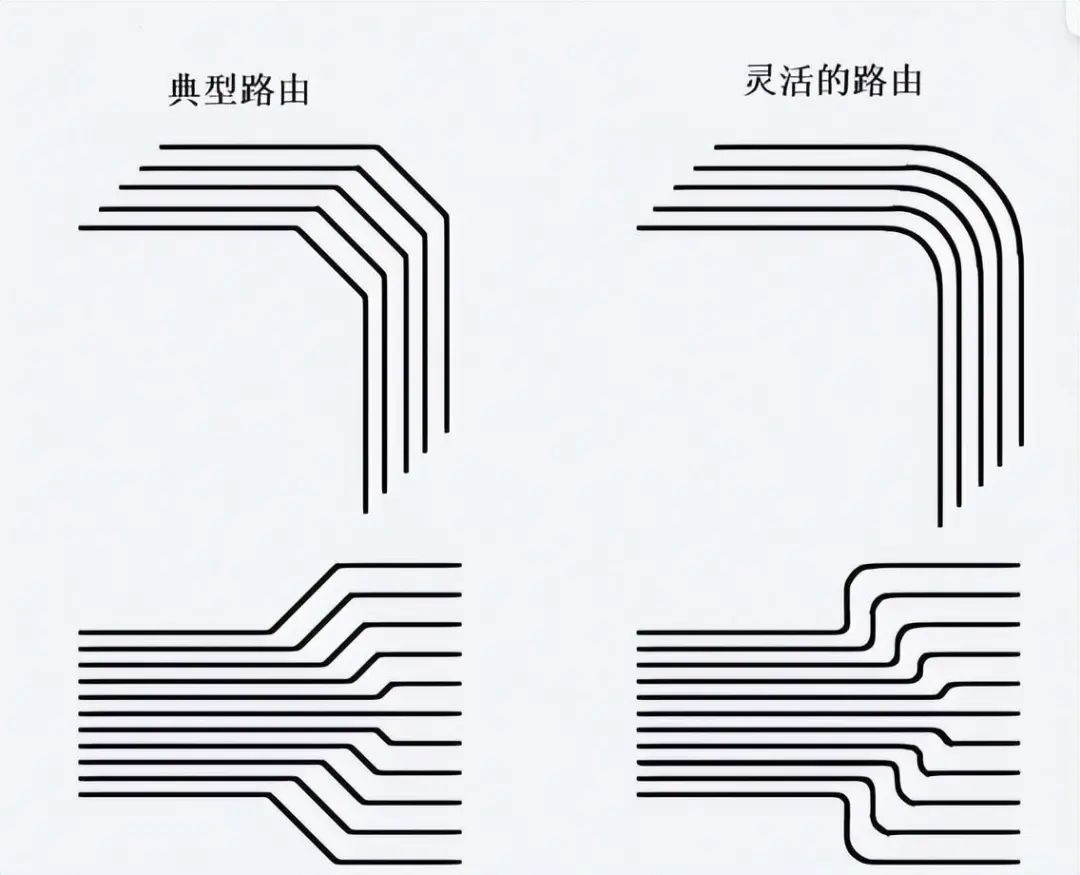 Typical Routing • Flexible Routing
4. Power Supply Modules
The power supply is a critical part of the circuit and requires careful handling. In general, power supply modules must be placed close to the components they power while being isolated from the rest of the circuit.
- For devices with many power pins in complex systems, dedicated power supply modules can be used for analog and digital sections to prevent noisy digital interference.
- To reduce inductance and prevent current limiting, power lines should be short, straight and use wide traces.
5. Decoupling
One of the key factors engineers must consider to meet the performance requirements of the system is the Power Supply Rejection Ratio (PSRR). The final performance of a device is determined by PSRR, which evaluates the device's sensitivity to power supply variations.
To maintain an ideal PSRR, high-frequency energy must be prevented from entering the device. For this purpose, a combination of electrolytic and ceramic capacitors can be used to effectively isolate the device power supply from the high-impedance ground plane.
Effective decoupling is to provide a low-noise environment for circuit operation. The basic rule is to provide the shortest possible path for current to return easily.
The following are general decoupling methods:
- Low-inductance ceramic capacitors are used to reduce high-frequency noise, while electrolytic capacitors reduce low-frequency noise on the power supply by acting as a charge bank for transient currents. In addition, ferrite beads are optional but can enhance the isolation and decoupling of high-frequency noise.
- Decoupling capacitors need to be placed as close as possible to the power pins of the device. To reduce additional series inductance, vias or short traces should be used to connect these capacitors to most of the low-impedance ground plane.
- The power pins of the device should be as close as possible to the device. Smaller capacitors (typically 0.01μF to 0.1μF) should be used; this configuration prevents the device from operating unstably when multiple outputs switch simultaneously. The distance between the electrolytic capacitor and the device power pin should not exceed one inch (average 10μF to 100μF).
- Decoupling capacitors can be T-connected to the ground plane using vias near the device's GND pins to simplify the structure instead of building traces.
For details, see the diagram below:
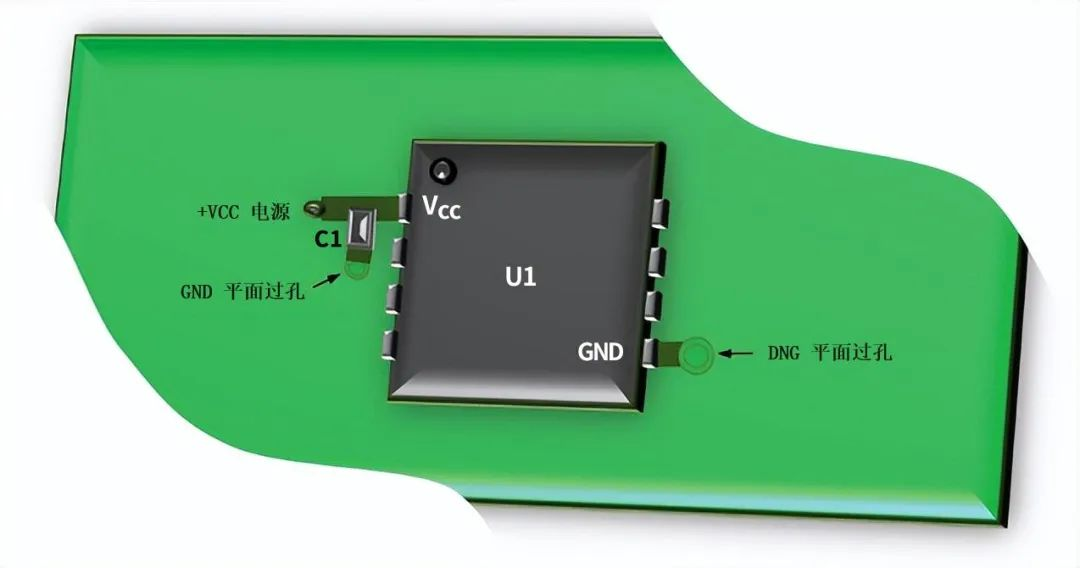 +VCC Power Supply | Vcc | U1 | GND Plane Via
GND | DNG Plane Via
Power Pin Decoupling Technology
+VCC Power Supply | Vcc | U1 | GND Plane Via
GND | DNG Plane Via
Power Pin Decoupling Technology6. PCB Stack-Up
PCB stack-up must be considered before PCB routing, otherwise it will affect the return paths allowed by the system design.
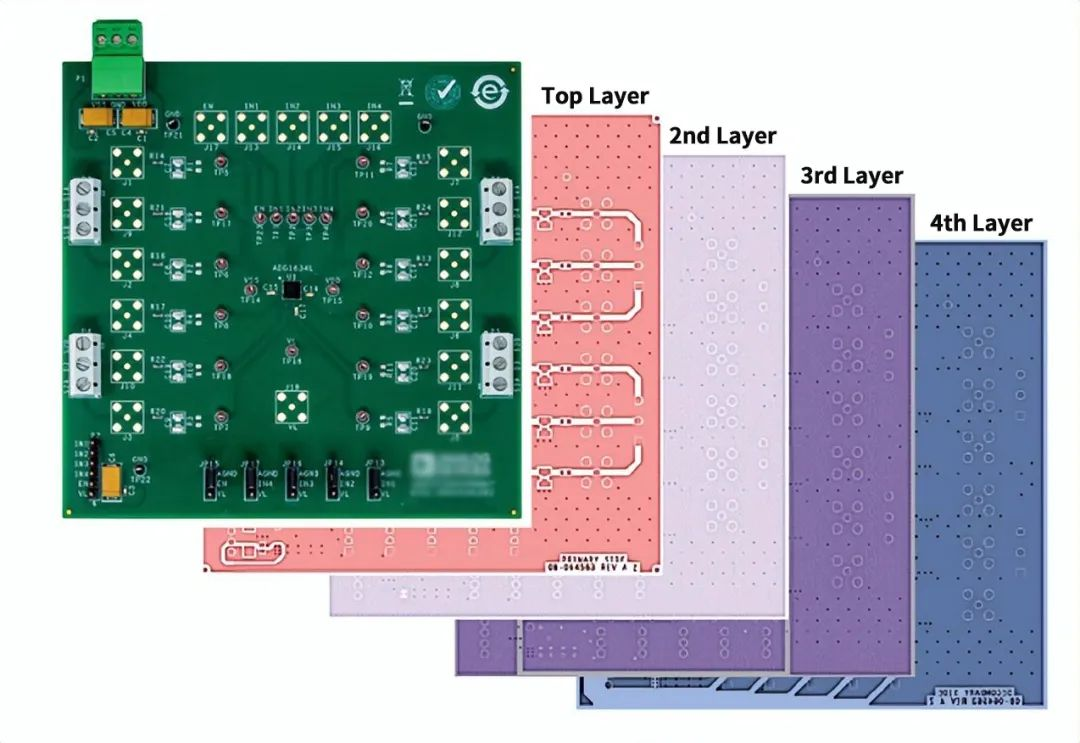 Top Layer | 2nd Layer | 3rd Layer | 4th Layer
4-Layer PCB Example
Top Layer | 2nd Layer | 3rd Layer | 4th Layer
4-Layer PCB ExampleThe above diagram shows a visual representation of the board layers. The following diagram details the setup of a typical PCB:
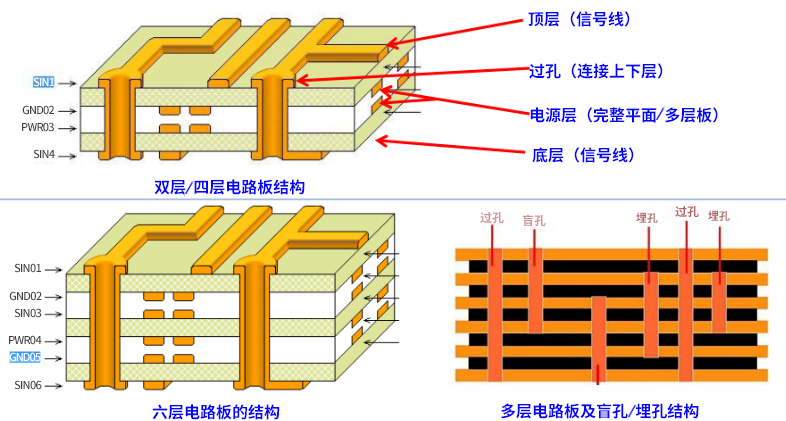 Top Layer (Signal Layer) | SIN1 | Vias (Connecting Upper and Lower Layers) | GND02 | Power Layer (Solid Plane/Multilayer Board) | PWR03 | SIN4→T | Bottom Layer (Signal Layer)
2-Layer/4-Layer Board Structure
Top Layer (Signal Layer) | SIN1 | Vias (Connecting Upper and Lower Layers) | GND02 | Power Layer (Solid Plane/Multilayer Board) | PWR03 | SIN4→T | Bottom Layer (Signal Layer)
2-Layer/4-Layer Board StructureSINO1 | SN3 | PWR04 | GNDO5 | SIN06
6-Layer Board Structure
Vias | Blind Vias | Buried Vias
Multilayer Board and Blind/Buried Via Structure
Typical PCB Layers
High-performance data acquisition systems should typically include four or more layers. Auxiliary signals are usually used on the bottom layer, while digital/analog signals are usually on the top layer. The second layer (also known as the ground layer) reduces IR drop and protects digital signals on the top layer by acting as a reference layer for impedance-controlled signals. The power layer is located on the third layer.
Power and ground layers must be placed close to each other because they provide additional interlayer capacitance for power supply decoupling at high frequencies.
7. PCB Copper Resistance
Copper resistance is also important in mixed-signal PCB layout, as copper traces can form good interconnections and ground planes.
Most PCBs use 1 oz copper, but high-power sections may use 2 or 3 oz copper. The resistivity of copper at 25°C is 1.724×10⁻⁶ Ω/cm.
The thickness of common 1 oz copper foil is 0.036 mm (0.0014 in) with a resistance of 0.48 mΩ/square. For example, the resistance per length of a commonly used 0.25 mm (10 mil) wide trace on a PCB is approximately 19 mΩ/cm (48 mΩ/in).
PCB trace resistance can be a source of error for mixed-signal ICs. For a 16-bit ADC with a 5 kΩ input resistance driven by a 5 cm 0.25 mm wide 1 oz copper trace, the trace resistance is 0.1 Ω, forming a voltage divider with the 5 kΩ load and producing an error of 0.1/5 k (approximately 0.0019%), which is higher than the 1 LSB (0.0015%) of a 16-bit ADC, as shown below:
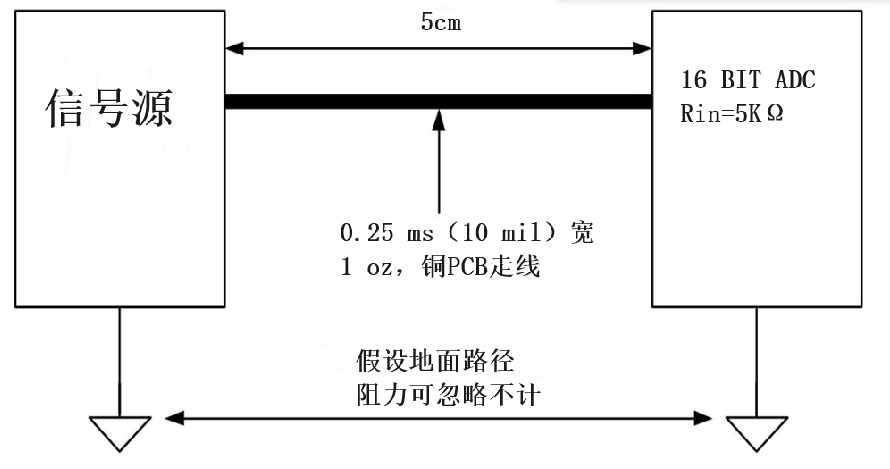 Signal Source | 5cm 0.25mm (10 mil) Wide 1 oz Copper PCB Trace | 16 BIT ADC Rin=5KΩ
Assuming Negligible Ground Path Resistance
PCB Trace Resistance is an Important Factor in Mixed-Signal PCBs
Signal Source | 5cm 0.25mm (10 mil) Wide 1 oz Copper PCB Trace | 16 BIT ADC Rin=5KΩ
Assuming Negligible Ground Path Resistance
PCB Trace Resistance is an Important Factor in Mixed-Signal PCBsThe situation may be more severe in practical applications because this ignores the return path and the 0.4%/°C temperature coefficient of copper at 25 °C. Copper resistance is critical for successful design when dealing with low-impedance precision circuits.
8. Grounding
8.1 Single Ground Plane
The best approach is to use a single solid ground plane for mixed-signal systems with a single ADC or DAC with low digital current.
To understand the importance of a single ground plane, it is necessary to analyze the return current. The term "return current" describes the current that completes the circuit loop and flows back to ground. Every return path must be followed throughout the PCB layout to avoid mixed-signal interference.
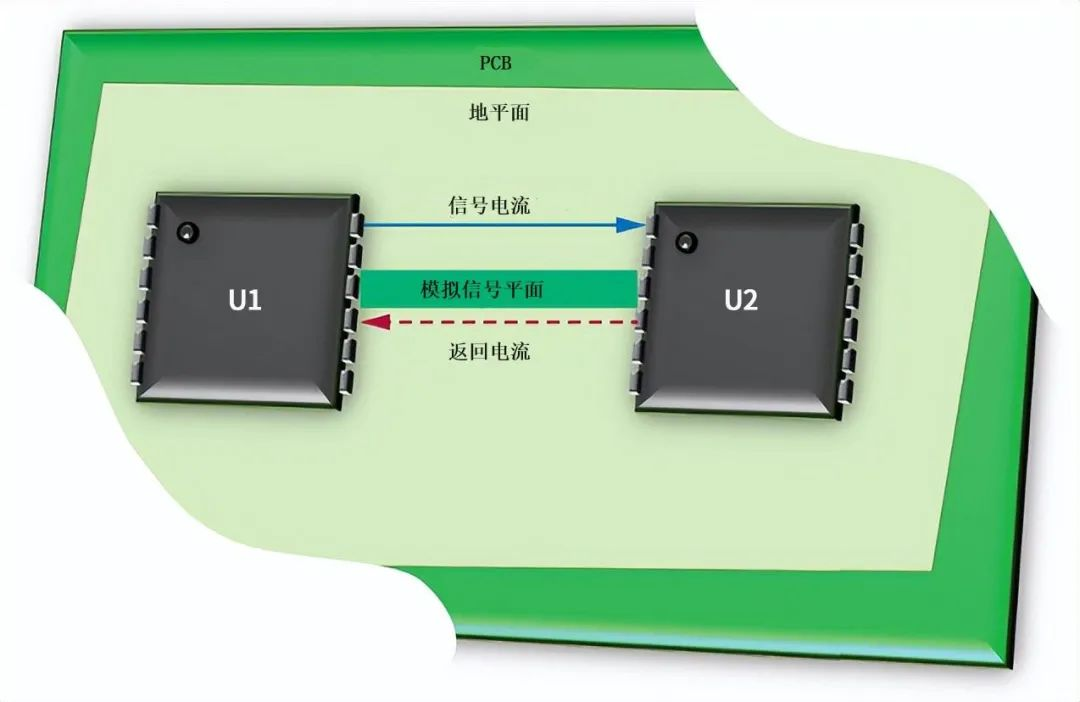 U1 | PCB | Ground Plane | Signal Current | Analog Signal Plane | U2 | Return Current
Return Current in a System Using a Solid Ground Plane
U1 | PCB | Ground Plane | Signal Current | Analog Signal Plane | U2 | Return Current
Return Current in a System Using a Solid Ground PlaneThe simple circuit in the above diagram illustrates the advantages of a single solid ground plane over multiple ground planes. There is a return current equal in magnitude but opposite in direction to the signal current. When the return current flows back to the source in the ground plane, it will take the path of least resistance.
The path of least resistance (usually a straight line between the device ground references) will be followed by the return current for low-frequency transmission. However, a portion of the return current will attempt to return along the signal path for higher-frequency transmission. This is because the impedance generated between the output and return currents along this path is lower and the loop is smaller.
8.2 Separate Analog and Digital Ground Planes
Another typical strategy is to divide the ground plane into two halves: an analog ground plane and a digital ground plane. This is suitable for more complex systems with a large number of mixed-signal components and high digital current requirements. The following diagram shows an illustration of a system with divided ground planes.
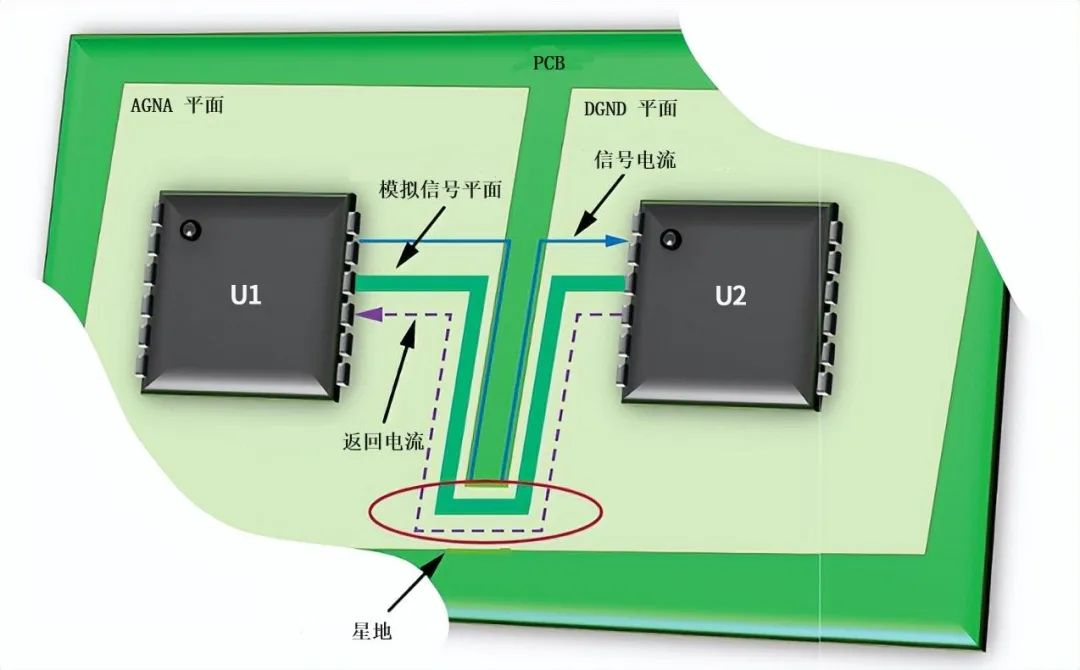 PCB | AGND Plane | DGND Plane | Signal Current | Analog Signal Plane | U1 | U2 | Star Ground
Return Current in a System Using Divided Ground Planes
PCB | AGND Plane | DGND Plane | Signal Current | Analog Signal Plane | U1 | U2 | Star Ground
Return Current in a System Using Divided Ground PlanesEliminating ground plane breaks and allowing return current to take a more direct path back through a star ground junction is the simplest way to achieve overall grounding for systems with separate ground planes. In mixed-signal layouts, the intersection of analog and digital ground planes is called a star ground.
Star grounding can be achieved with a typical thin continuous connection between analog and digital ground planes in common systems. For more complex systems, star grounding is usually performed by shunting jumpers to the ground connection.
Since there is no current in the star ground, high-current-carrying junctions and jumper shunts are not required. The main function of the star ground is to ensure that the reference levels of the two grounds are the same.
On the other hand, because the star ground also connects the two grounds at a single location, mixed-signal devices with AGND and DGND pins can be connected to their respective ground planes. This separates the precision analog circuitry from the high-noise digital currents that pass through the digital power supply to the digital ground plane and back to the digital power supply.
Multilayer PCBs must achieve complete isolation of AGND and DGND planes.
9. Electromagnetic Interference (EMI) Shielding
After addressing ground bounce, crosstalk, power supply noise and other interferences, the circuit may still suffer from electromagnetic interference (EMI). This can cause various problems such as:
- Interference with wireless communications
- Communication interruptions
- Corrupted sensor data
- Component failure
- Software errors and malfunctions
One effective method to handle EMI is to use a sufficient amount of metal shielding. Preferably, the shield should form a Faraday cage, covering the circuit from all six sides and the ground plane.
Although the use of shielding can block most incoming EMI, thermal cooling issues must also be addressed, and signal input and output must be allowed.
About Maxipcb
Maxipcb empowers innovators to turn cutting-edge technologies into reality.
We offer one-stop solutions for design, simulation, testing, PCB manufacturing, component procurement and SMT assembly, enabling efficient development, rapid deployment and risk control across the full product lifecycle.Serving the world in communications, industrial automation, aerospace, automotive, semiconductor and beyond, we build a safer, more connected future together.

 Digital: Logic Control, Timing Control, Demultiplexer, Clock Generator, Buffer Register, Memory Chip
Analog: Power Supply, ADC, FPGA, Reference, Filter, Amplifier
Analog and Digital Circuit Isolation
Digital: Logic Control, Timing Control, Demultiplexer, Clock Generator, Buffer Register, Memory Chip
Analog: Power Supply, ADC, FPGA, Reference, Filter, Amplifier
Analog and Digital Circuit Isolation Typical Routing • Flexible Routing
 +VCC Power Supply | Vcc | U1 | GND Plane Via
GND | DNG Plane Via
Power Pin Decoupling Technology
+VCC Power Supply | Vcc | U1 | GND Plane Via
GND | DNG Plane Via
Power Pin Decoupling Technology Top Layer | 2nd Layer | 3rd Layer | 4th Layer
4-Layer PCB Example
Top Layer | 2nd Layer | 3rd Layer | 4th Layer
4-Layer PCB Example Top Layer (Signal Layer) | SIN1 | Vias (Connecting Upper and Lower Layers) | GND02 | Power Layer (Solid Plane/Multilayer Board) | PWR03 | SIN4→T | Bottom Layer (Signal Layer)
2-Layer/4-Layer Board Structure
Top Layer (Signal Layer) | SIN1 | Vias (Connecting Upper and Lower Layers) | GND02 | Power Layer (Solid Plane/Multilayer Board) | PWR03 | SIN4→T | Bottom Layer (Signal Layer)
2-Layer/4-Layer Board Structure Signal Source | 5cm 0.25mm (10 mil) Wide 1 oz Copper PCB Trace | 16 BIT ADC Rin=5KΩ
Assuming Negligible Ground Path Resistance
PCB Trace Resistance is an Important Factor in Mixed-Signal PCBs
Signal Source | 5cm 0.25mm (10 mil) Wide 1 oz Copper PCB Trace | 16 BIT ADC Rin=5KΩ
Assuming Negligible Ground Path Resistance
PCB Trace Resistance is an Important Factor in Mixed-Signal PCBs U1 | PCB | Ground Plane | Signal Current | Analog Signal Plane | U2 | Return Current
Return Current in a System Using a Solid Ground Plane
U1 | PCB | Ground Plane | Signal Current | Analog Signal Plane | U2 | Return Current
Return Current in a System Using a Solid Ground Plane PCB | AGND Plane | DGND Plane | Signal Current | Analog Signal Plane | U1 | U2 | Star Ground
Return Current in a System Using Divided Ground Planes
PCB | AGND Plane | DGND Plane | Signal Current | Analog Signal Plane | U1 | U2 | Star Ground
Return Current in a System Using Divided Ground Planes