PCB testing has become an indispensable part of the circuit board manufacturing process, which can find problems in time, help staff to deal with them quickly and ensure the high quality of PCB. Let's learn about various testing methods commonly used in PCB.
Printed circuit board (PCB) is widely used in all kinds of electronic equipment, whether it is a mobile phone, a computer or a complex machine, you can find PCB. If the PCB has defects or manufacturing problems, it may lead to the failure of the final product and cause inconvenience. In these cases, manufacturers will have to recall these devices and spend more time and resources to repair the faults. Therefore, PCB testing has become an indispensable part of the circuit board manufacturing process, which can find problems in time, help staff to deal with them quickly and ensure the high quality of PCB. Let's learn about various testing methods commonly used in PCB.
1. On-line test (ICT) ICT, that is, automatic on-line test, is a necessary test equipment for modern PCB manufacturers and is very powerful. It mainly detects the open circuit, short circuit and faults of all parts of PCBA by contacting the test points from PCB layout with the test probe, and clearly informs the staff. ICT has a wide range of applications, high measurement accuracy, and clear instructions for detected problems, so it is very easy for workers with average electronic technology level to deal with problematic PCBA. Using ICT can greatly improve production efficiency and reduce production costs.
2. Flying needle testing, flying needle testing and on-line testing (ICT) are all recognized effective testing forms, both of which can effectively find production quality problems, but flying needle testing has been proved to be a particularly cost-effective method to improve circuit board standards. Contrary to the traditional test method of fixing the test probe in position, the flying probe test uses two or more independent probes and runs without a fixed test point. These probes are electromechanical controlled and move according to specific software instructions. Therefore, the initial cost of flying needle test is low, and it can be completed by modifying the software without changing the fixed structure. In contrast, the initial fixture cost of ICT is higher, so flying needle test is cheaper for small batch orders, but ICT is faster and less prone to errors than flying needle test, so ICT is more cost-effective for large batch orders.
3. Functional testing, functional system testing: The functional modules of the circuit board are comprehensively tested with special testing equipment at the middle and end of the production line to confirm the quality of the circuit board. Functional testing mainly includes Final Product Test and Hot Mock-up. Functional testing usually does not provide in-depth data (such as pin position and component-level diagnosis) to improve the process, but requires special equipment and specially designed test procedures. Writing functional test program is very complicated, so it is not suitable for most circuit board production lines.
4. Automatic Optical Inspection (AOI), which uses a single 2D camera or two 3D cameras to take photos of PCB, and then compares the photos of PCB with detailed schematic diagrams. If the circuit board does not match the schematic diagram to a certain extent, the mismatched parts of the circuit board will be marked for inspection by technicians, and AOI can detect the fault in time. However, AOI testing will not supply power to the circuit board, and it is impossible to detect the problems of all components 100%. Therefore, AOI is generally used in combination with other testing methods. The commonly used test combinations are:
AOI and flying needle
AOI and online testing (ICT)
AOI and functional testing
5.X-ray test, X-ray test, that is, X-ray inspection, which uses low-energy X-rays to quickly detect problems such as circuit board open circuit, short circuit, empty welding and missing welding. X-ray is mainly used to detect defective circuit boards with ultra-fine pitch and ultra-high density, as well as defects such as bridging, chip missing and dislocation during assembly. It can also use tomography to detect internal defects in IC chips. This is the only way to test the bonding quality of ball grid array and solder balls. The main advantage is that the quality of BGA solder and embedded components can be checked without spending fixing devices.
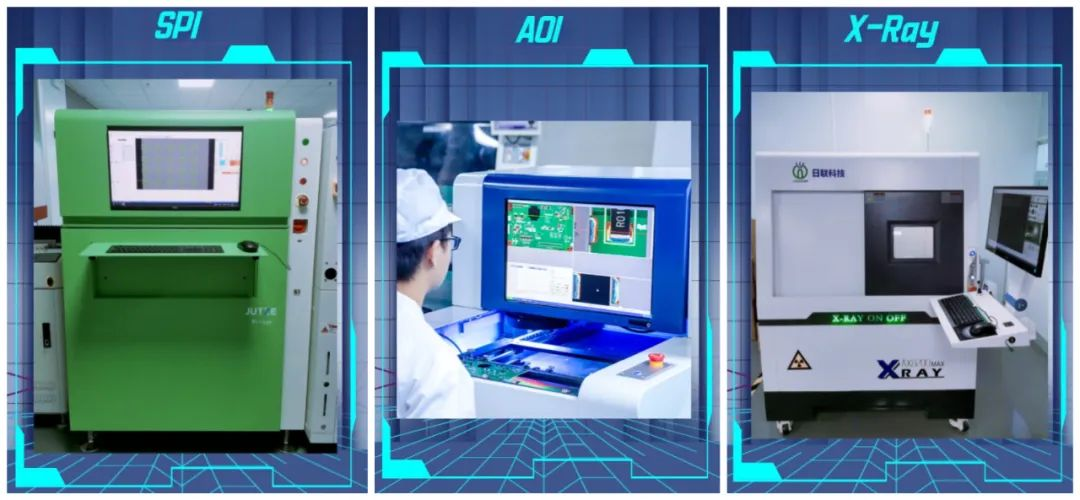 MaxiPCB's first-class testing equipment6. Laser inspection
, which is the latest development of pcb testing technology. It scans the printed board with a laser beam, collects all the measured data, and compares the actual measured value with the preset acceptance limit. This technology has been verified on bare board and is being considered for assembly board testing. This speed is enough for the production line. Its main advantages are fast output, no fixture and smooth vision. High initial cost, maintenance and use problems are its main shortcomings.
7. Aging test, aging test refers to the process of simulating various factors involved in the actual use conditions of products and carrying out corresponding condition-strengthening experiments on the aging of products. The purpose is to test the stability and reliability of the product in a specific environment. According to the design requirements, the product is placed under specific temperature and humidity conditions, and the simulation work is continued for 72 hours to 7 days, and the performance data is recorded, and the production process is improved in order to ensure that its performance meets the market demand. . Aging test usually refers to electrical performance test, and similar tests include drop test, vibration test and salt spray test.
In addition to the above seven tests, based on product requirements, other test methods will be used to further ensure PCB quality. For example:
Solderability test: Ensure the surface is firm and increase the chances of forming reliable solder joints.
PCB contamination test: detect a large number of ions that may contaminate the circuit board and cause corrosion and other problems.
Microsection analysis: Investigate defects, open circuits, short circuits and other faults.
Time domain reflectometer (TDR): Fault of high frequency board was found.
Peeling test: Find out the strength measurement required to peel the laminate from the board.
Float soldering test: Determine the thermal stress level that PCB holes can resist.
PCBA testing is a necessary process. If it is completed correctly, it can prevent the product from appearing quality problems and damaging the brand reputation.
MaxiPCB adopts first-class testing equipment, abides by strict testing procedures, and is committed to providing our customers with high reliability and high quality circuit boards.

