When we start a new design, because we spend most of our time on circuit design and component selection, we are often inexperienced and thoughtless in PCB layout and wiring stage.
When we start a new design, because we spend most of our time on circuit design and component selection, we are often inexperienced and thoughtless in PCB layout and wiring stage.
If enough time and energy are not provided for the design of PCB layout and wiring stage, it may lead to problems in manufacturing stage or defects in function when the design is transformed from digital field to physical reality.
So what is the key to design a circuit board that is real and reliable in paper and physical form?
Let's discuss the following six PCB design guidelines when designing a manufacturable and reliable PCB.
1. Fine-tune your component layout.The component placement stage of PCB layout process is both scientific and artistic, which requires strategic consideration of the main components available on the circuit board. Although this process may be challenging, the way you place electronic components will determine the difficulty of manufacturing your circuit board and how it meets your original design requirements.
Although there is a general order for placing components, such as sequentially placing connectors, mounting devices of printed circuit boards, power supply circuits, precision circuits, key circuits, etc., there are also some specific guidelines to keep in mind, including:
Orientation-Ensure that similar components are positioned in the same direction, which will help to achieve an efficient and error-free welding process.
Layout-Avoid placing smaller components behind larger components, which may lead to mounting problems due to the welding of larger components.
Organization-It is recommended to place all surface mount (SMT) components on the same side of the circuit board and all through hole (TH) components on the top of the circuit board to minimize assembly steps.
Last but not least, a PCB design guide-that is, when using mixed technology components (through holes and surface mount components), the manufacturer may need extra processes to assemble the circuit board, which will increase your overall cost.
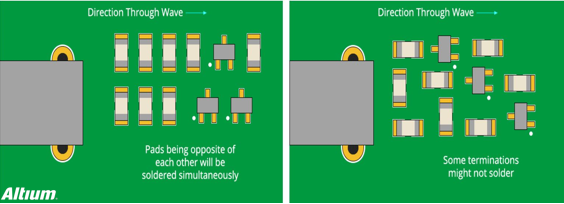
Good chip component direction (left) and bad chip component direction (right)
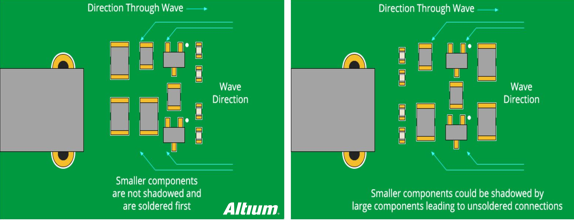
Good component layout (left) and bad component layout (right)
2. Properly place power supply, grounding and signal wiring.After placing the components, you can then place the power supply, grounding and signal traces to ensure that your signal has a clean and trouble-free path. At this stage of the layout process, keep in mind the following guidelines:
1) locate the power supply and ground plane layer.
It is always recommended to place the power and ground plane layers inside the circuit board while maintaining symmetry and center. This helps to prevent your circuit board from bending, which is also related to whether your components are positioned correctly.
For IC power supply, it is recommended to use a common channel for each power supply to ensure a firm and stable wiring width and avoid daisy-chain power supply connection from component to component.
2) Signal line routing connection
Next, connect the signal lines according to the design in the schematic diagram. It is recommended to always take the shortest possible path and direct path routing between components.
If your components need to be fixed in the horizontal direction without deviation, it is suggested that the components of the circuit board should be routed basically horizontally where they go out, and then vertically after they go out.
In this way, the component will be fixed in the horizontal direction with the migration of solder during welding. As shown in the upper part of the figure below. However, the signal routing mode in the lower part of the figure below may lead to the deflection of components with the flow of solder during welding.
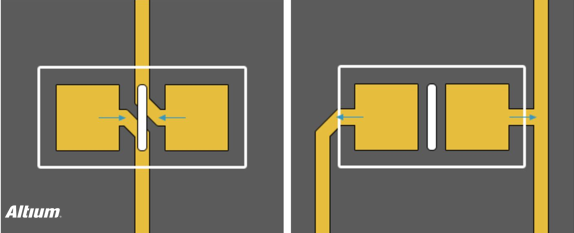
Suggested wiring method (arrow indicates solder flow direction)
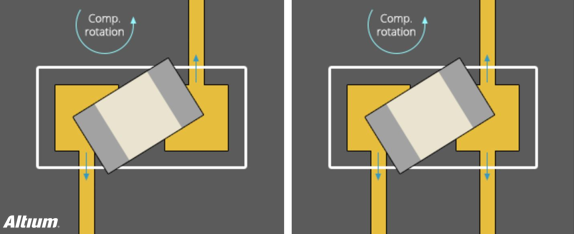
Not recommended wiring method (arrow indicates solder flow direction)
3) define the network width
Your design may require different networks, which will carry various currents, which will determine the required network width. Considering this basic requirement, it is recommended to provide 0.010''(10mil) width for low current analog and digital signals. When your line current exceeds 0.3 ampere, it should be widened. Here is a free line width calculator, which makes this conversion process simple.
3. Effective isolationYou may have experienced how large voltage and current spikes in the power supply circuit interfere with your low-voltage current control circuit. To minimize such interference problems, please follow the following guidelines: isolation-ensure that each power supply is separated from the control ground. If you have to connect them together in a PCB, make sure it is as close as possible to the end of the power path.
Layout-If you have placed a ground plane in the middle layer, make sure to place a small impedance path to reduce the risk of any power circuit interference and help protect your control signal. You can follow the same guidelines to keep your digital and analog separate.
Coupling-In order to reduce capacitive coupling due to placing a large ground plane and routing above and below it, try crossing the analog ground only through analog signal lines.
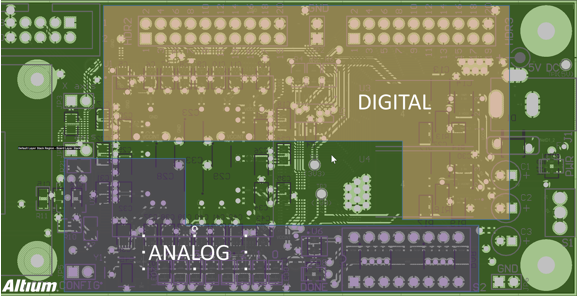
Component isolation examples (digital and analog)
4. solve the heat problemHave you ever caused circuit performance degradation or even circuit board damage due to thermal problems? Because of not considering heat dissipation, there have been many problems that have troubled many designers. Here are some guidelines to remember to help solve the heat dissipation problem:
1) Identify troublesome components
The first step is to start thinking about which components will dissipate the most heat on the circuit board. This can be achieved by first finding the "thermal resistance" rating in the data sheet of the component, and then transferring the generated heat according to the recommended guidelines. Of course, radiators and cooling fans can be added to keep the component temperature down, and remember to keep key components away from any high heat source.
2) Add hot air pads
Adding hot air pads is very useful for producing manufacturable circuit boards, and they are very important for high copper content components and wave soldering applications on multilayer circuit boards. Because it is difficult to maintain the process temperature, it is always recommended to use hot air pads on through-hole components in order to make the welding process as simple as possible by slowing down the heat dissipation rate at the pins of the components.
As a general rule, always connect any through hole or via hole connected to ground plane or power plane by hot air pad. In addition to the hot air pad, you can also add tears to the pad connection line to provide additional copper foil/metal support. This will help to reduce mechanical stress and thermal stress.
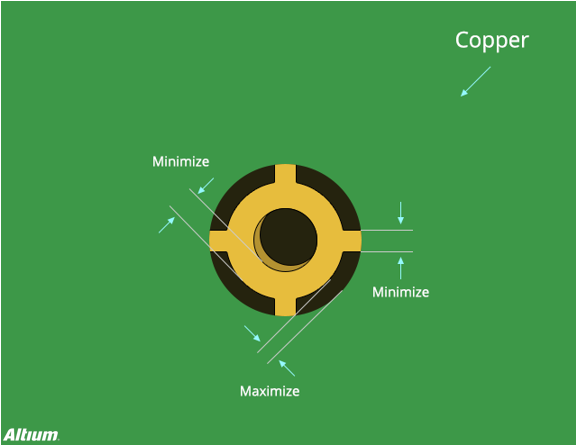
Typical hot air pad connection mode
5. Popular science of hot air padEngineers in charge of Process or SMT technology in many factories often encounter such bad problems as soldering empty, de-soldering or cold soldering of circuit board components. No matter how the process conditions are changed or the temperature of reflow soldering is adjusted, there is a certain ratio of non-soldering. What the hell is going on here?
Aside from the problem of oxidation of components and circuit boards, it is found that most of these welding defects actually come from the lack of layout design of circuit boards, and the most common one is that a few solder feet of components are connected to a large area of copper skin, resulting in poor welding of these components after reflow soldering. Some hand-welded components may also cause false welding or package welding problems due to similar situations, and some even weld the components because of excessive heating.
Generally, PCB often needs to lay a large area of copper foil for power supply (Vcc, Vdd or Vss) and Grounding (GND, ground) in circuit design. These large-area copper foils are generally directly connected to some control circuits (IC) and pins of electronic components.
Unfortunately, if we want to heat these large-area copper foils to the temperature of melting tin, it usually takes more time (that is, heating will be slower) than independent pads, and the heat dissipation will be faster. When one end of such large-area copper foil wiring is connected to small components such as small resistance and small capacitance, but the other end is not, it is easy to cause welding problems because of the inconsistent time of tin melting and solidification;
If the temperature curve of reflow soldering is not well adjusted and the preheating time is insufficient, the solder feet of these components connected to a large copper foil will easily cause the problem of virtual soldering because they cannot reach the melting temperature of tin.
In Hand Soldering, the welding feet of these components connected to a large piece of copper foil will not be able to complete the welding within the specified time because of the rapid heat dissipation.
The most common bad phenomena are package welding and virtual welding. The solder is only welded on the solder feet of the components and not connected to the pads of the circuit board. From the outside, the whole solder joint will form a ball; What's more, the operator keeps raising the temperature of the soldering iron in order to solder the solder feet to the circuit board, or heating it for too long, so that the components are damaged beyond the heat-resistant temperature without knowing it. As shown in the figure below.
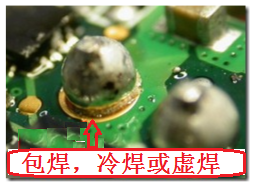
Covered welding, cold welding or virtual welding
Now that we know the problem, we can have a solution. Generally, we will ask for the so-called Thermal Relief pad design to solve this kind of welding problem caused by the welding feet of large copper foil connecting components.
As shown in the following figure, the wiring on the left does not use hot air pad, while the wiring on the right has adopted the connection mode of hot air pad. It can be seen that the contact area between the pad and the large copper foil is only a few small lines, which can greatly limit the loss of temperature on the pad and achieve better welding effect.
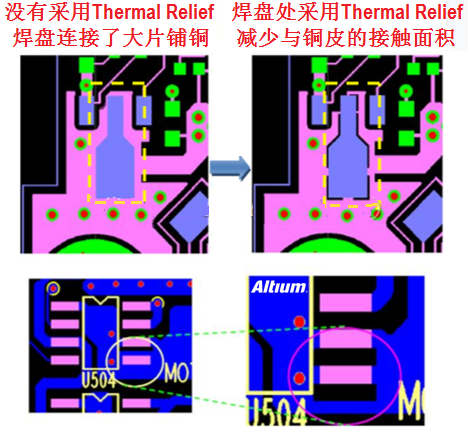
Thermal Relief pad was used for comparison.
6. check your workWhen you hum and hum all the parts together for manufacturing, it is easy to find the problem at the end of the design project and be overwhelmed. Therefore, double and triple inspection of your design work at this stage may mean success or failure of manufacturing.
In order to help complete the quality control process, we always recommend that you start with the Electrical Rule Inspection (ERC) and the Design Rule Inspection (DRC) to verify whether your design fully meets all the rules and constraints. Using these two systems, you can easily check the gap width, line width, common manufacturing settings, high-speed requirements and short circuits.
When your ERC and DRC produce error-free results, it is recommended that you check the wiring of each signal, from schematic diagram to PCB, and carefully check one signal line at a time to make sure that you have not missed any information. In addition, use the detection and shielding functions of your design tools to ensure that your PCB layout materials match your schematic diagram.
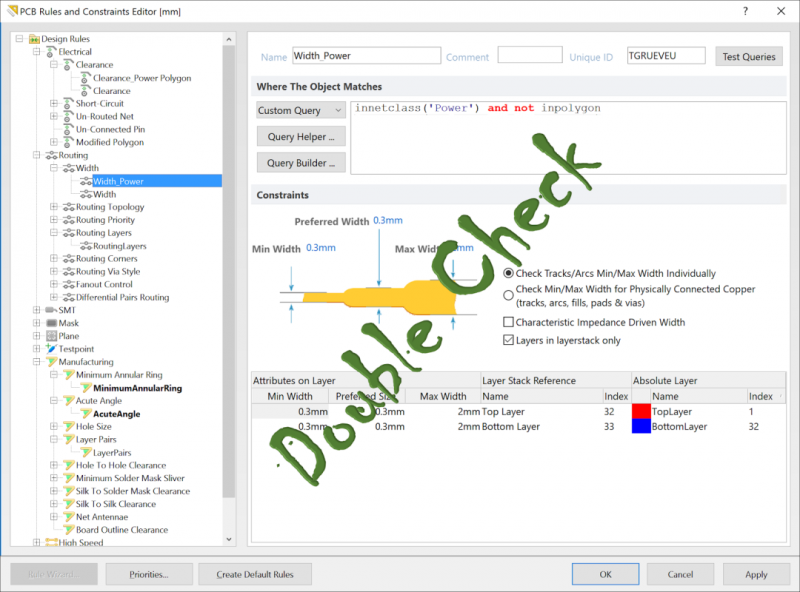
Check your design, PCB and constraint rules carefully
7. ConclusionWhen you master these design guidelines that PCB designers need to know, by following these suggestions, you will soon be able to design powerful and manufacturable circuit boards with real high-quality printed circuit boards.
Good PCB design practice is very important for success, and these design rules lay the foundation for building and consolidating the practical experience of continuous improvement in all design practices.
About Maxipcb
Maxipcb empowers innovators to turn cutting-edge technologies into reality.
We offer one-stop solutions for design, simulation, testing, PCB manufacturing, component procurement and SMT assembly, enabling efficient development, rapid deployment and risk control across the full product lifecycle.
Serving the world in communications, industrial automation, aerospace, automotive, semiconductor and beyond, we build a safer, more connected future together.

