The related parameters to evaluate the quality of PCB substrate mainly include glass transition temperature Tg, thermal expansion coefficient CTE, PCB decomposition temperature Td, heat resistance, electrical properties and PCB water absorption.
The related parameters to evaluate the quality of PCB substrate mainly include glass transition temperature Tg, thermal expansion coefficient CTE, PCB decomposition temperature Td, heat resistance, electrical properties and PCB water absorption.
Glass transition temperature (Tg)When the polymer is at a certain temperature, the substrate is hard and brittle, which is called glassy state: above this temperature, the substrate becomes soft and the mechanical strength obviously decreases. This critical temperature that determines the properties of materials is called glass transition temperature Tg. If Tg temperature is too low, PCB will be deformed and components will be damaged at high temperature. General requirements for selecting substrate materials:
1.Tg should be higher than the working temperature of the circuit;
2. Lead-free process requires high Tg(Tg ≥ 170℃). Jinjian Laboratory is equipped with professional thermal analysis equipment (such as DSC and TMA), which can accurately determine the Tg value of materials according to IPC-TM-650 and other standard methods, and provide customers with technical suggestions on material selection and process adaptation. For professional testing services, please contact Jinjian Testing Consultant at 189-2421-3655.
Coefficient of thermal expansion (CTE)CTE quantitatively describes the degree of expansion of materials after heating. CTE definition: the length of material per unit length is extended for every 1℃ increase in ambient temperature, and the unit is 10-6/℃.
Calculation formula:
α1 = Δl/(l0ΔT)
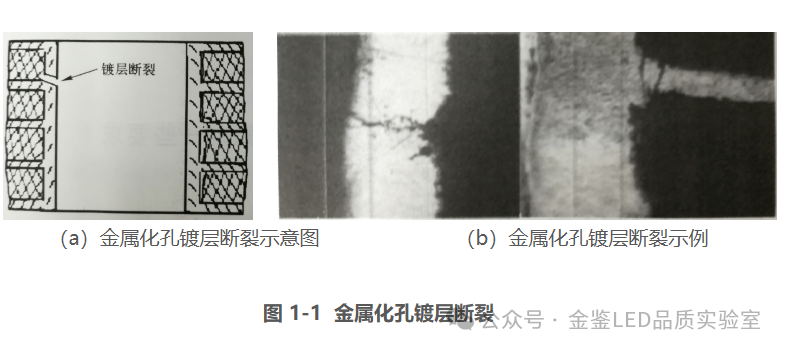
Where α1 is the coefficient of thermal expansion; L0 is the original length before heating; δ l is the length of elongation after heating; ΔT is the temperature difference before heating. SMT requires low CTE. Lead-free soldering requires PCB materials to have lower thermal expansion coefficient due to high welding temperature. Especially for multi-layer PCB, the Z-direction CTE has a great influence on the solderability of the plated layer with metallized holes. Especially when welding or repairing for many times, after many times of expansion and contraction, the metallized hole coating will break, as shown in Figure 1-1. Jinjian Laboratory adopts professional equipment, which can accurately measure the CTE of materials in different directions and provide data support for customers to evaluate the reliability of laminated plates and plated holes.
 PCB decomposition temperature (Td)
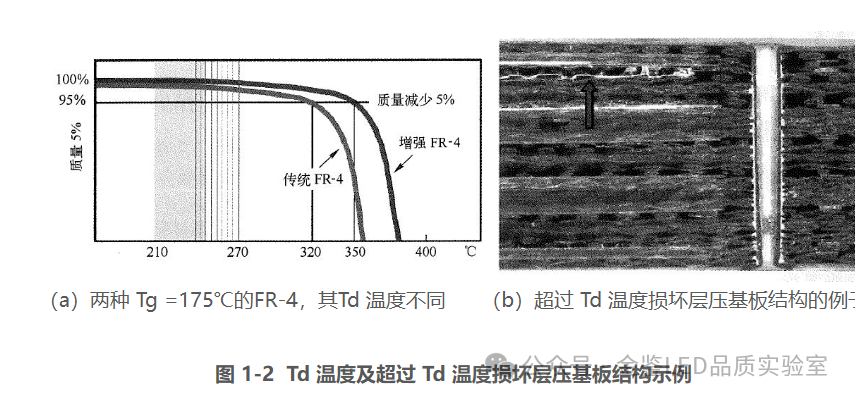
Td is the physical and chemical decomposition temperature of the resin. Td refers to the temperature when the PCB is heated to the point where its mass decreases by 5%. Figure 1-2(a) shows two kinds of FR-4 whose Tg temperature is 175℃, but their Td temperature is different. Traditional PCB decomposition temperature Td is 300℃, while lead-free PCB requires higher Td(340℃). Therefore, it is suggested that the Td of lead-free PCB should refer to the temperature at which the mass decreases by 2%. When the welding temperature exceeds Td, the PCB substrate will be damaged due to the fracture of chemical links, resulting in irreversible degradation. Fig. 1-2(b) is an example of damage to the laminated substrate structure when the temperature exceeds Td. Jinjian Laboratory has professional equipment and a team of related experts, which can provide Td testing and thermal stability evaluation, and help to screen high-performance substrates suitable for lead-free and high-temperature applications.
 Heat resistance
The heat resistance of PCB is usually evaluated by its holding time under specific high temperature conditions, such as t260, t288, t300, etc., which indicate the time from delamination or foaming of materials at 260℃, 288℃ and 300℃ respectively. This performance is directly related to the structural integrity of the board under SMT secondary reflow, repair and long-term high temperature working environment. SMT requires that the secondary reflow PCB is not deformed. 1. The traditional lead-containing process requires: t260℃≥50s2. Lead-free requires higher heat resistance: T260℃ > 30min; t288℃>15min; t300℃>2min.
MaxiPCB's professional services are not limited to testing and certification, but also include failure analysis, technical consultation and personnel training, providing customers with one-stop solutions. MaxiPCB will continue to uphold its professional service attitude, constantly improve its technical level and service quality, and contribute our strength to the PCB industry.

